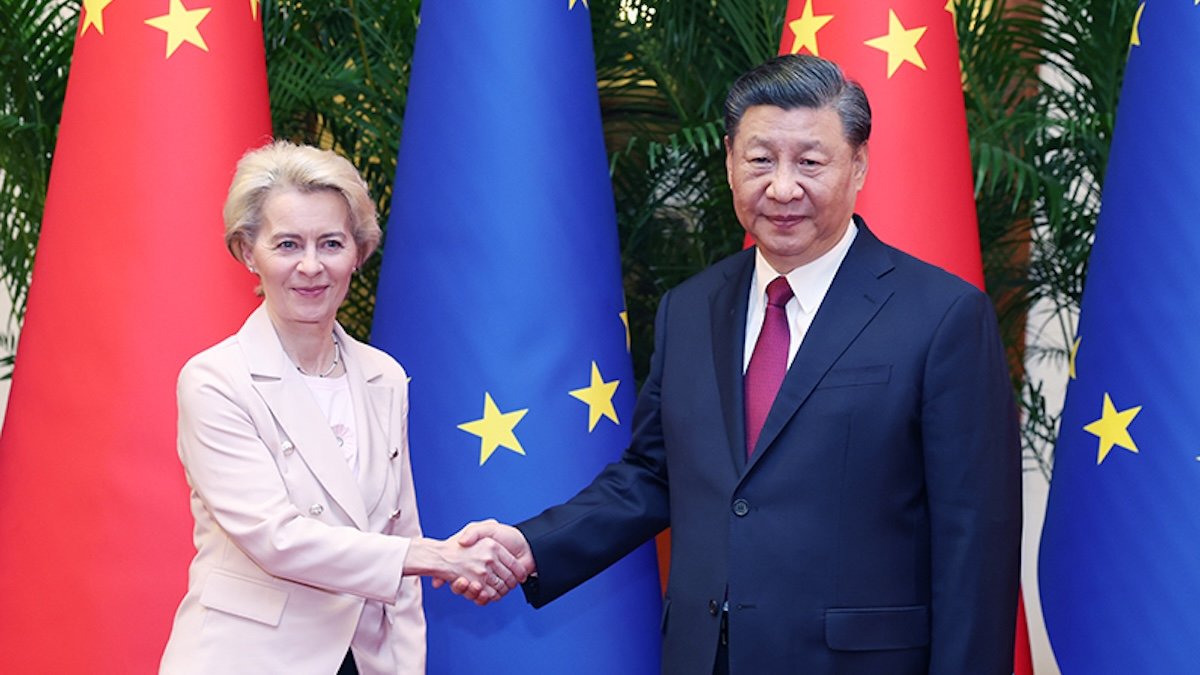
Beijing has urged dialogue and pragmatism after European Commission President Ursula von der Leyen warned that a second “China Shock” is already damaging key manufacturing sectors in the European Union. The term originally described the flood of cheap toys, textiles, and basic electronics that entered European markets after China joined the World Trade Organization in 2001, hollowing out low-end manufacturing. European industry then escaped by moving up the value chain into higher-end goods.
Now, “China Shock 2.0” refers to a new wave of exports—electric vehicles, chemicals, machinery, and power-generation equipment. Unlike two decades ago, Chinese manufacturing has followed European industry up the value chain, leaving little higher ground for European companies to retreat to. Moreover, tariffs imposed by the Trump administration have narrowed Beijing’s access to the US market, making Europe the largest remaining open destination for Chinese surplus goods.
“Our trade deficit with China is now 1 billion euros [US$1.15 billion] a day. It has reached a tipping point,” von der Leyen said in her annual State of the Union address before the European Parliament on Wednesday. “Some say the second China shock is looming, but it’s already here. It shows in our communities and in factories across our Union. It leads to deindustrialization in the industrial heartlands of Europe. This is unsustainable.”
She added: “We will use all the tools at our disposal to rebalance our relationship. Words are good. But deeds are better.” Von der Leyen also highlighted that the EU remains more than 80% dependent on China for many critical raw materials—90% for some rare earths. She announced a new European Corporation on Critical Raw Materials to help the bloc stockpile materials needed for EVs, semiconductors, batteries, and defense technology.
New procurement rules and industry concerns
On September 9, the European Commission proposed a Public Procurement Act that would allow public authorities to reject bids outright for major contracts when less than 50% of the value originates in Europe. The rules, which would apply to the EU’s €2.5 trillion annual procurement market covering national authorities, schools, and hospitals, still need approval from the European Parliament and member states.
On Thursday, the International Road Transport Union (IRU) and the European Metropolitan Transport Authorities (EMTA) issued a joint statement calling for three practical fixes to current procurement rules: electric buses already purchased and registered should remain eligible for their full operational lifetime, exemptions should be aligned across procurement and support schemes, and operators should be shielded from costs when manufacturers fail to deliver on time.
Beijing’s response came from Ministry of Commerce spokesperson He Yadong, who said Thursday: “China’s position and attitude are consistent and clear. We do not engage in microphone diplomacy, nor do we get into a war of words.”
EU Trade Commissioner Maroš Šefčovič held a call with Chinese Commerce Minister Wang Wentao the same day to discuss market access on both sides and Chinese export controls on rare earths. Šefčovič will travel to Beijing on October 8-9 to co-chair the second session of the EU-China Trade and Investment Council. The European Commission said it hopes the visit will deliver a credible outcome.
EU member states will discuss the matter at the European Council summit on October 15-16. The agenda is urgent as US-China political dynamics could shift again after the US midterm elections on November 3, while the one-year US-China trade truce is set to expire on November 10. US President Donald Trump and Chinese President Xi Jinping are scheduled to meet in Washington on September 24. Last month, media reports suggested Washington might unveil a 7.5% tariff on Chinese goods over industrial overcapacity before the summit, a move that would lift total duties on Chinese imports to roughly 20%.
From deficit to dispute
Over the past few years, China has used a tactic of negotiating with and pressuring EU member states individually rather than dealing with Brussels as a bloc. China’s anti-dumping duties on European pork hit Spain, the Netherlands, and Denmark hardest, while its tariffs on French and other European brandy exempted major cognac producers that cooperated with the investigation.
Eurostat reported in April that the EU’s full-year 2025 trade deficit with China had widened to a record 359.8 billion euros. EU exports to China fell 6.5% to 199.6 billion euros while imports rose 6.4% to 559.4 billion euros.
In late May, a France-led group of five countries—Italy, Spain, the Netherlands, and Lithuania—urged Brussels to use anti-dumping and anti-subsidy tools more broadly against Chinese imports, citing market distortions in the steel, automotive, and clean-technology sectors. Since then, Brussels has been seeking to push for collective measures to counter “China Shock 2.0.”
In late July, Chinese Vice Minister of Commerce Yan Dong pushed back against the framing at a media briefing, arguing it should instead be called “China Opportunity 2.0” because:
- China’s manufacturing base anchors global supply chains, offsetting shortages from protectionism and conflict. Its textile machinery exports topped $30 billion from 2012 to 2024, helping Southeast and South Asian nations become major producers.
- China drives global innovation, turning new technology quickly into products. Its open-source AI models have been downloaded more than 10 billion times, widening access to new technology in developing countries.
- China’s green industry, set to exceed 20 trillion yuan (US$2.98 trillion) by 2030, has helped cut global wind and solar costs by 60% to 80% over the past decade, according to the International Renewable Energy Agency (IRENA).
- China’s industrial output has lowered living costs and eased inflation worldwide.
The EU’s push for a united front comes as China's EV and AI advances hit the wall of real-world limits, and as a US-China AI regulation deal remains out of reach. The bloc’s response will be closely watched in capitals from Berlin to Tokyo, as the global trade order faces its most significant stress test in decades.