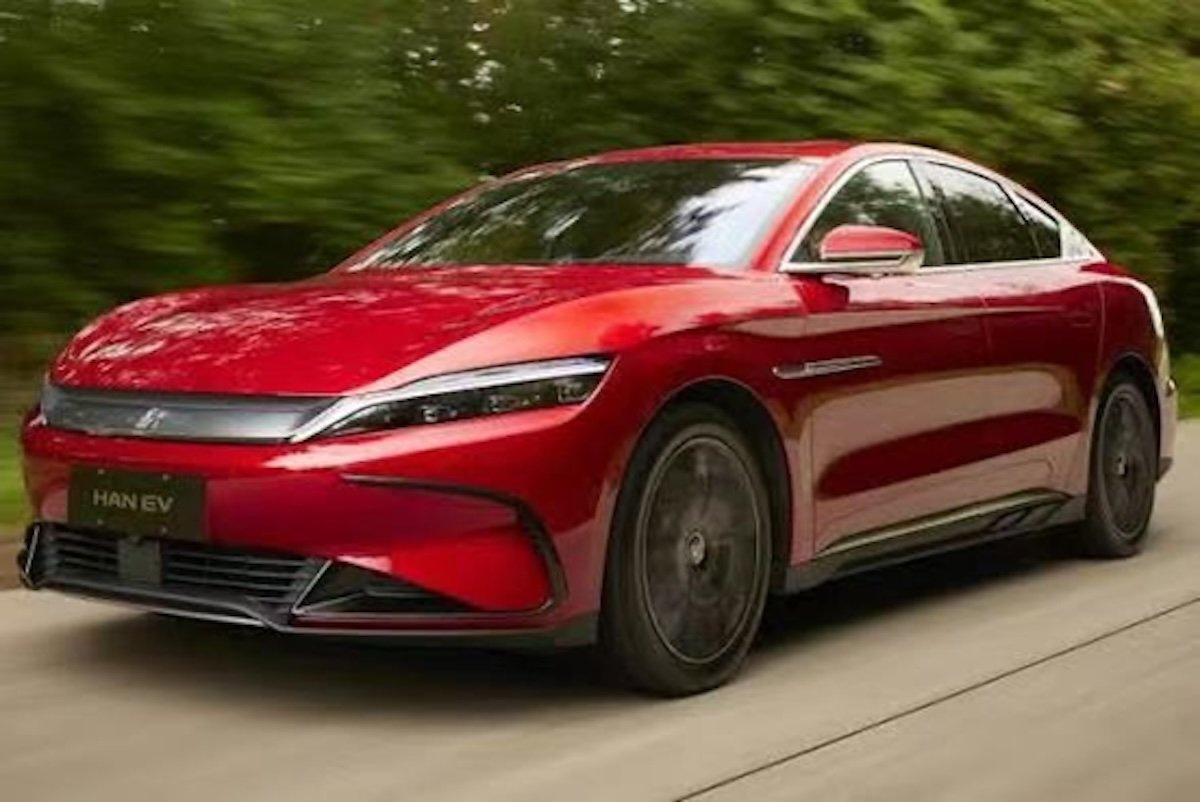
When I moved from Hong Kong to Beijing in 2022, a crimson BYD Han caught my eye. It was sleek, packed with features, and undercut the Tesla Model 3 by a noticeable margin. Today, that same car feels like a relic—a common sight in ride-hailing fleets, its novelty worn off.
China's electric vehicle industry has moved at a breakneck pace. The 2026 BYD Seal 08, for instance, is a larger, more advanced sedan than the 2022 Han, with improvements in battery, horsepower, self-driving, and even rear-wheel steering. Its top trim sells for about $35,500 in China—25% less than the 2022 Han's flagship—while entry and mid-level versions range from $29,300 to $32,300. The top-tier 'Great Han' now competes in the D-class segment, rubbing shoulders with Mercedes S-Class and BMW 7 Series, yet priced at $44,700, roughly the same as the 2022 Han.
This rapid improvement is not just about EVs. In late 2022, as China ended its zero-COVID policy, OpenAI launched ChatGPT, sparking a global race in large language models. Chinese labs, from DeepSeek to a host of open-source startups, have since released models that rival Western counterparts at a fraction of the cost. The result is a competitive landscape where Chinese innovation is forcing American tech giants to rethink their pricing and strategies.
Subsidies and the real cost of progress
US Treasury Secretary Scott Bessent recently quipped that a BYD is 'the best $70,000 car $35,000 can buy,' implying heavy subsidies. But the numbers tell a different story. China's per-vehicle EV purchase subsidies average just over $2,000 in 2026, far lower than those in the US and EU. China's success stems from a massive engineering talent pool—nearly seven times the number of new engineering graduates as the US—and a market that has embraced over 100 EV makers and 300 models.
The New York Times' test drive of a Geely M9, priced at $35,000 in China, noted it would cost more than twice that from any American brand. Yet, as Bessent's comments suggest, the perception of subsidy-driven advantage persists, even as China's EV industry matures and becomes globally competitive on its own merits.
But the real world imposes limits. China's EV market is nearing saturation, with growth slowing as domestic demand peaks. Export barriers, from EU tariffs to US restrictions, are mounting. Meanwhile, the AI sector faces its own constraints: chip export controls, data localization, and a growing regulatory burden. As China must feel real pressure for AI slowdown to work, the country's tech ambitions are colliding with geopolitical realities.
The hedonic improvements in Chinese EVs—quality-adjusted gains of over 20% annually—are remarkable, but they also highlight a widening gap with Western offerings. Tesla's Model 3, for example, has seen only marginal updates since 2022, while Chinese rivals have leapfrogged in specs and price. Yet, as Bessent's market bravado meets reality in Tokyo and Washington, the global response to China's rise is becoming more coordinated and defensive.
China's open-source AI models, like DeepSeek R1, have upended assumptions about the cost of frontier research. But the economic viability of American labs is not the only issue. The Hong Kong's capital markets fuel China's AI expansion, providing the funding for a new wave of startups. Yet, as a US-China AI regulation deal remains out of reach, the two powers are on divergent paths, each with its own strengths and vulnerabilities.
In the end, China's EV and AI sectors are not just about technology; they are about the ability to scale, adapt, and navigate a complex global landscape. The stopping power of the real world—be it tariffs, chip bans, or market saturation—will test whether China's momentum can be sustained. For now, the country's innovators are pushing forward, but the road ahead is fraught with obstacles that no amount of engineering brilliance can fully overcome.