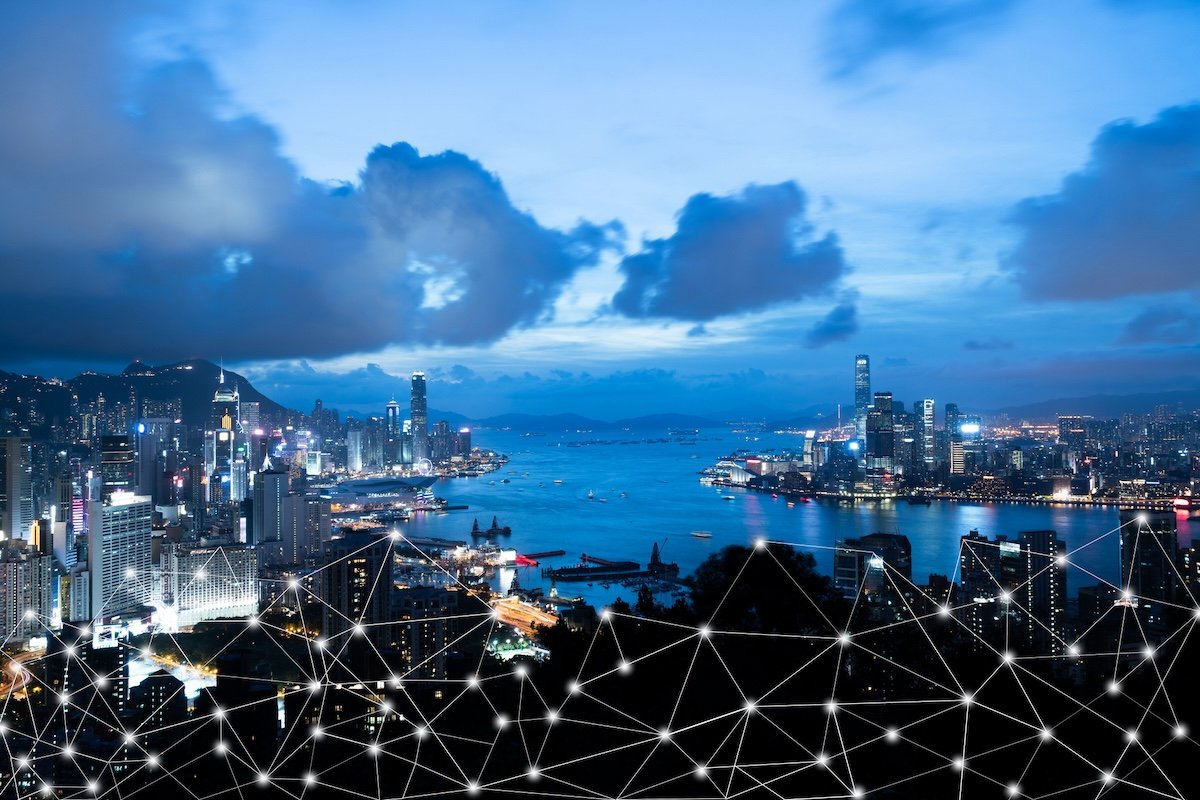
While Southeast Asia's multi-billion-dollar data-center boom stalls under US export controls and tighter bank lending, Hong Kong appears to have lost the regional AI infrastructure race. The city ranked fourth globally in Cushman & Wakefield's 2023 data center comparison but fell out of the top 10 by 2026, slipping to seventh in Asia-Pacific as high costs, scarce land, and export restrictions pushed hyperscale projects toward Johor, Singapore, and Thailand.
Yet measuring Hong Kong's role by server-farm megawatts misses a deeper transformation. The city has quietly become mainland China's indispensable semiconductor re-export hub, its primary offshore AI capital-markets conduit, and a common-law regulatory sandbox for cross-border financial AI governance.
Trade pivot drives record chip flows
Official customs data show the scale of this shift. In the first five months of 2026, semiconductors re-exported through Hong Kong to mainland China reached US$124 billion, accounting for a record 52% of China's total chip imports, up from roughly one-third a decade ago. By September, monthly semiconductor exports hit an all-time high of HK$345.7 billion (US$44.15 billion). Electronics, led by AI processors and memory devices, expanded to 80.1% of Hong Kong's total merchandise exports in the first seven months of the year, fueling the city's fastest monthly export growth in seven decades.
This pivot reflects hard economic math. Hong Kong ranks among the region's most expensive construction markets, alongside Tokyo, Singapore, Seoul, and Sydney, according to Cushman & Wakefield's 2026 cost guide. Once Washington folded Hong Kong into China's semiconductor export-control perimeter and barred frontier AI accelerators, global cloud operators saw little reason to pay Hong Kong's land and power premiums for large-scale training.
Instead, Hong Kong has leaned into high-velocity logistics and targeted domestic compute. Air freight accounts for more than 45% of total merchandise trade value, driven by Hong Kong International Airport's automated cargo terminals and expanded three-runway capacity handling high-value integrated circuits and server components. The SAR government allocated HK$3 billion (US$383 million) under its Artificial Intelligence Subsidy Scheme to underwrite up to 70% of computing costs for local universities and enterprises using Cyberport's 3,000-petaFLOPS AI Supercomputing Centre, while awarding more than 11 hectares at the Sandy Ridge data facility cluster to expand sovereign supercomputing capacity.
For regional policymakers, the distinction is critical: physical data-center capacity and semiconductor supply-chain centrality are no longer synonymous. While Southeast Asian economies poured billions into land and grid allocations only to see US chip curbs freeze their data-center boom, Hong Kong's zero-tariff, free-port regime and customs speed made it the primary clearinghouse for non-restricted semiconductors, high-density memory modules, and electronics feeding Greater Bay Area manufacturing.
Monetizing AI through capital markets and common law
Hong Kong's sharpest long-term leverage lies in financial infrastructure and regulatory architecture. On October 23, HKEX launched the HKEX Artificial Intelligence Index, tracking 40 listed companies across a five-layer AI stack from chip design to physical applications, and the HKEX Semiconductor Index, covering the city's 30 largest listed chip-related firms. HKEX paired the launch with a licensing agreement with Shenzhen-based China Southern Asset Management to introduce mainland exchange-traded funds tracking the benchmark.
As US dollar venture funds retreat from Chinese tech, Hong Kong's capital markets are stepping in. The city's common-law legal system and independent judiciary offer a familiar framework for cross-border financial AI governance, attracting mainland firms seeking offshore listings and international investors seeking exposure to Chinese AI. This financial role, combined with its trade dominance, positions Hong Kong as a critical node in the global AI economy, even as its physical data-center footprint shrinks.
CBRE's 2026 Asia Pacific Data Centre Trends & Outlook shows Hong Kong's active capacity at 687 MW with 653 MW in upcoming supply, supported by enterprise, financial institution, and AI inference demand. JLL's 2026 outlook highlights unprecedented investor demand driven by local data sovereignty and generative AI. These figures suggest a resilient, if smaller, role for Hong Kong in the regional compute landscape.
For now, Hong Kong's strategy is clear: leverage its unique position as China's gateway to global capital and technology, while building targeted domestic compute capacity. The city may not host the region's largest server farms, but it is becoming the financial and logistical engine of Asian AI. As the region grapples with the fallout of US export controls, Hong Kong's pivot offers a model of adaptation—one that prioritizes trade, finance, and regulatory agility over raw megawatts.