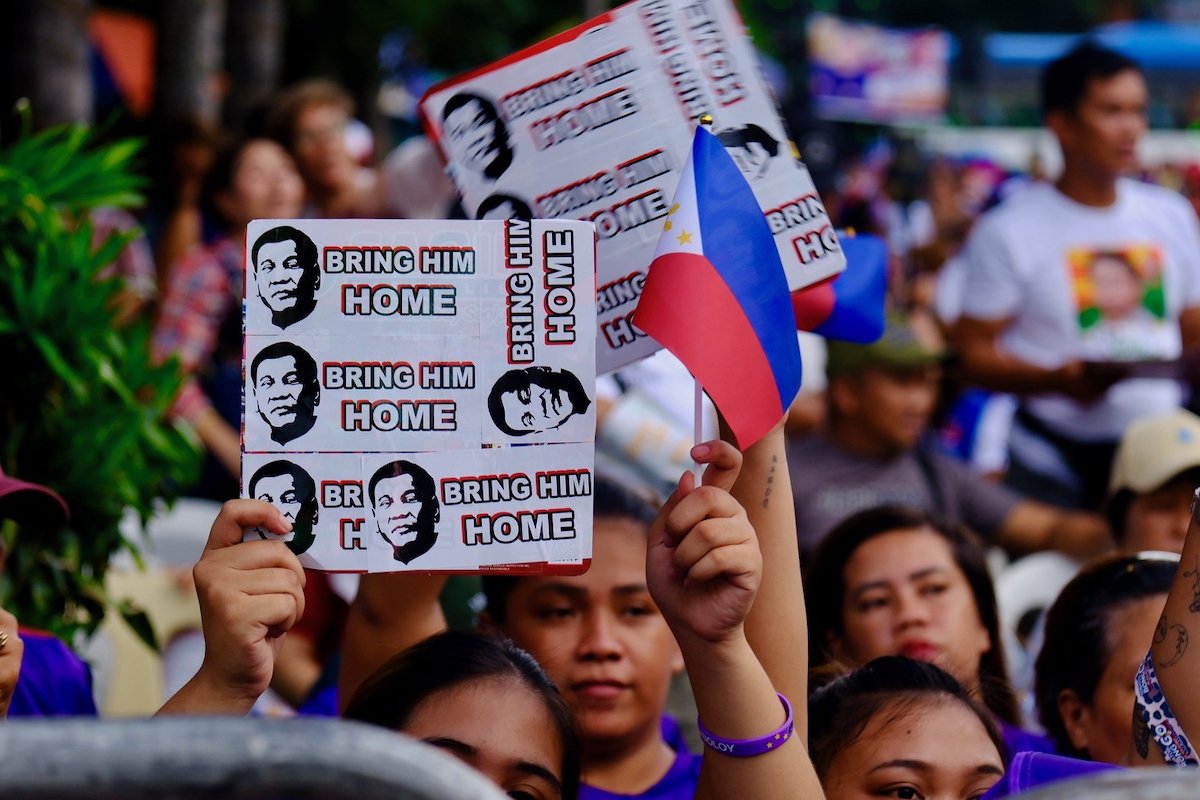
THE HAGUE – The International Criminal Court (ICC) on Thursday confirmed all charges against former Philippine President Rodrigo Duterte, who is detained in The Hague for crimes against humanity linked to his brutal anti-drug campaign that left thousands dead.
Duterte faces three counts of crimes against humanity related to 49 incidents of killings involving 78 victims. The charges represent a fraction of the estimated deaths during his six-year presidency, which ended in 2022. The ICC’s pre-trial chamber ruled that there are substantial grounds to believe Duterte is criminally responsible as an indirect co-perpetrator, and for ordering, inducing, or aiding and abetting the crimes.
“These crimes were allegedly committed as part of a widespread and systematic attack against a civilian population on the territory of the Republic of the Philippines,” between November 2011 and March 2019, the court stated. Duterte, who turned 81 in March, had repeatedly urged police to “kill, kill, kill” suspects during drug raids.
Historic Moment for International Justice
Ritz Lee Santos III, Philippine director of Amnesty International, called the confirmation a “historic moment” for international justice. “It sends a clear message that those who are alleged to have committed widespread and systematic murder as a crime against humanity will one day find themselves in the dock, facing trial. Justice may be slow in coming, but it cannot be delayed forever,” Santos said.
“This trial is not about politics. It is about a campaign in which thousands of people were killed in cold blood, and a justice system in the Philippines that has consistently failed them,” he added. For families of the victims, the decision “affirms that their voices have been heard and their persistence is not in vain.”
Leila de Lima, a House of Representatives member and Duterte’s longtime critic who was previously detained by his administration, told Asia Times that the decision should have come sooner. “The wheels of justice should have not taken that long to turn. But we take what we are dealt with for the sake of the rule of law,” said de Lima, a former human rights commissioner who investigated killings allegedly by Duterte when he was mayor of Davao City. “This is still a great day for the fighters against impunity and state-sponsored violence.”
Duterte has questioned the ICC’s jurisdiction, claiming he was “forcibly pushed into a jet and rendition” to The Hague in violation of Philippine sovereignty. He called the charges “an outrageous lie” from political opponents. However, the killings were extensively documented by the press, and Duterte often praised police for shooting suspects.
The case is closely watched in Manila, where Duterte’s daughter, Vice President Sara Duterte, is embroiled in a political feud with President Ferdinand Marcos Jr. Sara Duterte has been impeached on corruption charges and accused of threatening to assassinate Marcos, his wife, and his cousin. She has declared her intention to run for president in the next elections, while Marcos has yet to choose a successor.
The ICC has not set a trial date. Duterte is not automatically entitled to appeal the confirmation, but his lawyers may do so. The court has granted 539 relatives of drug war victims permission to attend the trial. The confirmation underscores ongoing challenges to impunity in Southeast Asia, as the region also grapples with other complex issues such as Myanmar's competing councils and shifting trade dynamics.