Within a critical twelve-day period in late March and early April, two separate councils emerged in Myanmar, each asserting it holds the legitimate path to national unity and peace. The stark contrast between their origins and composition presents the international community with a defining choice about who truly represents the country's future.
A Grassroots Federal Alliance Versus a Top-Down Decree
On March 30, a coalition of powerful ethnic armed organizations and the shadow civilian government established the Steering Council for the Emergence of a Federal Democratic Union (SCEF). The founding members include the Kachin Independence Organization (KIO), Karen National Union (KNU), Karen National Progressive Party (KNPP), Chin National Front (CNF), and the National Unity Government (NUG). This body, built from the ground up, controls or contests an estimated 79% of Myanmar's territory.
The SCEF adopted six clear political objectives: abolishing the military-drafted 2008 constitution, placing all armed forces under civilian command, and establishing transitional justice mechanisms. Its structure formally institutionalizes representation for states, ethnic revolutionary organizations, the people's movement, and women. NUG Acting President Duwa Lashi La hailed its creation as "a milestone of the Spring Revolution."
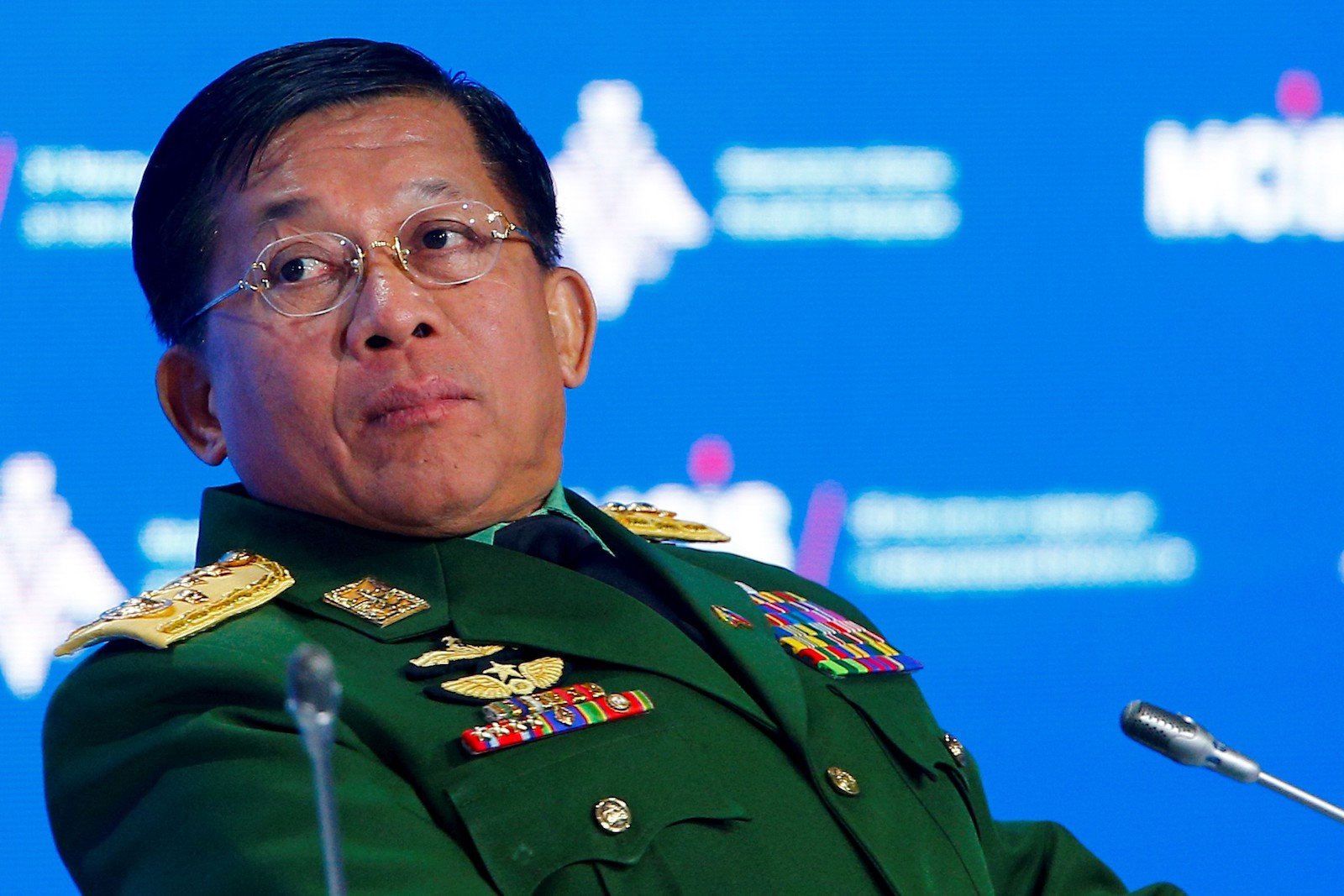
Twelve days later, on April 11, coup leader Senior General Min Aung Hlaing signed an order creating the National Unity and Peacemaking Central Committee (NSPCC) and appointed himself its chairman. Of its 15 members, nine are individually sanctioned by the United States, the European Union, the United Kingdom, Canada, Australia, or Switzerland. Min Aung Hlaing himself is sanctioned by all six and faces an unissued arrest warrant from the International Criminal Court, filed in November 2024.
The Junta's Narrative Built on Falsehoods
The day before forming his peace committee, Min Aung Hlaing delivered an inauguration address to the military-appointed Pyidaungsu Hluttaw legislature. Key assertions in his speech were demonstrably false. He repeated the discredited claim that the 2020 election was fraudulent. International observers from the Asian Network for Free Elections and The Carter Center found the voting largely peaceful and orderly. Human Rights Watch called the military's fraud allegation "unfounded."
He also declared the 2021 coup constitutional, a claim contradicted by the International Commission of Jurists, which documented at least four violations of constitutional Article 417. Furthermore, he proclaimed the military's 2026 election "free, fair, and dignified," despite the forced dissolution of the National League for Democracy (NLD)—which won 82% of contested seats in 2020—and the exclusion of parties that held over 90% of those seats. The EU called those polls "not free, fair, inclusive, or credible," and even ASEAN did not recognize them.
His speech omitted the severe human toll of his rule: over 22,800 political prisoners, more than 6,760 civilians killed, over 1,020 airstrikes on civilian targets, and 3.58 million people displaced. He made no mention of the 630,000 Rohingya people classified by Genocide Watch as facing Stage 9: Extermination, nor the ICC warrant against him.
A Pattern of Sanctions and Isolation
The NSPCC is not an isolated entity but the culmination of a pattern. In Min Aung Hlaing's cabinet, 43% of Union Ministers are individually sanctioned. His Union Consultative Council has 55% of its members under sanctions. The new peace committee has the highest concentration yet, with 60% of its members individually sanctioned. This includes Vice-Chairman General Ye Win Oo, sanctioned by five governments.
This composition creates an operational absurdity. Nine of the committee's 15 members cannot travel to major Western nations without risking asset freezes. The chairman cannot transit through countries with ICC cooperation agreements. This severely undermines the committee's ability to interface credibly with Western-aligned mediators, international peace mechanisms, or donor governments that enforce sanctions. The Nationwide Ceasefire Agreement it ostensibly seeks to revive has been called a "scrap of paper" by six of its original signatories.
The economic reality under the junta further erodes its claims to legitimacy. Since the coup, Myanmar's GDP has fallen 13% below pre-pandemic levels. The local currency, the kyat, has collapsed by 240%. Poverty has doubled to nearly 50% of the population. The country has also been blacklisted by the Financial Action Task Force for failing to combat money laundering and terrorist financing.
The formation of these two councils forces a reckoning. One represents a broad-based, territorially grounded coalition with a codified federal vision. The other is a top-down creation of an isolated regime, led by a sanctioned general whose claims to power are built on falsehoods and violence. For Washington and other international actors, the question is no longer about hedging but about choosing which Myanmar they will engage. The answer has profound implications for the future of a country whose stability is crucial to Southeast Asia. As resistance forces consolidate, the strategic landscape shifts, a dynamic explored in our analysis of Myanmar's unified resistance alliance. Furthermore, the international community's approach to Myanmar's fractured authority is tested in other strategic domains, such as the Quad's efforts to secure rare earth minerals.