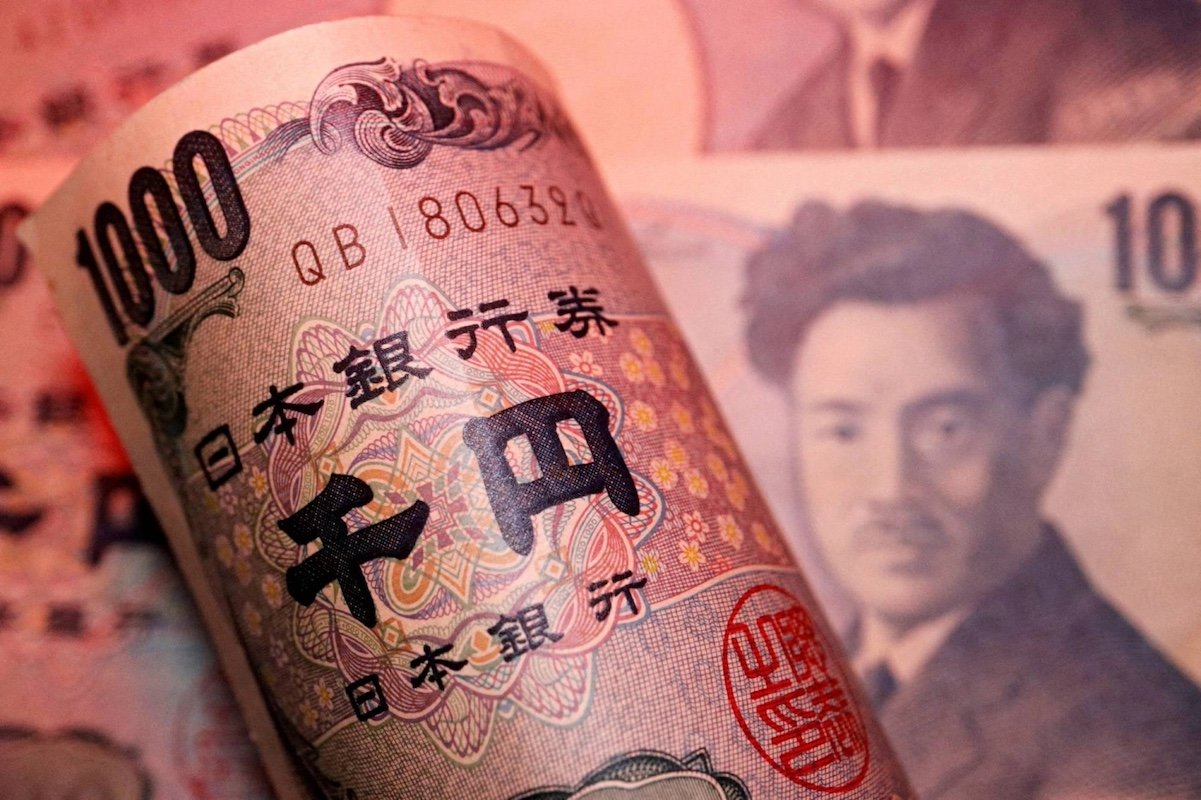
TOKYO — The Japanese yen has tumbled toward 164 against the U.S. dollar, its lowest level since 1986, and the political fortunes of Prime Minister Sanae Takaichi are sliding in tandem. A mid-July Mainichi Shimbun poll shows her Cabinet's approval rating dropping 10 points to 41%, slipping below the 50% threshold for the first time. The correlation is no coincidence: both reflect a ruling Liberal Democratic Party (LDP) that has run out of fresh ideas for managing an economy increasingly overshadowed by China's industrial machine.
For a quarter-century, the LDP has relied on a weak yen as its default growth lever, boosting exports without forcing structural reform. That strategy is now fraying. Takaichi, rather than addressing the economic headwinds, is pouring political capital into an unpopular revision of the Imperial House Law — a move that changes marriage and adoption rules within the royal family but does nothing to revive Japan's growth engine. The disconnect is striking: while the yen sinks and inflation bites, Tokyo's energy is consumed by a dynastic debate.
Washington's Silence and the Safe-Haven Shift
A second troubling dimension is the near-total silence from Washington. Given the scale of the current trade war — President Donald Trump has layered new 10% to 12.5% tariffs onto most major trading partners — one might expect sharp U.S. criticism of Japan for manipulating its exchange rate. Yet Treasury Secretary Scott Bessent's department has said almost nothing about the yen. This quiet suggests either tacit approval of Japan's currency stance or a calculation that other priorities, such as containing China, outweigh currency disputes.
Third, the yen no longer attracts the safe-haven demand it once did during global turmoil. That may partly reflect broad dollar strength — gold is not rallying either — but it also confirms a fear long held in Tokyo: that global capital is routing around Japan. Investors increasingly see the yen as a one-way bet, and that perception is self-reinforcing.
Japan's economy is projected to grow just 0.5% in 2026, far below the inflation trajectory the Bank of Japan (BOJ) has been signaling. Since the BOJ raised rates to a 31-year high of 1% in mid-June, the reemergence of the Iran war as a major risk threatens to push oil-importing Japan into stagflation — a scenario even harder to manage than the deflation of past decades. As Japan's yen crisis could trigger a US debt contagion, the stakes extend well beyond Tokyo.
The China Shadow and the AI Boom
Beijing's shadow looms large. China has spent the past two years exporting industrial overcapacity worldwide, intensifying price competition that President Xi Jinping's government has struggled to rein in. A stronger yen would blunt Japan's ability to compete on price in export markets — markets that are also getting a boost from the AI boom. SoftBank Group's market value has now surpassed Toyota's, and firms like Kioxia and Taiyo Yuden are gaining ground. Regardless of what Takaichi says publicly, she worries a firmer yen could slow that momentum, along with the broader rally that pushed the Nikkei 225 above 72,000 last month (it has since eased to around 64,000, after starting the year near 50,000).
Finance Minister Satsuki Katayama continues to warn that “decisive action” is available if the yen weakens excessively, and Tokyo did intervene briefly in April and May when the rate crossed 160. But as Deutsche Bank strategist Mallika Sachdeva notes, without a credible plan to rein in Japan's soaring debt, these moves are largely symbolic. If fiscal capacity becomes the dominant policy concern, currency management could increasingly give way to yield management, and how the government handles that trade-off will shape the yen's trajectory going forward. That is why past interventions have not stuck this time — traders have watched this pattern repeat too often to expect a different outcome.
Lessons from the 1930s — and Their Limits
Tokyo does have levers left to pull, even if using them would be risky. One path involves persuading Bessent's Treasury to join a sustained, coordinated intervention. The more radical option would be resurrecting the reflationary strategy of Korekiyo Takahashi — the finance minister often called “Japan's Keynes” — who combined aggressive monetary easing with fiscal expansion, including direct central bank purchases of government debt, to pull Japan out of the Great Depression in the 1930s. Former Federal Reserve Chair Ben Bernanke has praised the approach, and many economists consider it an early precursor to Modern Monetary Theory. Takaichi's mentor, Shinzo Abe, was drawn to Takahashi's example during his 2012-2020 premiership, pushing the BOJ toward supersized quantitative easing starting in 2013. By 2018, the BOJ's balance sheet had grown larger than Japan's entire economy — a first among G7 nations. Yet even Abe stopped short of going all-in on Takahashi-style debt monetization.
Trying that now, in 2026, could easily backfire. Twenty-seven years of near-zero rates and a weak yen never revived Japan's underlying growth engine — if anything, they dulled the urgency for structural reform. While Japan stood still, China reshaped global manufacturing much as Japan itself did in the 1980s, and Japanese industry still has not found an answer to competitors like electric-vehicle giant BYD or AI success DeepSeek. The 'Honebuto Shock' term emerges as bond yields hit 30-year high, underscoring the fiscal constraints Tokyo now faces.
All of this leaves the BOJ facing a precarious stretch as it tries to keep normalizing rates. Moody's Analytics economist Sarah Tan points out that the inflation outlook now hinges largely on developments in the Middle East and their effect on commodity prices. If nominal wages fail to keep pace, real incomes and consumer spending could suffer, with any further yen depreciation only adding to imported inflation. Takaichi's team appears to be drawing the wrong lessons from two eras of quantitative easing — the 2000s version and Takahashi's original 1930s model. Modern QE traces back to 2001, when the BOJ first experimented with asset purchases, but that history offers no easy template for the stagflationary trap Japan now confronts.