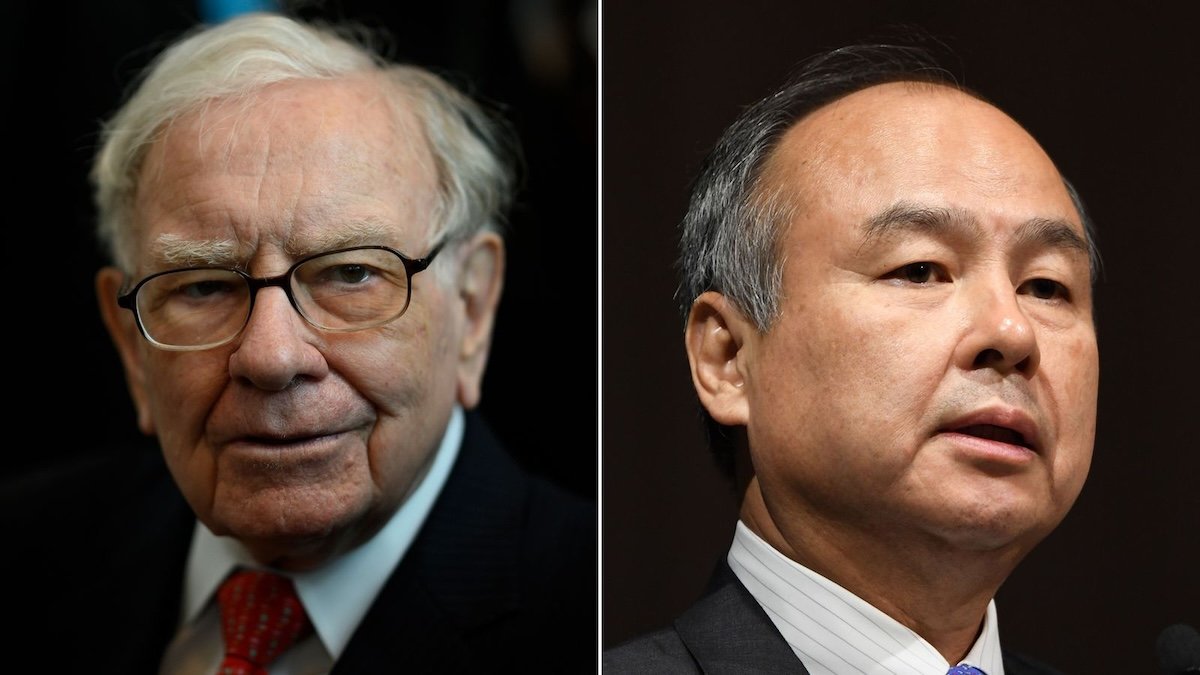
For Masayoshi Son, the artificial intelligence boom has been a double-edged sword. In June, SoftBank Group briefly overtook Toyota Motor in market capitalization to become Japan's most valuable public company for the first time in 22 years, riding a wave of euphoria in AI stocks. That marked a stunning reversal for a conglomerate that had been nursing wounds from the WeWork disaster and a Vision Fund that had limped into 2026.
The turnaround is largely credited to Son's 2016 acquisition of British chip designer Arm, which now looks like a contrarian masterstroke, and his big bets on OpenAI and Nvidia. But the latest earnings report, released Thursday, reveals cracks beneath the surface. Vision Fund, the world's most important venture fund, reported an 18% drop in fiscal first-quarter profit to $2.2 billion for April-June, down from $2.6 billion a year earlier. Investors chose to focus on the positives: quarterly sales rose nearly 11% to 2 trillion yen ($12.7 billion), and CFO Yoshimitsu Goto touted Arm's thriving business and a lucrative Intel stake.
Portfolio, not strategy
The problem, as analysts note, is that Vision Fund's success has always hinged on the swings of giant bets—Intel, ByteDance, PayPay, and Taiwan Semiconductor Manufacturing Co. It's a portfolio, not a strategy, and portfolios can turn. SoftBank has poured an additional $20 billion into OpenAI and plans more such bets this fiscal year. Macquarie analyst Paul Golding says SoftBank Group “continues to scale in the key enablement vectors of the AI revolution, investing in leading automation companies, software platforms, data centers and semis firms, delivering quality exposure to the theme and benefiting from secular tailwinds for its equity holdings and the resilience of its balance sheet.”
Yet SoftBank's balance sheet tells a different story. Debt hit $113 billion as of March 31, up from $77 billion a year earlier. In April, the company paid a record 8.5% coupon on a 10-year dollar tranche as part of a $3.6 billion raise—a rate more typical of junk-rated borrowers than a company leading a nation's stock market. The $14 billion WeWork write-down raised questions about Son's judgment, and his $60 billion-plus commitment to OpenAI has revived them.
Son's history looms large here. In 2000, he handed an obscure English teacher in Hangzhou $20 million. When Jack Ma took Alibaba public in New York 14 years later, that stake was worth $60 billion, cementing Son's reputation as the “Warren Buffett of Japan.” The Vision Fund, launched in 2017, was an attempt to recapture that magic. With his AI bets, Son is betting he's done it again—and that investors will look past the debt.
In June, Son told CNBC that AI is “probably 50x bigger than dot-com.” Behind that optimism sits his long-held belief that the “singularity”—the moment AI outsmarts humanity—is near. For years, he's called himself the “crazy guy who bet on the future.” In 2026, that future seems to have finally arrived. Only time will tell if he's right—or if history remembers him as a cautionary tale, the man who turned SoftBank into an AI meme stock.
What Son really needs is a page from Buffett's playbook for stabilizing Berkshire Hathaway's balance sheet—including some unexpected bets on Japan, of all places. For Son, Vision Fund was always a way to escape Japan's rigid, aging, slow-growth economy. It's no coincidence that the year he effectively discovered Alibaba's Ma coincided with the Bank of Japan's slashing of rates to zero and pioneering quantitative easing. His venture ambitions were an attempt to find growth abroad that no longer existed at home.
Japan's deflation, dismal demographics, and play-it-safe corporate culture pushed Son to deploy billions across China, India, South Korea, Indonesia, Bangladesh, Brazil, Kenya, Israel, and beyond—riding a herd of tech “unicorns” toward riches SoftBank could no longer find domestically. Buffett has been going the other way since 2020. That year, the Oracle of Omaha shocked even Tokyo's biggest bulls with a $7 billion bet on five centuries-old Japanese trading houses. While financial media gushed over Jack Ma's Ant Group and the FAANGs, Buffett was getting deliberately old-school, old-economy.
Few are second-guessing that move now. Buffett's retro-Japan bets are paying off handsomely: shares of “sogo shosha” trading conglomerates have rallied as energy, metals, and crop prices surged amid geopolitical tension and supply-chain chaos. Management at Buffett-backed Itochu, Marubeni, Mitsubishi, Mitsui, and Sumitomo have boosted forecasts—or look set to shortly. Turns out Buffett's “Moneyball” experiment was a hit. He was, in effect, doing for stock-picking what Oakland A's manager Billy Beane did for baseball in 2002—using unconventional, data-driven analysis to build a winner on a budget, as Michael Lewis chronicled in his 2003 book and as the 2011 Brad Pitt film dramatized. As Tokyo investment veterans noted at the time, Buffett was running the same play: rebuilding Berkshire's steady, unglamorous returns through predictable, low-risk Japan. Mission accomplished.
But Berkshire's success rests heavily on the steady income from General Re. Boring as it is, that reinsurance shock absorber is what lets Buffett take his big swings elsewhere. Son knows it. In recent years he flirted with buying a $10 billion stake in reinsurance giant Swiss Re—a move that would have given SoftBank a similar cushion. He ultimately passed, and that decision may come back to haunt him as he doubles down on AI.
For now, SoftBank's fate is tied to the AI trade. If AI delivers on its promise, Son will be vindicated as a visionary. If not, he may be remembered as the man who bet the company on a bubble. The world is watching—not just Tokyo, but every market where SoftBank has placed its chips. As the hybrid state-market model debate intensifies, Son's gamble is a test case for whether private capital alone can sustain the AI revolution. And as China's bamboo growth model versus India's eucalyptus approach shows, different paths to growth carry different risks. SoftBank's path is the riskiest of all.