Japan is moving closer to a decision that was once politically unthinkable: whether to adopt nuclear propulsion for its next generation of submarines. Defense Minister Shinjiro Koizumi confirmed this month that Tokyo is keeping the option open as it prepares to revise three key national security documents by the end of the year.
Speaking at a regular press conference, Koizumi said Japan would not rule out acquiring nuclear-powered submarines, following encouraging signals from a US Navy official. The unnamed official, later corroborated by the US Pacific Fleet, suggested that discussions should proceed given Japan's advanced nuclear expertise, noting that asset procurement must align with national operational needs.
The debate marks a notable shift in Japanese security policy. In July 2026, Koizumi called for Japan to discuss nuclear deterrence without taboos, arguing that the country could no longer avoid confronting nuclear weapons policy amid a worsening security environment. His latest remarks sharpen the question of whether nuclear-powered submarines would strengthen Japan's undersea deterrent enough to justify their higher financial, acoustic, and technical costs.
China's naval expansion and the case for nuclear propulsion
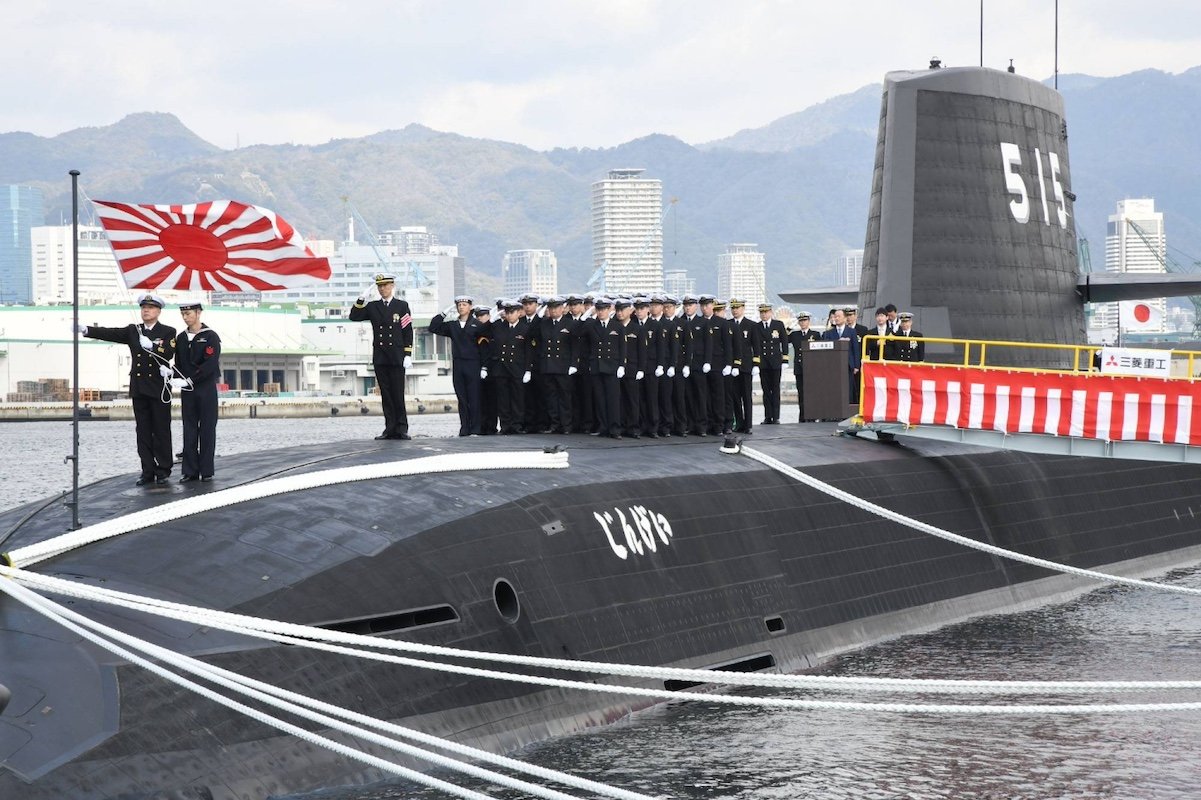
Japan currently operates an all-diesel fleet of 23 conventional attack submarines (SSKs), but security hawks from the Liberal Democratic Party and its coalition partner, the Japan Innovation Party, have pushed for modernization in response to China's rapid naval buildup in the Pacific. According to Rear Admiral Mike Brookes, Director of the US Office of Naval Intelligence, China's People's Liberation Army Navy (PLAN) is making a major strategic shift from diesel-electric to a fully nuclear submarine fleet. Shipyard expansions have more than doubled production capacity, and China now fields advanced platforms like the Type 093B nuclear cruise missile submarine (SSGN) and the compact Type 41 nuclear attack submarine (SSN) for regional patrols.
Brookes projects that China's submarine fleet will reach roughly 80 vessels by 2035—about half nuclear-powered—culminating in next-generation Type 095 SSNs and Type 096 ballistic missile submarines (SSBNs) designed to contest blue-water approaches beyond the First Island Chain. For Japan, that trajectory strengthens the case for submarines able to shadow Chinese forces across much greater distances than its current coastal defense doctrine demands.
North Korea is also pursuing a sea-based second-strike capability, combining modified conventional submarines with ambitions for true SSBNs. Suspected Russian technical assistance could accelerate that effort, although reactor, acoustic, and anti-submarine warfare constraints are likely to keep North Korea's fleet largely confined to coastal bastions for years.
Costs and operational trade-offs
Nuclear-powered submarines offer unmatched underwater endurance, higher speeds, and the power to defend vital Indo-Pacific sea lanes independently. However, they are constrained in confined coastal environments: their massive hulls increase sonar detection risks, coolant intakes risk fouling near the seabed, and active reactor machinery generates persistent acoustic noise. Japan's Taigei-class SSKs, powered by diesel-electric machinery and lithium-ion batteries, can operate extremely quietly and are optimized for prolonged submerged operations, making them well suited to coastal defense, reconnaissance, and chokepoint interdiction.
Cost also differs significantly. At roughly US$700 million per boat, nuclear submarines are far more expensive than conventional ones, and their lifecycle costs include reactor refueling and specialized maintenance. Japan has the scientific and industrial base to shorten the path to a nuclear deterrent if policy shifts, with its nuclear fuel-cycle expertise and advanced high-energy-density and laser-fusion research at Osaka University's Institute of Laser Engineering underscoring its significant latent technical capacity.
Technical capacity, however, does not settle whether nuclear propulsion is the best fit for Japan's likely operating environment. As John Bradford and other writers note in a November 2025 report for the S. Rajaratnam School of International Studies (RSIS), advocates argue that nuclear propulsion provides unmatched underwater endurance, higher speeds, and the power to defend vital Indo-Pacific sea lanes independently against expanding Chinese and North Korean threats. But they also caution that the strategic value of nuclear submarines derives largely from remaining submerged and difficult to locate for extended periods far from home waters—advantages most consequential when paired with a survivable nuclear deterrent. If Japan remains committed to a purely conventional arsenal, absorbing the extraordinary cost and complexity of nuclear propulsion becomes harder to justify.
Koizumi's remarks come as Japan plans to include submarine-launched hypersonic weapons in its fiscal year 2027 budget, aiming to strengthen its long-range counterstrike capabilities against enemy bases. That missile program raises the stakes of the propulsion debate, because longer-range weapons become more strategically useful when their launch platforms can patrol farther, faster, and for longer periods. Japan plans to field vertical launch systems capable of firing solid-fuel Hyper Velocity Gliding Projectiles (HVGP) and scramjet-powered cruise missiles from submarines and unmanned underwater vehicles. While intended to provide a survivable conventional deterrent that bypasses vulnerable air bases and surface ships, the same infrastructure would narrow the technical gap between conventional undersea strike and a future sea-based nuclear deterrent.
The submarine debate is part of a broader reassessment of Japan's security posture, as seen in its energy security concerns and its fiscal challenges. Whether Tokyo ultimately chooses nuclear propulsion will depend on how it weighs these strategic, operational, and financial factors—and on whether it is willing to break a taboo that has shaped its postwar identity.