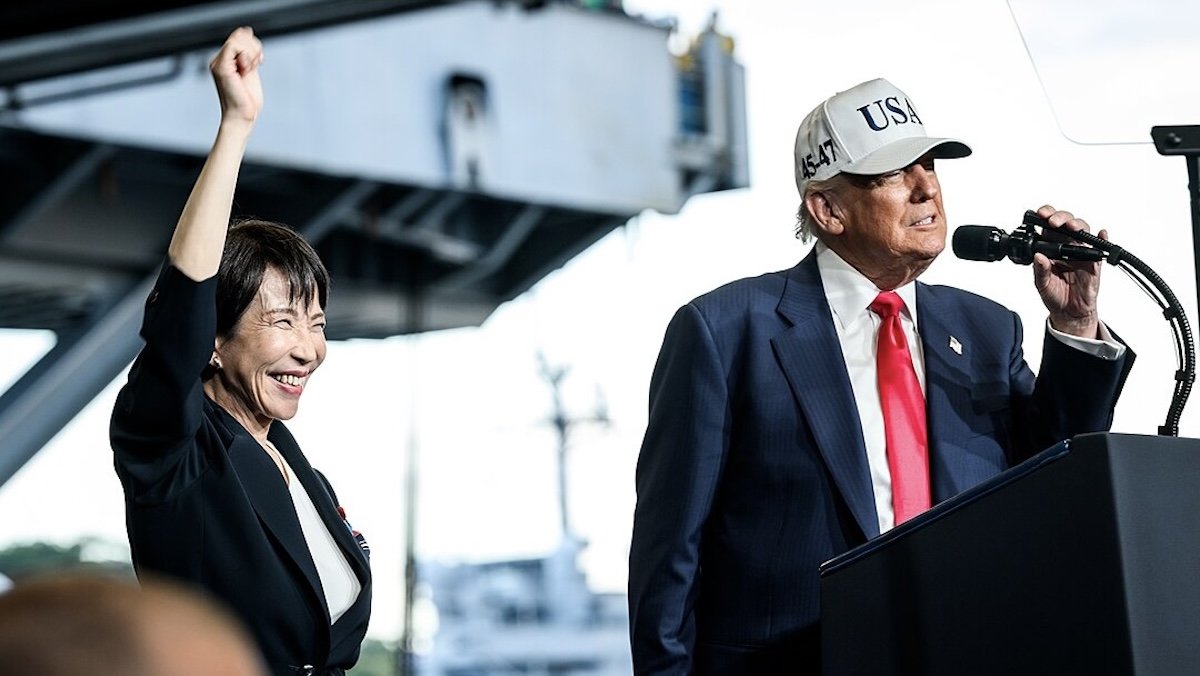
Among all allied leaders, from Europe to the Indo-Pacific, none has courted Donald Trump as assiduously as Japanese Prime Minister Takaichi Sanae. In her first year, she met the US president three times, pledged tens of billions in investment, and stayed silent when Washington sanctioned the International Criminal Court and its Japanese chief prosecutor, or when Trump embraced Xi Jinping's overtures to split Tokyo from Washington.
Now, with the US midterm elections approaching on November 3, polls suggest a potentially crushing defeat for Trump and his MAGA movement. Even if the scale remains uncertain, a weakened and isolated Trump could become more erratic, raising the question: did Takaichi make a bad bet?
Richard Samuels, a prominent MIT scholar of Japan, told Toyo Keizai: “No, I don’t think Takaichi has made a mistake. From Japan’s perspective, hugging the US and hedging against its abandonment makes sense and seems to be working. She is smart to do this for as long as she can.” Most US-based Japan experts share that view, but they also acknowledge the risks ahead.
Two paths for a wounded Trump
What happens next depends largely on Trump’s state of mind after a defeat. One possibility, according to a former senior State Department official, is that he focuses on legacy-building—erecting monuments, enriching himself and his family through deals with foreign powers, and pursuing domestic enemies. Bill Emmott, former editor of The Economist, noted that for a president with such a personal conception of power, “the prospect of spending his next two years in this way may well be quite attractive.”
But other analysts warn of a more dangerous path. Trump’s recent embrace of Russian President Vladimir Putin could signal more provocative foreign policy moves. Ivo Daalder, former US ambassador to NATO, told Toyo Keizai: “There is definitely going to be legacy Don because that is who he is, but he will definitely also be unhinged.” The former senior official predicts a weaker Trump “will also become increasingly authoritarian and of the view that he and Xi and Putin should rule the world.”
Daalder believes a trilateral summit with Putin and Xi on the sidelines of the APEC meeting in Shenzhen in November is highly likely. Such a summit might focus on forcing Ukraine to surrender on Russian terms, but Trump may simply relish the image of three strongmen arm in arm. As Daalder puts it, “Trump needs to project power – and that increases the likelihood of him doing unhinged things.”
Iran escalation and other nightmares
The most immediate challenge for Trump after the midterms—or even before—is extricating himself from the Iran war. Unable to admit mistakes, he seeks a way to declare victory and leave. But Daalder argues the price of victory has risen. “Now it becomes more difficult,” he says, predicting a major military strike on Iran’s buried nuclear site at Pickaxe Mountain or the Kharg Island oil terminal. “Trump may use a tactical nuclear weapon on either or both,” he worries.
Israeli Prime Minister Benjamin Netanyahu has openly called for resuming large-scale attacks to topple the Iranian regime after the US election. Escalation would trigger retaliation against Gulf states, disrupting global oil and gas markets and supply chains for chemicals and fertilizers—a serious threat to Japan’s economic growth plans, though Trump may not care about the broader crisis.
After declaring victory, Trump might turn to the Western hemisphere, with Cuba a likely target, Daalder predicts. “Even Greenland is not over,” he adds.
Another concern for Japan is the possibility of a Trump summit with North Korea’s Kim Jong Un. Recent remarks by Trump seemed to dampen prospects, and most North Korea watchers believe Kim has little incentive to meet. “Trump has nothing he wants, other than the US leaving South Korea,” said the former senior State Department official. China and Russia might urge Trump in Shenzhen to seek a meeting with Kim to declare an end to the Korean War and begin withdrawing US forces from South Korea. “If I were Kim, I would get Putin to carry his water on this and declare it a victory for peace,” the official added.
For Takaichi, the bet on Trump may still be rational, but the coming months could test Japan’s patience and strategic agility. As a Trump-Putin-Xi summit would hand Xi the diplomatic pivot, Tokyo must prepare for a more unpredictable Washington. The Starlink reversal shows Trump yields to pressure, not flattery, a lesson Takaichi may need to learn. Meanwhile, Middle East actors are already hedging against US policy, a model Japan might consider.