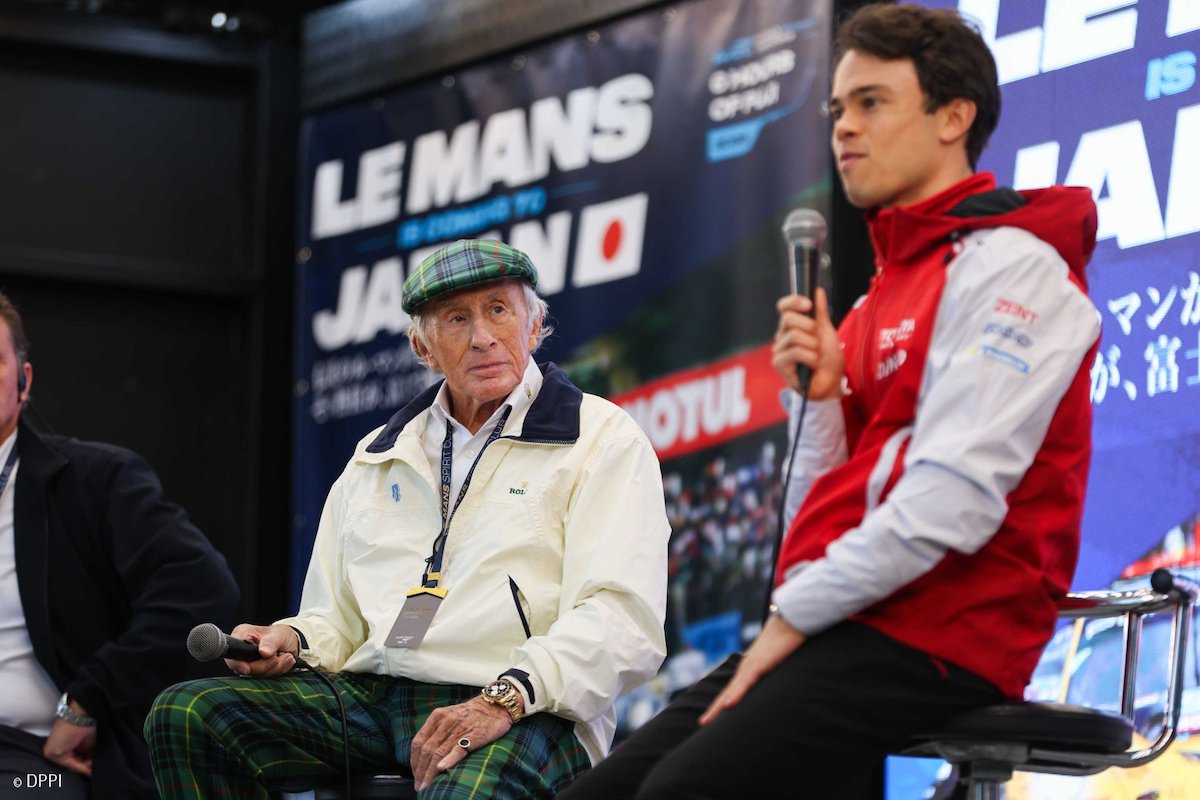
Sixty years after winning the Fuji 200 race, Sir Jackie Stewart returned to Japan last weekend, not for a victory lap but to wave the green flag at the start of the FIA World Endurance Championship (WEC) race at Fuji Speedway. The three-time Formula One world champion was there to campaign for his charitable foundation, Race Against Dementia, which he established in 2016 after his wife, Lady Helen Stewart, was diagnosed with the condition.
On the track, Toyota Racing's #8 crew of Ryo Hirakawa, Sebastian Buemi, and Brendon Hartley took the checkered flag, beating the #36 Alpine Endurance Racing crew by just 0.591 seconds. BMW M Team WRT's #15 car finished third, 6.415 seconds behind. The victory puts Toyota's #8 crew at the top of the 2026 WEC Hypercar standings with two of eight rounds remaining, including the prestigious 24 Hours of Le Mans held in June.
A race against time
Stewart's mission is a longer-term challenge. Dementia affects over 55 million people worldwide, a number projected to rise to 152 million in 25 years. In the UK alone, the condition costs £42.5 billion annually, a figure expected to more than double by 2040. Stewart, who survived a near-fatal crash in 1966 and lost five close friends to racing accidents, draws a parallel between the sport's problem-solving culture and medical research.
“Any problem with my racing car and the whole team would work to resolve it – fast. This problem-solving mentality should be applied to medical research,” Stewart said.
His son, Mark Stewart, who chairs the foundation's board, described the search for a treatment as “an endurance race.” Since 2016, Race Against Dementia has funded nearly 90 researchers across more than 50 projects, providing five-year grants to early-career scientists to encourage innovative thinking. The foundation has also held international conferences bringing together dementia researchers and Formula 1 experts to apply racing's precision and teamwork to the disease.
The charity has partnerships with institutions including the UK Dementia Research Institute, Alzheimer's Research UK, the Mayo Clinic in the US, and Dementia Australia. In July, it announced its first AI Innovation Fellowship, awarded to Dr. Alex Smith, a mathematician who will use artificial intelligence to analyze medical records of over half a million people with dementia in the UK, aiming to identify patterns and predict disease progression.
Japan's growing dementia challenge
Japan faces a particularly acute demographic challenge. With 30% of its population aged 65 or older and over 100,000 centenarians, the number of people living with dementia is approaching 5 million, or 4% of the population. The Japan Agency for Medical Research and Development (AMED) projects that figure could reach 9 million by 2040. The government launched a community support system in 2005, and public awareness was boosted by the 2006 film Memories of Tomorrow (Ashita no Kioku), starring Ken Watanabe, who plays a businessman grappling with Alzheimer's.
During the Fuji weekend, Race Against Dementia held a gala dinner at the Fuji Speedway Hotel, featuring a charity auction with items such as a crash helmet from Toyota driver Nyck de Vries, racing suits, and a high-performance alloy wheel forged by Japan's RAYS Engineering. The proceeds support the foundation's work, which now extends to Japan, joining its presence in the UK, Europe, South Africa, Australia, and the US.
Stewart's return to Japan underscores a broader regional concern: as Japan debates its security posture and energy independence, the health of its aging population remains a critical domestic issue. The race against dementia, like any endurance race, requires sustained effort, collaboration, and a willingness to innovate.