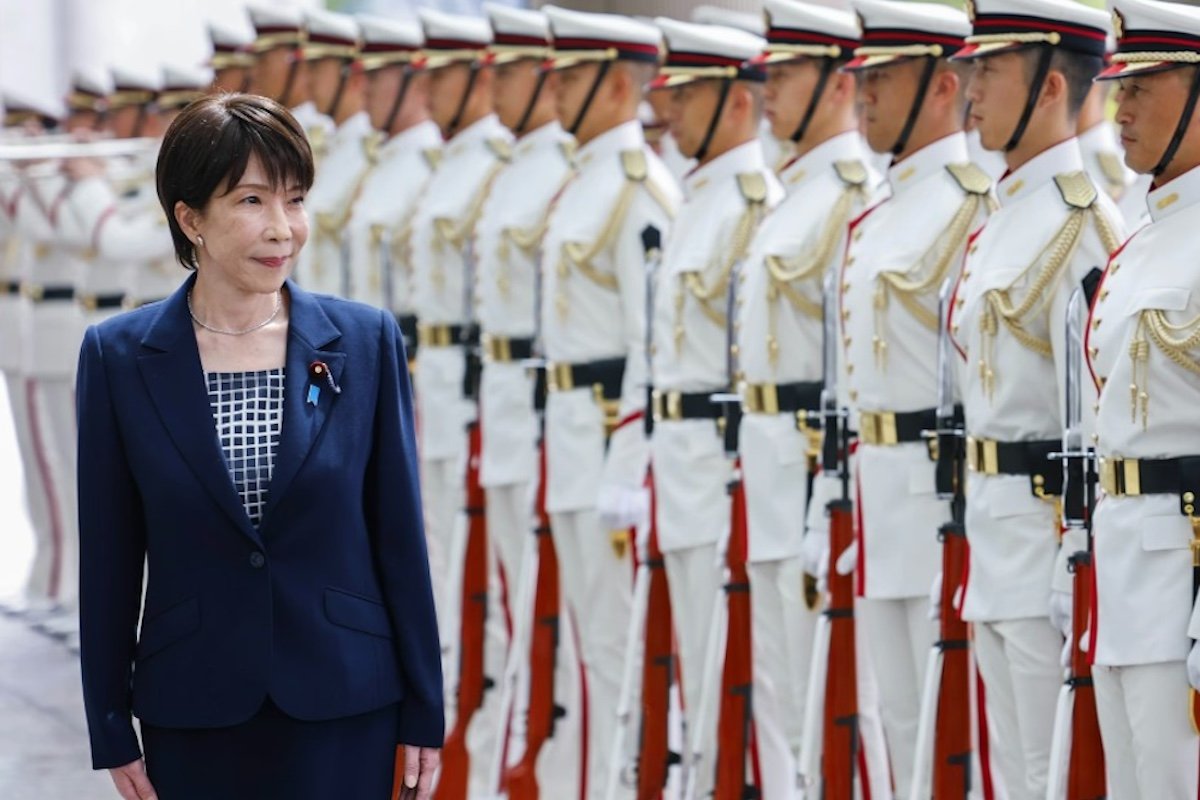
Japan's ambitious military expansion, a cornerstone of Prime Minister Sanae Takaichi's security agenda, is running into severe fiscal, supply-chain, and industrial obstacles just as regional threats intensify. Multiple reports indicate that the country's five-year defense program, due for revision by year-end, is being undermined by surging procurement costs, delayed US weapons deliveries, and domestic parts shortages.
The weak yen, inflation, and supply-chain bottlenecks have driven up hardware prices sharply. According to Japanese Ministry of Defense disclosures and a January Board of Audit report, the unit cost of the domestically built Kawasaki P-1 maritime patrol aircraft has jumped 50% to 46 billion yen (US$290 million) between fiscal 2023 and 2026. Similarly, the price of US-made F-35 fighters has climbed, reflecting broader cost overruns in the F-35 program.
Delivery delays are equally troubling. As of August, 118 US Foreign Military Sales contracts worth 1.14 trillion yen ($7.2 billion) remain undelivered after at least five years. The Tomahawk cruise missile order, up to 400 missiles, faces two-year delays because US stockpiles were depleted following operations against Iran. These bottlenecks threaten Japan's ability to meet its force-expansion targets within existing budget frameworks.
Domestically, the P-1 fleet's mission-capable readiness rate has fallen to roughly 30% due to salt-spray corrosion and spare-parts shortages. The Japan Maritime Self-Defense Force (JMSDF) has been forced to cannibalize aircraft for components, severely limiting maritime surveillance capabilities—especially critical given China's growing activities around the Senkaku Islands and in the Miyako Strait.
Fiscal constraints and strategic pivot
At the May 2026 Shangri-La Dialogue, US Secretary of Defense Pete Hegseth pressed Asian allies to spend at least 3.5% of GDP on defense, warning against freeloading. However, Nikkei reported that Japan is unlikely to meet that target by fiscal 2031, citing competing domestic priorities such as Prime Minister Takaichi's growth-oriented investments and a proposed consumption tax cut. The weak yen also inflates host-nation support costs.
Japan's budgeting system lacks a clear distinction between core and related military expenditures, prompting officials to consider independent standards that could include AI, economic security, and energy. This ambiguity complicates efforts to secure additional funding.
In response to these challenges, Tokyo is pivoting toward unmanned systems like MQ-9B drones, which offer a more cost-effective way to maintain surveillance and deterrence. This shift reflects a broader recognition that traditional platforms may be unaffordable at the scale originally envisioned.
The F-35 price hikes are particularly concerning. According to the US Department of Defense's April 2026 F-35 Modernized Selected Acquisition Report, the average procurement unit cost rose 3.69% to $96.099 million in constant 2012 dollars ($144.700 million in then-year dollars). Engine program costs climbed 20.07% over the 2012 baseline. Technical complexity across 55 Block 4 capabilities and engine thermal management upgrades are cited as key cost drivers.
Japan's aging fighter fleet adds urgency. The Japan Air Self-Defense Force (JASDF) relies on early-1980s F-15J fighters, now largely obsolete, and a smaller F-2 fleet with limited range and payload. A May 2026 Military Watch Magazine article noted that Chinese J-15B carrier jets overwhelmingly outmatched Japanese F-15s during two December 2025 encounters, underscoring the widening sensor and avionics gap.
While Japan depends on a limited number of F-35 stealth fighters, Block 4 upgrade delays further undermine its air superiority. The combination of fiscal constraints, industrial bottlenecks, and evolving threats is forcing a difficult recalibration of Japan's defense posture.
As Tokyo revises its three key national security documents, the focus is shifting toward resilience and innovation. The move toward unmanned systems and the exploration of nuclear submarine options reflect a pragmatic adaptation to resource limits. Yet, the gap between ambition and capability remains a pressing concern for regional stability.