Earth's Moon formed more than four billion years ago when a Mars-sized body slammed into our planet, hurling molten rock into orbit that later coalesced. But what about Mars? The Red Planet hosts two small, irregular moons—Phobos and Deimos—whose origins remain a puzzle. Competing theories have vied for decades, but no consensus has emerged. Now, a Japanese-led mission aims to settle the question.
On October 19, the Martian Moons Exploration (MMX) spacecraft is scheduled to lift off atop an H3 rocket from Tanegashima Space Center in southern Japan. Its primary target is Phobos, the larger and closer of the two moons, where it will attempt to land and collect a soil sample. The precious cargo will then be returned to Earth for laboratory analysis.
Two moons, two theories
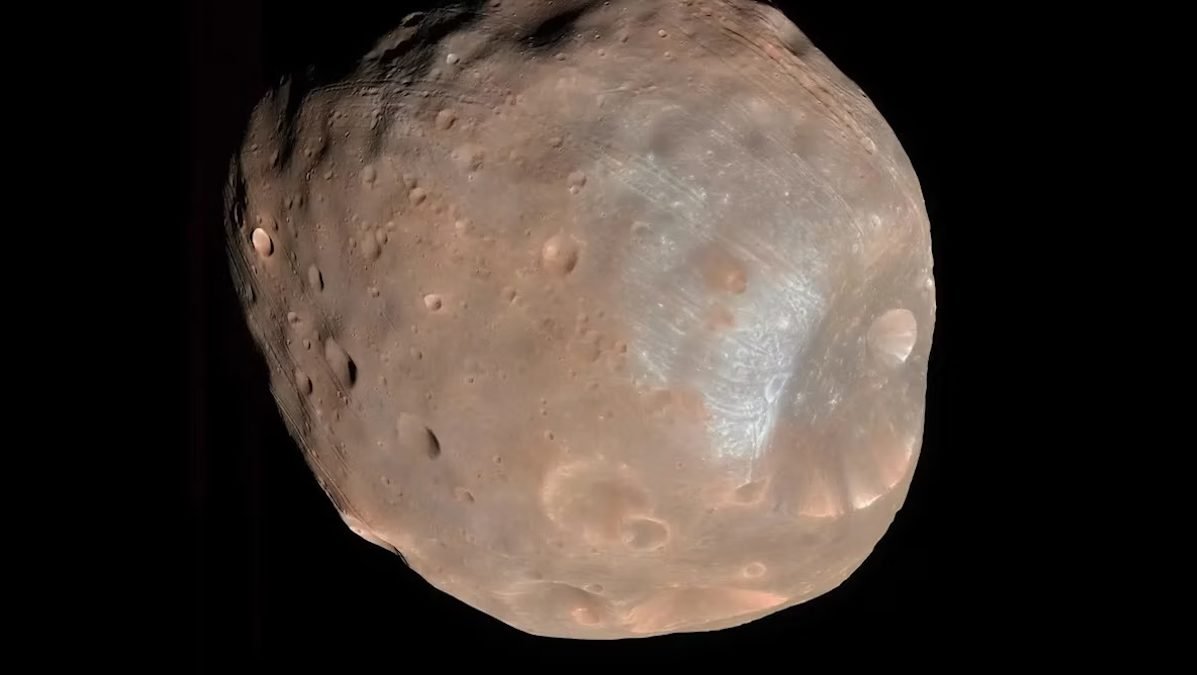
Phobos, with a mean diameter of 22.2 kilometers and a mass of about 10,637 million million kilograms, orbits Mars at a distance of roughly 9,400 kilometers. Deimos, the smaller and more distant moon, has a mean diameter of 12.5 kilometers and a mass of 1,480 million million kilograms. Both were discovered in 1877 by American astronomer Asaph Hall at the US Naval Observatory in Washington DC.
The leading explanation, the giant impact theory, proposes that a celestial body about one-third the size of Mars struck the planet early in its history, ejecting material into space. This process would have created a single large moon and a swarm of smaller satellites, most of which eventually fell back to the Martian surface. Simulations by Pascal Rosenblatt of the Laboratoire de Planétologie et Géodynamique in Nantes, France, suggest that only Phobos and Deimos would have survived.
The alternative, the captured asteroid theory, dates back to the 1960s. It posits that Phobos and Deimos were originally asteroids from the main belt between Mars and Jupiter, or even a binary pair, that wandered too close and were ensnared by Mars' gravity. This idea is supported by the moons' low densities, implying porous interiors. However, it requires an implausibly dense Martian atmosphere to explain the capture, and captured asteroids typically have highly eccentric orbits, whereas Phobos and Deimos orbit almost circularly.
Other, less supported hypotheses include the destruction of a single proto-moon and a cyclical process where rings of rocky debris periodically coalesce into moons, only to be torn apart again by tidal forces. Under that scenario, we happen to be living in an era when the debris exists as moons rather than rings.
What MMX will do
MMX is designed to collect more than 10 grams of material from Phobos—the world's first sample return from that moon. The spacecraft comprises three modules: one for the journey to Mars, one for landing on Phobos, and one for returning the sample to Earth. It carries 11 scientific instruments, including a gamma-ray and neutron spectrometer to measure Phobos' chemical composition, two cameras, and a near-infrared spectrometer for mineral analysis. A 25-kilogram rover named Idefix will also be deployed on the surface.
The mission's findings could be decisive. If the samples contain a significant amount of Martian material, along with remnants of the impacting asteroid, that would support the giant impact theory. Conversely, if the composition matches known meteorite types from the asteroid belt, the captured asteroid theory would gain ground.
MMX's round trip will take five years, arriving at Mars in late 2027 and returning to Earth in 2031. The mission is a landmark in planetary science, and its results could reshape our understanding of how planets and their moons form. As Japan continues to expand its space ambitions—recently exploring quantum drone swarms for defense—this scientific endeavor underscores the nation's growing role in space exploration.
The debate over Mars' moons has raged for decades. With MMX, scientists may finally have the evidence needed to close the case.