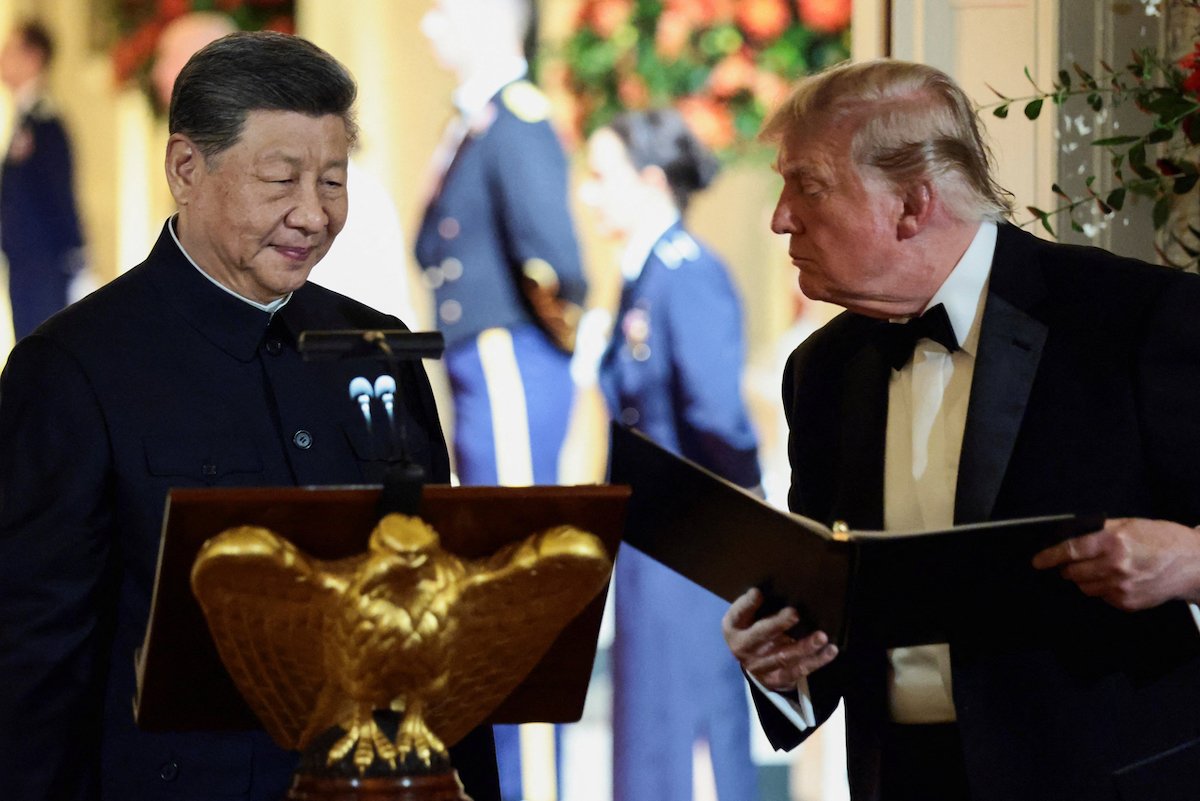
Beyond the ceremonial grandeur of Xi Jinping's state visit to Washington, the Chinese leader pursued a clear strategic objective: to weaken the American-Japanese partnership. By all indications, he succeeded beyond expectations.
Japanese policymakers anticipated this move. They arranged a brief, seemingly reassuring meeting between Prime Minister Takaichi Sanae and Donald Trump on the sidelines of the UN General Assembly, ahead of Xi's arrival. But the next day, Trump welcomed Xi by fondly recalling "the greatness that we had together fighting in World War Two," omitting any mention of the postwar alliance with Japan. Xi, at the official banquet, made the point explicit: "Over 80 years ago, the Chinese and American people stood shoulder to shoulder in the fight against Japanese militarist aggressors." Notably, he glossed over the fact that wartime China was led by the Nationalists, not the Communists who now rule.
The joint statements from both governments echoed this wartime alliance language, a deliberate framing that serves Beijing's broader diplomatic campaign against Tokyo. As scholar Mike Mochizuki of the Quincy Institute told Toyo Keizai, "Clearly, Beijing would like to drive a wedge between Trump and Takaichi, but Takaichi clings to Donald while Donald does not return the favor by calling her Sanae."
Wartime history as a diplomatic weapon
This invocation of the past is part of a sustained effort to pressure Japan over Prime Minister Takaichi's remarks on a potential Taiwan contingency and to paint Japan's defense buildup as a revival of wartime militarism. Trump, apparently delighted by his role as host, either ignored the strategic intent or failed to grasp the trap. "Trump's failure to grasp that the United States had allied with a different China and fought a different Japan will only invite more Chinese coercion," warned Mireya Solis, a senior Japan expert at the Brookings Institution.
The wedge strategy may not be fully effective. The US-Japan alliance remains anchored in security establishments whose bonds have "deepened enough to prevent a US-Japan estrangement even under Trump," Mochizuki noted. Yet Japanese officials are clearly rattled. The Prime Minister's office felt compelled to tell the Yomiuri Shimbun that during a phone call with Trump after the Xi visit, the president reassured her he had not sided with Xi in criticizing Japan. A recently retired senior State Department official expressed skepticism: "I'd be surprised if Trump spoke in detail about Japan with Xi."
China's campaign against Takaichi
China's criticism of Japan intensified after Takaichi's victory in the Liberal Democratic Party presidential election last October. Even before her remarks on using Japanese forces in a Taiwan crisis, Chinese officials warned of her administration as a triumph of "new conservatives" favoring defense buildup and close ties to pro-independence forces in Taiwan.
Takaichi's unapologetic views on the war are well known in Beijing. In 1994, as a young Diet member, she challenged then-Prime Minister Murayama Tomiichi for his acknowledgment of Japan's wartime aggression. Later, Murayama issued his landmark statement apologizing for "colonial rule and aggression." Takaichi rejected it: "You can't just apologize on my behalf without my consent," she said, viewing the war as "legally justifiable." She later pledged to revise the Murayama Statement, arguing that Japan "fought wars for self-preservation and self-defense."
When Takaichi met Xi on the sidelines of the APEC summit in Korea in late October, the Chinese leader pointedly challenged her. "We should widely promote the spirit of the Murayama Statement," he reportedly told her, "which reflected on the history of aggression and apologized to victimized countries."
In this sense, Takaichi has handed Beijing an opening. "Takaichi shares Abe's revisionist views of history but lacks Abe's pragmatic and prudent judgement," Mochizuki said. "So it is not surprising that China has linked Taiwan, Japanese imperialism, and Japan's defense buildup together to criticize what they see as Japan's neomilitarism."
The campaign continued during former Foreign Minister Iwaya Takeshi's visit to Beijing in late September. Chinese Foreign Minister Wang Yi tied the talks to the anniversary of the Tokyo war crimes trials, warning that if Japan "does not learn lessons from history and challenges the postwar 'Peace Constitution,' tries to revive its history of aggression and resurrect war criminals, it will not even be able to face the world."
Behind the war rhetoric, Wang's talks with Iwaya also signal an effort to reach out to Japanese figures who view Takaichi's anti-China stance and reliance on the unpredictable Trump as a mistake. Iwaya, along with former Prime Minister Ishiba Shigeru, is among those clearly opposed to the Prime Minister's policies toward China. The internal Japanese debate over how to balance relations with Washington and Beijing is intensifying, with China's wartime narrative adding a potent layer of pressure. As the alliance weathers this storm, the region watches closely—especially given the broader geopolitical rifts that continue to shape Asian diplomacy.