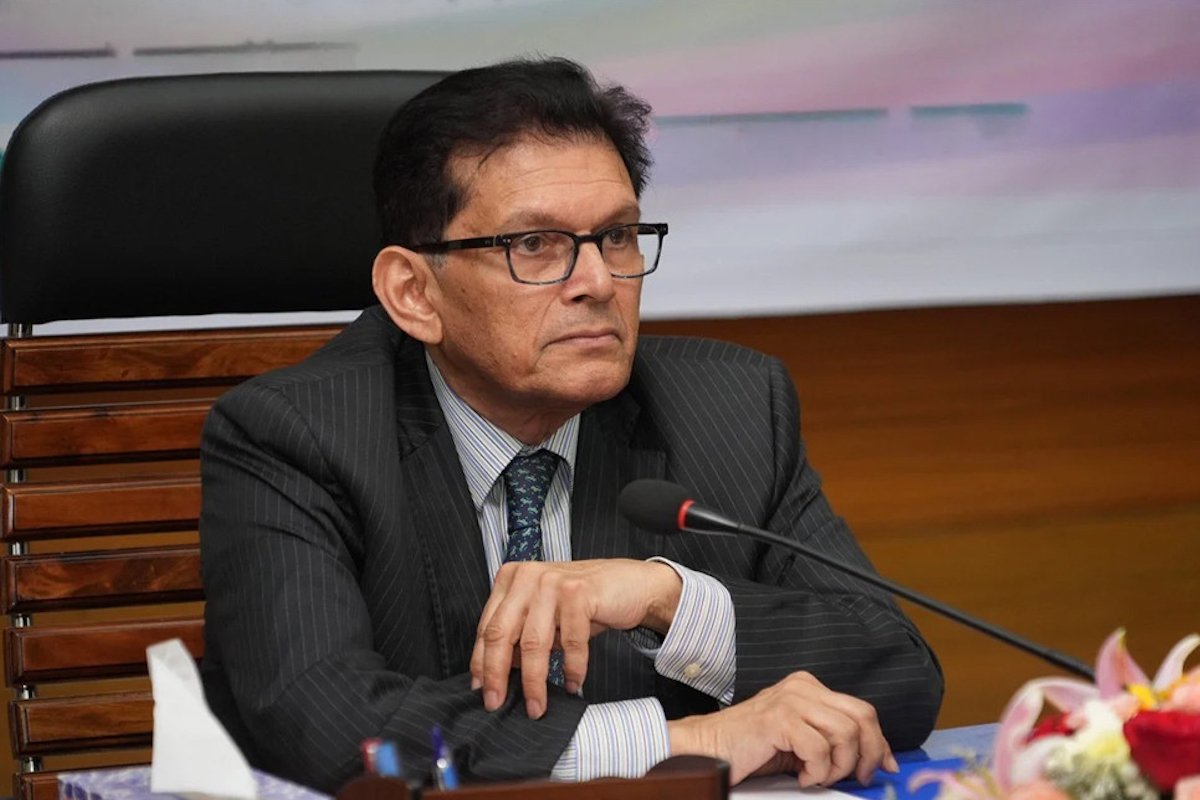
In Bangladesh's turbulent political landscape, few figures have demonstrated the staying power of Dr. Khalilur Rahman. Neither a party ideologue nor a conventional bureaucrat, he has emerged as the master of strategic ambiguity—a diplomat who thrives in the gray zones between competing powers.
His appointment as foreign minister under Prime Minister Tarique Rahman's government surprised even ruling Bangladesh Nationalist Party (BNP) insiders. Just months earlier, while serving as national security adviser under Muhammad Yunus's interim administration, Rahman faced open hostility from BNP figures who questioned his outsider status. Yet he not only survived the transition but emerged stronger, a feat rare in a country where political purges are the norm.
The Technocrat's Toolkit
Rahman's credentials set him apart. He topped Bangladesh's civil service examination in 1977, graduated first in economics from the University of Dhaka, and earned advanced degrees from Tufts University's Fletcher School and Harvard's Kennedy School. His decades at the United Nations in Geneva and New York gave him a global perspective that few Bangladeshi diplomats possess.
This international pedigree allows Rahman to speak fluently to both domestic political paranoia and foreign capitals' expectations. He moves through crises with an ease that appears either deeply strategic or recklessly improvised, depending on the observer.
His recent state visit to China exemplifies this approach. The joint statements from Dhaka and Beijing promised eternal cooperation and deeper economic ties. Yet critics note that Bangladesh's recent agreement with the United States reportedly contains clauses that could complicate large-scale Chinese investments without Washington's approval. Rahman stands in the middle of these contradictions without appearing cornered.
More remarkably, he revived discussions on China's involvement in the long-stalled Teesta River management project—an issue historically entangled with India's regional sensitivities. Even Sheikh Hasina's government, seen as exceptionally close to New Delhi, approached this cautiously. Rahman reopened the conversation with notable confidence.
Balancing India and China
His handling of India may be his most impressive balancing act. Relations between Dhaka and New Delhi deteriorated sharply during the Yunus-led interim administration, with Indian media portraying Bangladesh's transition as chaotic. But after Tarique Rahman's government took office, the tone shifted. Indian strategic circles began speaking about pragmatism and cooperation, with editorials advocating recalibration appearing frequently.
Diplomatic sources attribute part of this shift to Rahman's intervention. Whether this reflects genuine strategic brilliance or his ability to tell every side what it wishes to hear depends on one's ideological loyalties.
Bangladesh's geopolitical position is unusually delicate. The country depends on both Chinese investment and Indian cooperation, while maintaining ties with Washington. Rahman's critics see contradiction everywhere; his supporters see flexibility. The truth may be that modern diplomacy increasingly rewards exactly this kind of ambiguity.
As India and Bangladesh weigh political fixes for strained ties, Rahman's role becomes more critical. His ability to navigate these tensions without alienating any major power defines his approach.
Yet questions remain. Can strategic ambiguity sustain Bangladesh's interests indefinitely? As Bangladesh's power sector faces monumental challenges, the country needs more than diplomatic finesse. Rahman's success will ultimately be measured by tangible outcomes—investment flows, infrastructure projects, and regional stability.
For now, he remains the indispensable man, calibrating every ambiguous statement toward a larger geopolitical design. Whether that design is genuine strategy or polished improvisation may no longer matter. In an era of fractured truths, ambiguity itself has become a form of power.