When Russian President Vladimir Putin hosts Southeast Asian leaders in Kazan from June 17 to 19 for the ASEAN-Russia summit, the gathering will test whether the regional bloc can maintain its policy of excluding Myanmar's military junta from high-level diplomatic engagements. The Kremlin has confirmed that invitations are being prepared, and Myanmar's junta-controlled foreign ministry has already discussed summit preparations with Russia's ambassador in Naypyitaw.
The stakes are high because Myanmar currently serves as ASEAN's country coordinator for dialogue relations with Russia. While there is no public confirmation that coup-maker Senior General Min Aung Hlaing has been formally invited, the risk of his participation is glaring. ASEAN leaders took a firm stand at the 48th ASEAN Summit in Cebu in early May by keeping Min Aung Hlaing out, despite his staged election and new presidential title. The Chair's Statement acknowledged "minimal progress" on the Five-Point Consensus and denounced violence against civilians.
But exclusion alone is not a strategy. After five years of war, "deep concern" is no longer a policy. For Myanmar's people, ASEAN's habit of delay is becoming indistinguishable from abandonment.
Delay Measured in Blood
The military has given ASEAN no reason to reward its claims of peace or stability. ACLED data cited by the UN Special Rapporteur shows military airstrikes on civilian targets rising from nine in 2021 to 1,140 in 2025. The Office of the UN High Commissioner for Human Rights (OHCHR) reported in February that credible sources had verified the killing of more than 7,700 civilians since the coup, including over 1,650 women and 1,000 children. Its annual update found that 2025 was the deadliest year for children since the coup, with military airstrikes killing at least 982 civilians that year alone—a 52 percent increase from 2024.
The UN's Independent Investigative Mechanism for Myanmar reports that children were killed or injured in at least 640 airstrikes between the coup and 2025. As recently as May, an air attack killed at least five children at a playground in Chin State. During the military-controlled election period, the UN reported at least 170 civilians killed by airstrikes.
These are not arguments for patience. They are the cost of it: bodies, prison cells, and children afraid to sleep, study, or play. The crisis is not confined to Myanmar's borders. The UN Special Rapporteur reports that armed conflict, cyber scam operations, drug trafficking, and refugee flows are now affecting neighboring countries' sovereignty and citizens.
A Consensus That Buys Time
The Five-Point Consensus was meant to stop the violence, deliver aid, and begin inclusive dialogue. Instead, it has become a waiting room where the junta makes gestures, ASEAN issues statements, and civilians continue to die. The bloc is deeply divided. Thailand favors greater engagement with Naypyidaw. Malaysia's foreign minister, Mohamad Hasan, after visiting Naypyidaw on May 19, called the junta's apparent openness to bringing "all parties" together a "positive development." But a softer tone from Naypyidaw is not proof that the killing will stop. The real test is whether the military acts on demands for an end to hostilities and an extended ceasefire rather than merely receiving new diplomatic attention.
This exposes the danger of ASEAN's consensus rule: it allows the governments most willing to accommodate the military to dictate the speed of the region's response. Min Aung Hlaing understands this perfectly. His foreign ministry complained after Cebu about "discriminatory measures" and "equal representation." This is classic military logic: seize power, jail elected leaders, stage an election, and then demand recognition as the victim of unfair treatment.
His allies are also not waiting for ASEAN. Both China and Russia are already treating the rebranded regime as a new political reality. They are the military's chief enablers, acting not just as critical suppliers of advanced weapons and spare parts, as identified by the UN Special Rapporteur, but as diplomatic shields for the junta at the United Nations and beyond. As we have noted in our analysis of China and Russia's strategic partnership, mutual suspicion between Beijing and Moscow does not prevent them from cooperating on issues like Myanmar. If ASEAN now relaxes its position while Moscow and Beijing continue to give the junta military and diplomatic room to survive, it will not protect ASEAN centrality. It will surrender it.
Pressure Before Normalization
Before Kazan, ASEAN leaders must make clear that they will not accept Min Aung Hlaing's participation in leader-level ASEAN engagement unless the military delivers measurable action: an immediate halt to airstrikes and indiscriminate violence; verified access and freedom to Aung San Suu Kyi and political prisoners; humanitarian delivery without military gatekeepers; and inclusive talks with democratic and ethnic resistance forces. Any engagement with Naypyidaw should come with time-bound and verifiable commitments, backed by hard consequences for failure. Member states must block the flow of arms, dual-use goods, and jet fuel, and investigate the companies and financial channels that keep the military's aircraft in the sky.
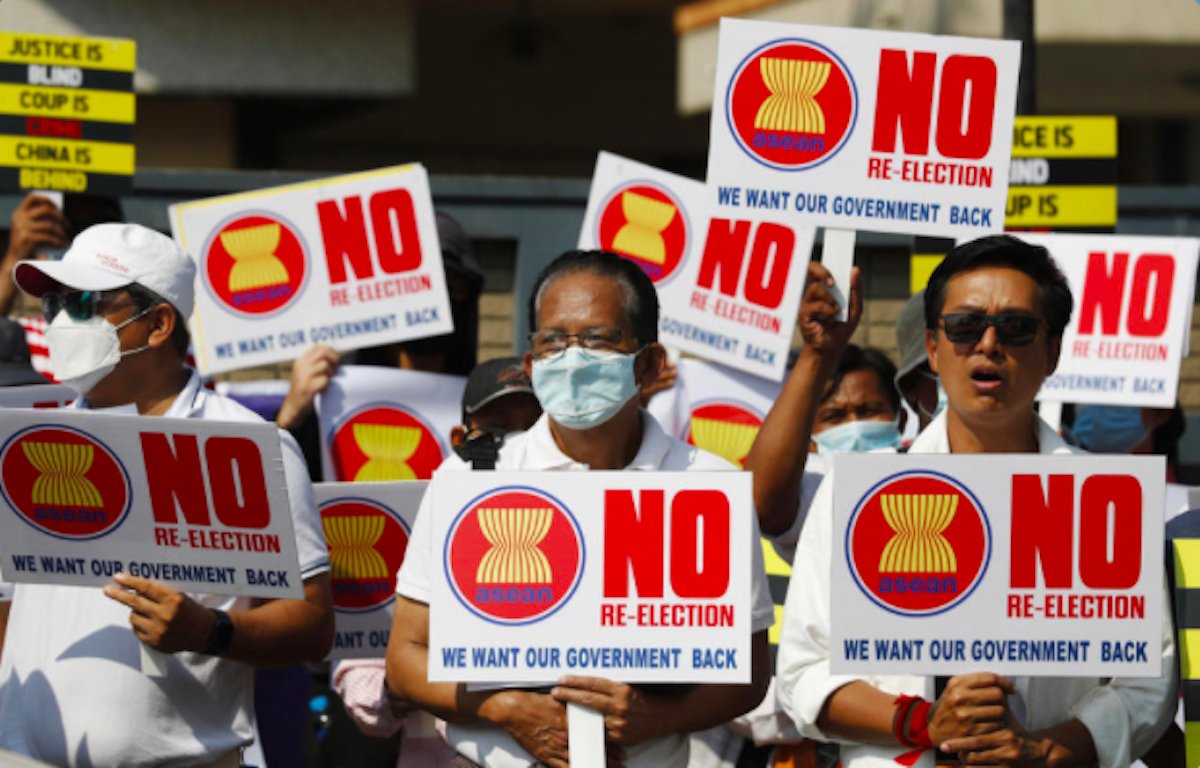
ASEAN must also formally engage the National Unity Government (NUG), the major anti-junta force and ethnic resistance organizations, and civil society. In many areas outside military control, local authorities linked to the NUG or ethnic groups administer communities and provide basic services. Speaking only to Naypyidaw is not neutrality—it is complicity. The bloc's credibility in the Indo-Pacific depends on whether it can move beyond statements and enforce real consequences. As we have argued in our piece on Europe's response to the junta's Suu Kyi ruse, the international community must not be fooled by cosmetic gestures. For Myanmar's people, ASEAN's vacillation is a death sentence.