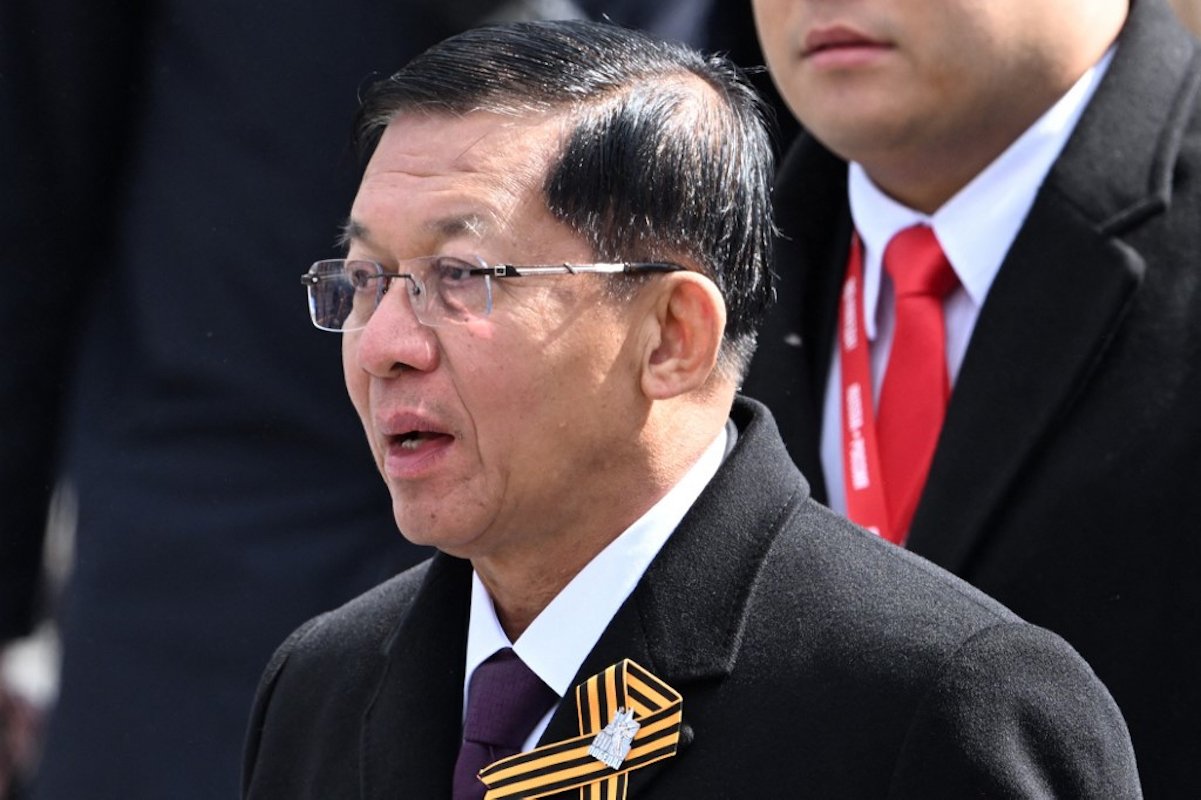
After five years of conflict and a tightly controlled election, Myanmar's junta leader, Senior General Min Aung Hlaing, has traded his military uniform for a civilian suit, declared himself president, and begun speaking of peace and reconciliation. The release of elected President Win Myint, a reduction in Aung San Suu Kyi's sentence, and her transfer to house arrest all appear designed to burnish this new image.
Yet these cosmetic moves do not signal a genuine democratic transition. They are part of a political makeover by a military ruler who still cannot claim control over the country he purports to govern. To understand Myanmar in 2026, one must look at the battlefield rather than the speeches emanating from Naypyitaw.
The Map of Resistance
The coup-installed regime controls the capital, major airports, and the urban cores of Yangon and Mandalay. Beyond these centers, however, its authority fades rapidly. In areas where rebel forces hold sway, the military resorts to bombing, raids, and blockading transit arteries. It punishes civilian populations rather than governing them.
Myanmar is no longer a classic civil war with a central state fighting rebels on the margins. Since the 2021 coup, armed resistance has spread into central Myanmar, breaking the old center-periphery pattern. The conflict is now fragmented, with rival claims to legitimacy and multiple armed groups exercising power and control. The anti-coup National Unity Government (NUG) claims democratic legitimacy from the 2020 election and has built parallel armed and administrative structures, including People's Defense Forces (PDF)—some of which it controls, many others it does not.
ISP-Myanmar estimated in January that the regime had lost control of roughly 38% of the country's territory and had not recovered at least 150 overrun bases. A 2025 ISEAS study claimed that anti-junta armed groups controlled as much as half the country, while the military held only about a quarter. Figures may differ, but the broad picture is clear: Myanmar's map does not support the regime's claim of restored national control, and its recent tactical gains do not represent stabilization.
Siege in Rakhine, Stalemate Elsewhere
In northwestern Myanmar, the regime recently retook Falam, Chin State's second city, after a six-month offensive involving ground assaults and heavy airstrikes. The recapture is a reminder that the junta can still concentrate firepower. But Falam does not indicate the revolution is waning. Resistance forces remain active across Chin State, and retaking a town is different from holding territory, governing people, reopening roads, and restoring legitimacy.
The same is true in Magway, where the military recently seized Kangyi village in Saw Township—a strategic route to Chin State and onward toward Paletwa near the Rakhine State border. The move appears aimed not only at local control but at tightening pressure on routes feeding into Rakhine. That matters because Rakhine State remains one of the clearest examples of the junta's loss of authority. The Arakan Army now controls most of the state except for three townships, and the military is reduced to defending a few remaining strategic pockets, including Sittwe, Kyaukphyu, and Manaung. Recent reports describe Arakan Army pressure around Sittwe, with the regime responding through naval blockades and airstrikes. The junta's rule is less governance than a siege in Rakhine.
Across Myanmar, crisis monitoring continues to describe clashes, displacement, airstrikes, and insecurity across multiple regions, including the central heartland. In Karen State, resistance forces reportedly captured regime positions over the Myanmar New Year holidays in April, while fighting along the Thai-Myanmar border remained intense. In the north, the Kachin Independence Army and allied anti-junta forces have expanded their influence, seizing towns, border crossings, and rare-earth mining areas. The battle for Bhamo, near routes linking central Myanmar, northern Kachin, and the China border, has become one of the country's most important fronts.
Northern Shan State tells a different story. Operation 1027, launched by the Three Brotherhood Alliance, exposed the military's weakness but also revealed the limits of gains in a war shaped by outside actors, especially China. Formally, this is still Myanmar's internal war. In practice, Beijing is shaping parts of the battlefield by pressuring armed groups it tacitly supports or arms, and seeking to secure trade corridors near its border.
Geopolitical Stakes
Myanmar's conflict is also geopolitical. The country sits between China and India, linking South and Southeast Asia. Rakhine State is especially critical: China sees Kyaukphyu as a route to the Indian Ocean, while India has connectivity interests through the Kaladan project and Sittwe port. When the military blocks roads between Magway, Chin, and Rakhine, or when the Arakan Army dominates much of Rakhine, the issue affects trade routes, border stability, humanitarian access, and the geopolitical calculations of Beijing and New Delhi. The junta's inability to control these areas also fuels transnational crime, as Myanmar's scam centers continue to operate with impunity, directly harming consumers abroad.
Foreign governments must be careful not to confuse Min Aung Hlaing's new title with a new reality. The junta's so-called transition is not ending the war—it is simply trying to repackage it. The 100-day talks proposal is less a breakthrough than another attempt to turn military setbacks into political cover. As long as the battlefield remains fragmented and the regime's authority confined to a shrinking core, Myanmar's political makeover will remain a facade.