Two events in Myanmar this past week, seemingly separate, are in fact two faces of the same strategy. On July 28, courts in Mandalay sentenced nine peaceful protesters to prison terms of up to 37 years, using the junta's "election protection" law and a counter-terrorism statute. Their offense: a December 2025 flash rally urging a boycott of the staged vote and an end to forced conscription. The lead defendant, 24-year-old Htet Myat Aung, was a Yangon University student union president.
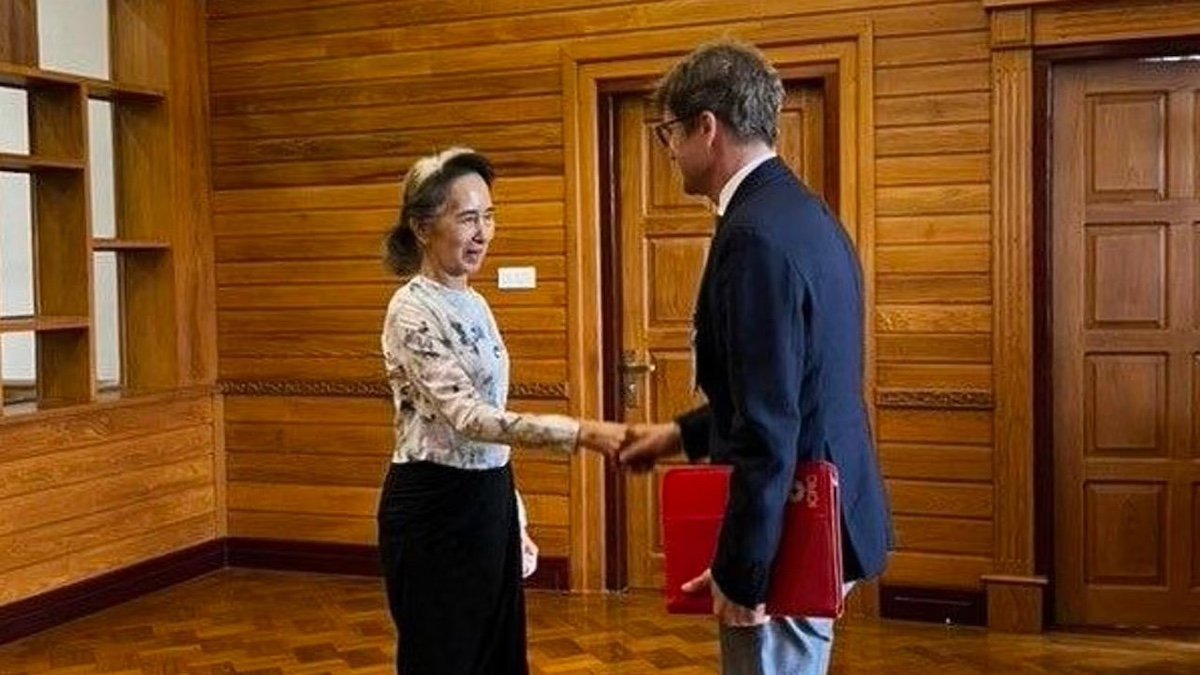
Days later, on August 3, the junta released four photographs of Aung San Suu Kyi—the first images of the deposed civilian leader in over five years—showing her seated in a wood-paneled room with a representative of the International Committee of the Red Cross (ICRC). State media announced the visit before the ICRC confirmed it in its typically restrained language, noting that a delegate had spoken with her privately under standard detention procedures.
These events are not opposites; they are the same phenomenon at different scales. Both deploy the vocabulary of law—statutes, courts, humanitarian protocols—as tools of coercion or legitimacy. Both occur as ASEAN is being quietly urged to accept the junta as normal. This push is framed by a fashionable argument in regional policy circles: the rules-based international order is dead, and a "new realism" demands that Southeast Asian states abandon outdated norms.
Myanmar's own diplomacy this week refutes that argument. If rules were truly obsolete, Naypyidaw would not need to release a photo of Suu Kyi with the ICRC. It would simply proceed with Min Aung Hlaing's state visit to Thailand—his first since installing himself as president in April—and dare anyone to object. Instead, the junta staged a proof-of-life tableau on the eve of that trip, and Thailand's Deputy Prime Minister Sihasak Phuangketkeow issued a formal statement welcoming the ICRC meeting "especially… in light of the upcoming visit of the President of Myanmar to Thailand."
The choreography is complete: the junta produces a gesture, Bangkok reciprocates with diplomatic warmth, and the reciprocity becomes the currency for quietly buying legitimacy. As several regional analysts noted on August 3, the visit functions as a diplomatic gift to Thailand—and, in the same motion, as a wedge between Thailand and the rest of ASEAN.
A Softer Benchmark
That wedge was laid weeks earlier. At the July 12 informal ASEAN meeting in Bangkok, Sihasak proposed four "indicators of progress" that quietly substituted a "reduction of violence" for the Five-Point Consensus's original standard of "immediate cessation of violence." At the same press conference, Philippine Foreign Secretary and ASEAN Chair's Special Envoy Maria Theresa Lazaro held the original line, calling for "concrete actions towards the cessation of hostilities."
Thailand was offering the junta a softer benchmark on the eve of a state visit; the ASEAN Chair was holding the harder one. Ten days later, on July 23, the junta's foreign ministry issued a formal statement explaining why its proxy parliament had voted to reject the Five-Point Consensus outright, invoking the ASEAN Charter, the 2008 Constitution, and "sovereignty and non-interference."
A regime that believed the rules were finished would not spend diplomatic capital on legal argumentation. It would not need Sihasak's softened language. It would not need the photograph. The theater is the evidence.
The Photo's Hollow Promise
Examined carefully, the photograph shows how empty this compliance is. The ICRC's own working standards for detention visits require unrestricted access to all detainees at all stages, the ability to repeat visits as often as necessary, access to all premises, and—critically—the restoration of family links. The August 3 meeting was Suu Kyi's first known contact with any foreign visitor in more than five years. Her son Kim Aris, in London, said he still has no direct contact with her, no independent confirmation of her condition, no lawyer visits, no diplomat access, and no family access.
He is asking for exactly what the ICRC's standards and the UN Standard Minimum Rules for the Treatment of Prisoners—the Nelson Mandela Rules, adopted by consensus in 2015—require for every criminal prisoner: regular family communication, access to independent medical care, and access to legal counsel. One managed photo-op, five years into isolation, does not satisfy those baseline norms even for an ordinary convict. And Suu Kyi is not an ordinary convict.
She is a political prisoner recognized as arbitrarily detained by the UN Working Group on Arbitrary Detention in six separate opinions across two decades, most recently for trials the UN Special Rapporteur called a "sham." She is one of an estimated 15,000 to 20,000 political prisoners in the country, all held under the same regime that just produced this photograph.
The realist turn, correctly examined, strengthens the case for holding the line. The states pushing the "new realism" thesis loudest—the United States, China, Russia—can walk away from rules because their size lets them substitute power for law. That is why they cherry-pick. Middle and small powers cannot. For sovereignty-minded ASEAN states, and for Australia, Japan, South Korea, and the EU, predictable procedure substitutes for size. It keeps trade routes open, borders respected, and disputes manageable.
Thailand's gambit may buy short-term favor with Naypyidaw, but it undermines the very framework that protects smaller states. As ASEAN diplomacy stalls, the junta consolidates gains. The photo of Suu Kyi is not a sign of progress; it is a reminder of how far the regime will go to manufacture legitimacy while continuing its brutal repression. The international community should see it for what it is: proof of nothing.