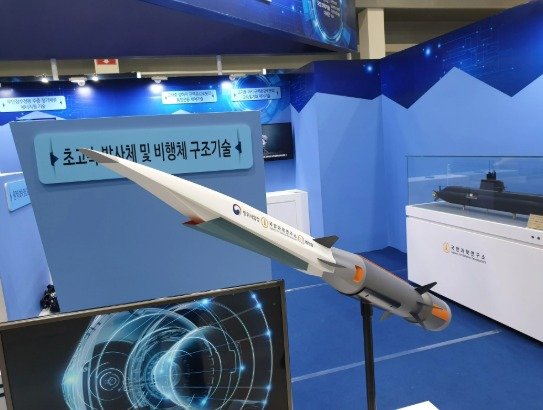
South Korea's first flight test of a domestically developed hypersonic glide vehicle marks a significant step in its effort to field high-speed conventional strike assets capable of penetrating regional missile defenses. The test, overseen by President Lee Jae-myung, underscores Seoul's drive to reduce reliance on the United States and strengthen its own deterrence against North Korea's expanding nuclear arsenal.
The weapon was launched from a barge off Taean, about 130 kilometers south of Seoul, according to reports. After separating from its booster at high altitude, the glide vehicle descended and maneuvered both horizontally and vertically at low altitude to strike an offshore target. The test validated guidance systems and ultra-high-temperature thermal shielding, key technologies for hypersonic flight.
The timing is notable: it follows a September border land mine blast that wounded South Korean soldiers and comes days after North Korea tested an intermediate-range hypersonic missile. Lee, who inspected the military's bunker-busting Hyunmoo-5 ballistic missile, urged researchers to accelerate deployment of the strategic deterrent.
Counterstrike doctrine meets hardened reality
Seoul's push for hypersonic capabilities fits into its broader "Three-Axis System" outlined in the 2022 Defense White Paper. This doctrine includes the preemptive "Kill Chain" to detect and neutralize imminent nuclear and missile threats, the Korea Air and Missile Defense (KAMD), and the Korea Massive Punishment and Retaliation (KMPR) plan. Hypersonic missiles are seen as a flexible, survivable tool to strike hardened targets without resorting to nuclear escalation.
However, analysts caution that such assets face formidable obstacles. North Korea operates an estimated 15 to 20 undeclared ballistic missile bases, heavily hardened with underground facilities, protective berms, and reinforced drive-through bunkers. Bases like Sakkanmol, Sino-ri, and Sangnam-ni serve as dispersal hubs for conventional and nuclear first-strike capabilities against South Korean, Japanese, and US forces.
Markus Garlauskas and colleagues, writing for the Atlantic Council in August 2026, argue that non-nuclear hypersonic missiles are a viable counterstrike option to deter and respond to limited North Korean nuclear attacks. They recommend integrating "new US and allied non-nuclear counterstrike options such as hypersonic missiles" alongside South Korea's heavy penetrating ballistic missiles to strike hardened targets.
Yet the sheer number of North Korea's mobile launchers poses a significant operational challenge. In August 2024, Kim Jong Un oversaw the delivery of 250 tactical ballistic missile launchers to front-line troops. Detecting and destroying hundreds of mobile launchers and underground facilities within a compressed launch window could severely strain South Korea's intelligence and strike capacities.
Chang-Young Lee, writing in War on the Rocks in September 2025, highlights that South Korea's intelligence, surveillance, and reconnaissance (ISR) capabilities lack a sovereign, persistent space architecture. Seoul depends heavily on US and Japanese data feeds to track North Korean nuclear sites, creating blind spots if Washington reprioritizes assets toward other regional contingencies.
North Korea has also diversified its delivery systems, including solid-fuel intercontinental ballistic missiles like the Hwasong-18, which can be launched with little warning. Sea-based options, such as the Amnok-class corvette potentially armed with nuclear cruise missiles, further complicate defense planning.
Despite these hurdles, South Korea's hypersonic test signals a determination to build a more autonomous deterrent. As Lee Jae-myung balances diplomacy with deterrence, the challenge lies in closing the gap between ambition and capability. The path forward may require deeper trilateral cooperation with the US and Japan, as well as investments in space-based ISR and resilient command structures.
For now, Seoul's hypersonic leap is a clear message: it intends to counter North Korea's nuclear wall with a high-tech spear. Whether that spear can pierce the wall remains an open question.