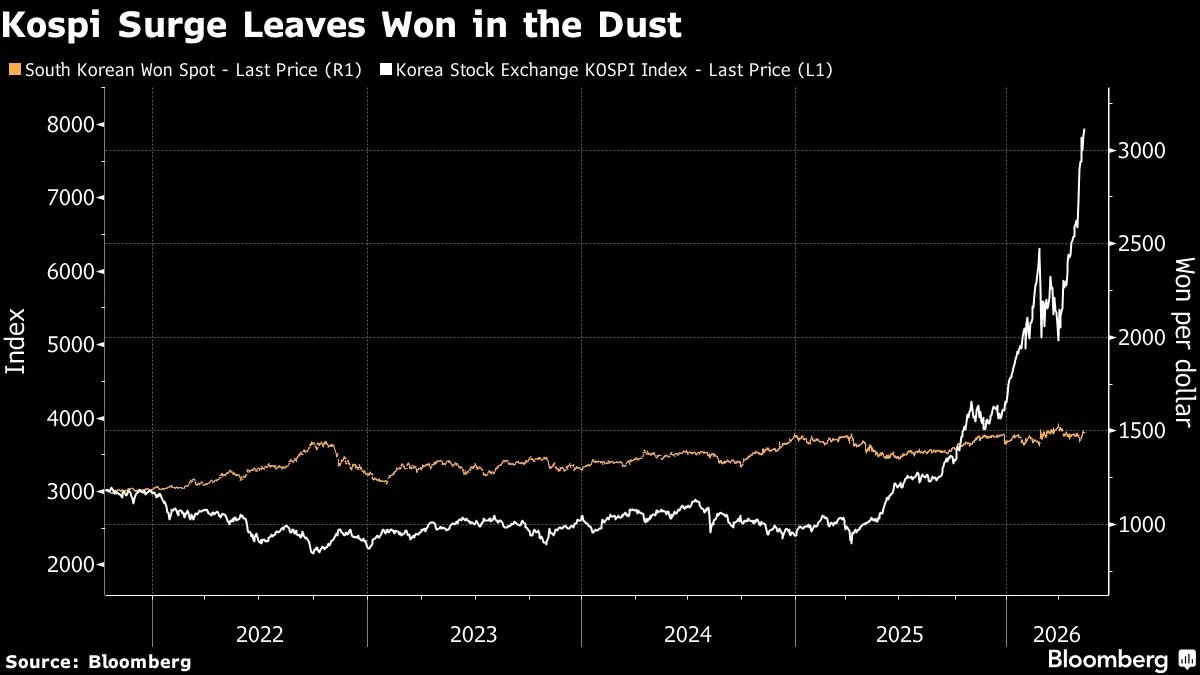
In Seoul, a striking market divergence is unfolding. The Kospi index has soared 85% since January and 200% over the past year, fueled by an artificial-intelligence frenzy that has lifted tech giants SK Hynix and Samsung Electronics to extraordinary heights. Yet the South Korean won has slumped 4.5% this year, making it one of Asia's weakest currencies and hovering near levels last seen during the 2009 global financial crisis.
President Lee Jae-myung, who took office in June 2025 after promising to double the Kospi to 5,000 over his five-year term, has seen the index blow past 8,000 in under a year. But the won's slide is marring his market triumph. The currency has drifted steadily lower even as stocks have soared, a disconnect that economists say signals deeper structural problems.
The Korea Discount Persists
Despite the stock rally, South Korea still suffers from the long-standing "Korea discount," which keeps local equities priced below global peers. MSCI has repeatedly withheld developed-market status, citing outdated rules, ownership limits, and insufficient currency convertibility. In June 2025, MSCI rejected Korea's upgrade request again, stating that "developed markets typically feature fully convertible currencies with active, unconstrained offshore and onshore forex markets."
Foreign investors have become net sellers of Kospi shares this year, with outflows topping US$62 billion. "Foreigners became huge sellers of domestic assets," notes economist Paul Cavey, founder of East Asia Econ. Part of the worry is that AI made it too easy for President Lee's team, and that the market is too frothy for comfort.
Citigroup analysts recently raised the specter of "irrational exuberance" dominating the Kospi, a phrase made famous by former Federal Reserve Chairman Alan Greenspan in 1996. "Although we believe it's too early for a severe market correction or the end of the bull market due to tightening financial conditions caused by interest rate factors, the Kospi appears significantly more overbought compared to the US market," Citi writes. "A prudent approach would be to take profits on half of the positions."
Currency Weakness and Inflation Pressures
The won's weakness is particularly concerning because South Korea has no fiscal problems or shortage of foreign exchange, according to Brad Setser, an economist at the Council on Foreign Relations. "Creative policy makers should be able to engineer a stronger won," he says. Setser recommends that Korea's giant National Pension System pause its accumulation of foreign assets, effectively selling dollars for won, and that the US join the Bank of Korea in directly supporting the currency. "It's time to be creative," he adds.
The surging US dollar is siphoning capital out of emerging markets and raising the risk of accelerated outflows from Korea. It also magnifies the country's exposure to soaring energy costs. With Middle East turmoil keeping oil in the $100 a barrel range, the shock poses a direct threat to Asia's fourth-largest economy. In March, Korea imposed nationwide fuel-price caps for the first time in nearly three decades, but inflation still accelerated. Consumer prices rose 2.6% in April from a year earlier, the fastest pace in about two years.
That leaves the Bank of Korea in a bind. The BOK has held rates steady since May 2025 after delivering four 25-basis-point cuts in the previous seven months. Though the BOK meets on May 28, it's not expected to start hiking its 2.5% benchmark until the second half of 2026. However, BOK Deputy Governor Ryoo Sang-dai recently warned it may be "time to consider stopping rate cuts, and thinking about increases" as inflation heats up.
Geopolitical and Economic Vulnerabilities
The longer the Strait of Hormuz stays closed, the more Korea's 2026 outlook unravels and the more vulnerable the AI-driven economy becomes. As inflation pushes bond markets into turmoil, the risk grows that capital will retreat from AI, data centers, and cloud infrastructure. Korea may become ground zero for a new clash between the "old economy"—surging commodity prices and other traditional pressures—and the "new economy" that AI is building in real time.
South Korea's market is being challenged from both ends amid domestic rigidities and global headwinds. The country's weighting in MSCI Emerging Markets Index recently increased to 21.7% from 15.4%, putting it in league with China's 22% weighting. But that doesn't mask the underlying tensions. As economist Kong Dong-rak of Daishin Securities notes, compared with the last policy meeting—when officials adopted a wait-and-see stance—the situation has become more precarious.
The AI euphoria that has propelled Seoul stocks to record after record is getting a reality check. The won's slide, inflation pressures, and geopolitical risks are all converging, testing President Lee's market aura and the resilience of South Korea's economy. For an informed audience watching the Indo-Pacific, this is a story of how even the most promising technological booms can be undermined by structural weaknesses and global shocks.