TOKYO — South Korea, long a bellwether for global economic shifts, is now flashing warning signals about the perils of staking its future on artificial intelligence. The country's $1.9 trillion economy, once defined by cars, ships, and smartphones, has pivoted almost entirely toward AI under President Lee Jae-myung, who took office in June 2025. But the market is showing signs of strain.
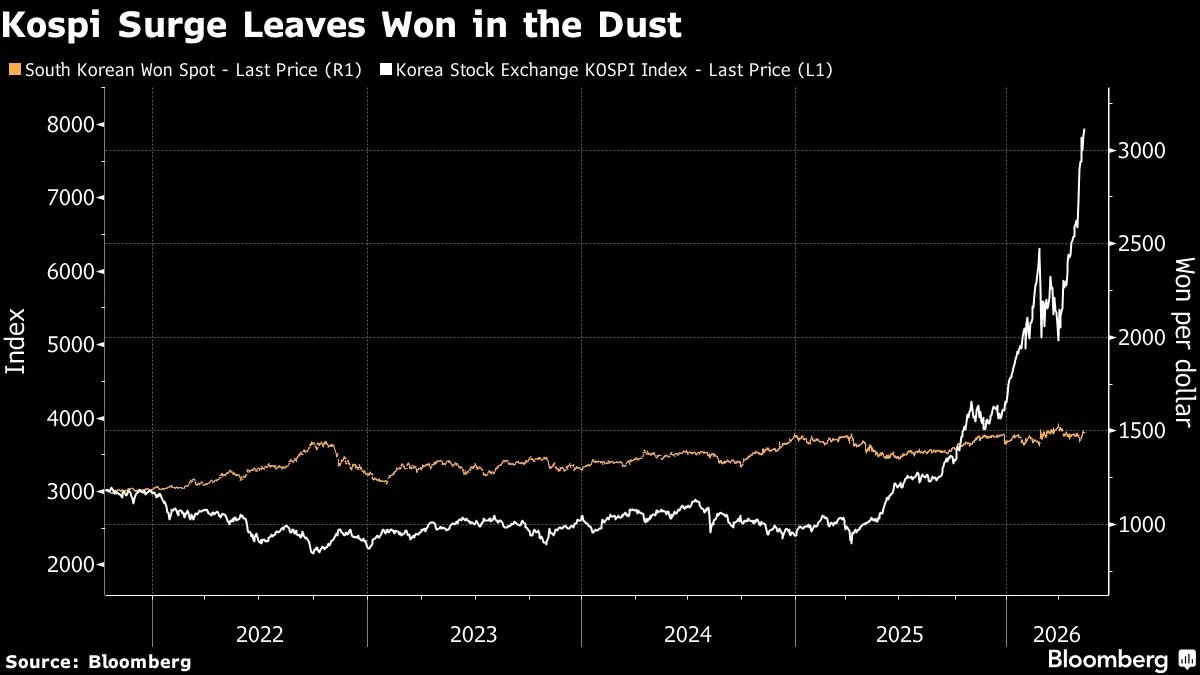
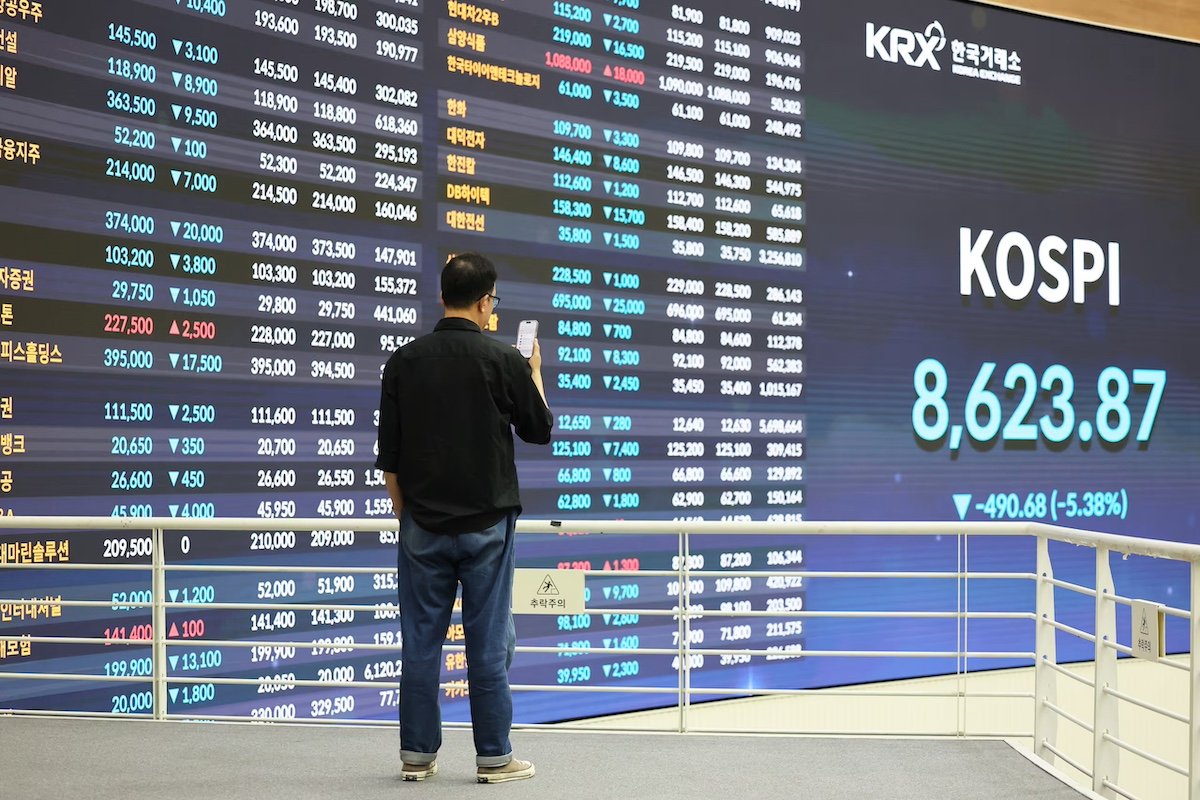
The Kospi index, valued at nearly $5 trillion, has been swinging wildly—erratic behavior for a top-10 global bourse. A rally powered by just two or three companies and an unproven technology now dwarfs South Korea's GDP by more than 2.5 times. Monday's 5% drop barely raised eyebrows; the index has hit 12 circuit-breaker halts in its history, six of them this year alone.
AI Hype Meets Market Reality
The sell-off came despite Samsung Electronics posting a record 1,800% year-on-year profit jump on nearly double sales. That scale unnerved investors, stoking fears that AI infrastructure spending is outpacing actual demand for machine-learning tools. “Markets need confident guidance, durable pricing power and proof that AI demand is still accelerating,” said Charu Chanana, chief investment strategist at Saxo Markets. The real question, she noted, is whether today's memory-chip shortage becomes tomorrow's glut.
Tickmill Group analyst Patrick Munnelly framed it similarly: investors haven't given up on the AI story, but they're testing whether a sector priced for perfection can keep delivering through earnings season.
That backdrop is particularly uncomfortable for SK Hynix, which debuts Friday in a $28 billion U.S. IPO—the largest ever by a foreign company, and many times oversubscribed. The turbulence heading into the listing likely isn't helping anyone sleep in Seoul's boardrooms, especially with SK Hynix up 639% year-to-date.
Regulators on Edge
South Korea's Ministry of Finance warned this week that concentration in the semiconductor sector is amplifying market-wide volatility, since swings in chip stocks now ripple through the entire index. The Financial Supervisory Service said it's watching the fallout from newly launched single-stock leveraged ETFs tied to chipmakers, scrutinizing how asset managers market them. The Bank of Korea said Sunday it's coordinating with other agencies on the same concentration risk.
This isn't just a Korean story. Taiwan is living a similar reality: betting on Taiwan increasingly means betting on Taiwan Semiconductor Manufacturing Co. AI chip demand pushed Taiwan's GDP up 13% year-on-year in the first quarter, its $976 billion economy just as leveraged to the AI cycle as Korea's.
Japan is heading that way, too. SoftBank has overtaken Toyota as Tokyo's most valuable company. The 588% year-to-date rally in Kioxia shares saw the memory maker leapfrog Toyota, and components supplier Taiyo Yuden is gaining on the automaker. The Nikkei 225 surged through 72,000, up from 50,000 on January 1, despite stagflation, falling real wages, and Bank of Japan rate hikes at a 31-year high. AI is lifting all financial boats.
What's striking is how completely AI has taken over Korea's growth model in months. Autos have gone flat, but nobody seems to mind—because the 61% jump in exports in the first 20 days of June is an AI story, not a car story. Semiconductors now account for 41.2% of total exports, up 18.3 percentage points from a year earlier, with chip exports alone up 188.4%.
The deeper worry: this isn't confined to one company or one stock. Korea is the world's 15th-largest economy, Taiwan the 22nd-largest, and both are tying their futures to a technology that hasn't yet proven it can generate returns to match the hype. It's a reversal of the diversification drive both pursued after the 1997 Asian financial crisis.
Seoul isn't hedging that bet—it's doubling down. Korea is backing AI with more than $102 billion in incentives, blurring the line between the sector and the economy itself. Late last month, Lee stood with the heads of Samsung and SK Hynix to announce corporate investment pledges of at least $880 billion, including $500 billion in new chipmaking plants far from the capital. As Lee frames it: “Balanced national development is no longer merely a policy objective—it has become a national survival strategy.”
But if global investors ever decide that titanic bets on monetizing AI—and the sprawling data centers underwriting it—are too risky, Korea won't be a bystander to the reckoning. It and the rest of Asia will be ground zero for the financial fallout should AI experience a dot-com-style reckoning. The U.S. faces its own risks, as Goldman Sachs strategist Ben Snider noted: “Sharp momentum factor rallies with the equity market near highs have historically boded poorly for subsequent S&P 500 returns.”
Looking through the lens of valuations, positioning, and sentiment, “all measures of asymmetry and risk are flashing amber,” said Oliver Shale, investment specialist at Ruffer LLP. “None of this is to say that the end is nigh, but that is a fragile setup for any market.”
For more on South Korea's political landscape, see South Korea's New Fake-News Law Tests the Limits of Democratic Power. On regional currency vulnerabilities, read Strong Dollar Pummels Asia's Vulnerable Currencies from Tokyo to Jakarta.