For decades, the relationship between Beijing and Pyongyang operated on a simple premise: North Korea needed China far more than the reverse. China supplied over 95 percent of North Korea's foreign trade—food, fuel, machinery, and electronics—creating a dependency that Beijing wielded as leverage, cloaked in the language of fraternal socialism. That era has ended.
Kim Jong Un has systematically dismantled this arrangement over the past four years, exploiting Russia's war in Ukraine to secure a new patron. In exchange for ammunition, artillery shells, and the deployment of 11,000 North Korean soldiers by late 2024, Pyongyang extracted between $7.7 billion and $14.4 billion from Moscow—more than North Korea's total foreign trade of $3.2 billion in 2025. Russia supplied advanced drone technology, air defense systems, anti-aircraft missiles, electronic warfare gear, and possibly a nuclear submarine reactor. President Vladimir Putin's two-day visit to Pyongyang in June 2024, his first since 2000, cemented this shift.
Xi's Pyongyang Visit: A Measure of Alarm
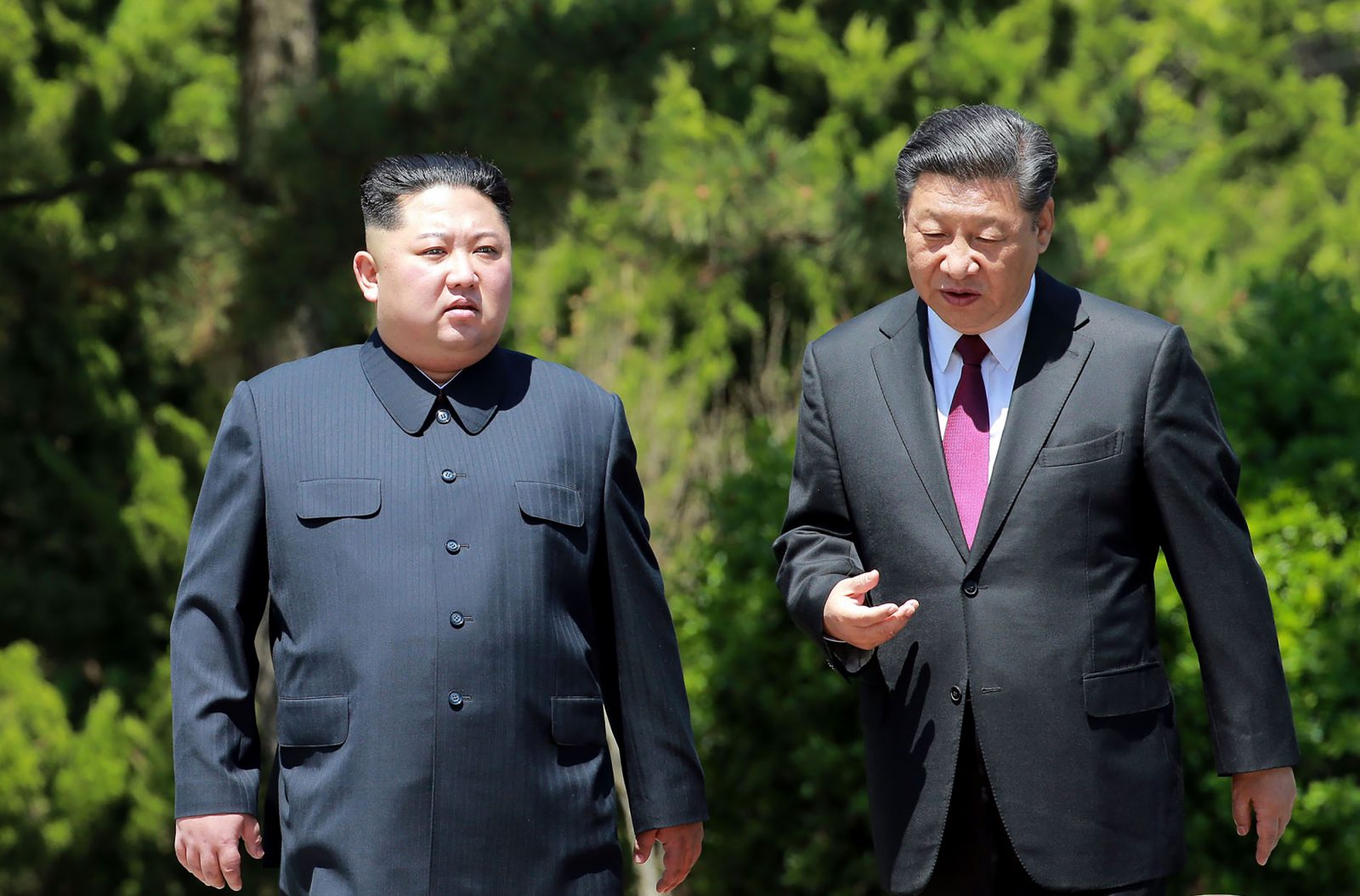
President Xi Jinping's first foreign trip of 2026 was not to Washington or Moscow but to Pyongyang—a stark indicator of Beijing's unease. Xi, who has drastically curtailed overseas travel since the pandemic, hosted over a dozen world leaders in Beijing this year, including Donald Trump and Putin. His choice to visit Kim Jong Un underscores the gravity of what analysts call the "patron problem."
The diplomatic elevation of Kim was on full display during Beijing's Victory Day parade on September 3, 2025, commemorating the 80th anniversary of Japan's World War II surrender. Kim stood on the rostrum alongside Xi and Putin, accompanied by his teenaged daughter and possible successor, Kim Ju Ae. They were greeted at Beijing Railway Station by Cai Qi, a member of the Standing Committee of the Chinese Communist Party Politburo, and Foreign Minister Wang Yi. This marked the first public appearance of Xi, Putin, and Kim together, and the first such trilateral display since Chairman Mao hosted Kim Il-sung and Soviet leader Nikita Khrushchev in 1959. Among 26 foreign leaders at the parade, only Putin and Kim were invited to tea and a banquet at the Great Hall of the People—a clear signal of Kim's newfound status.
Kim's response to former President Trump's overtures for dialogue was equally self-assured. When Trump expressed readiness to revive personal diplomacy, telling South Korea's prime minister in March 2026 that he had "maintained a good relationship with Chairman Kim," Kim replied: "If the US drops its hollow obsession with denuclearization and wants to pursue peaceful coexistence with North Korea based on the recognition of reality, there is no reason for us not to sit down."
Beijing's Nightmare: The Leash Is Gone
For Xi, this transformation is structural, not tactical. China renewed its 1961 Treaty of Friendship, Cooperation and Mutual Assistance with North Korea in 2021, Article 1 of which obligates immediate military assistance "by all means at its disposal" if either party is attacked. For seven decades, this made China North Korea's sole guarantor. But the 2024 Russia-North Korea Comprehensive Strategic Partnership gives Kim a second guarantor, fundamentally altering the balance.
Beijing's discomfort has been palpable. In October 2024, Xi pointedly omitted the traditional reference to North Korea as a "friendly neighboring state" in a reply to Kim's congratulatory message. Experts described this as policy paralysis: every option is bad. Beijing cannot afford to lose sway over Kim to Russia, destabilize a nuclear neighbor, or see Europe's war imported into Asia. The readout from the Xi-Kim meeting in September 2025 conspicuously omitted any mention of "denuclearization," a departure from all five previous summits.
Kim's defiance was underscored in May 2024, when North Korea launched a military satellite showcasing its deepening military cooperation with Russia, timed precisely as Premier Li Qiang attended the China-Japan-South Korea summit in Seoul. The message was clear: Pyongyang no longer dances to Beijing's tune.
Xi's visit to Pyongyang—marking the 65th anniversary of diplomatic ties—aims to manage a nuclear North Korea now aligned with Moscow. But the leash is gone. Kim Jong Un has played both patrons, rattled China, and emerged as a player in his own right. For more on how this reshapes regional dynamics, see our analysis of Xi's Pyongyang visit and how South Korea is navigating this new landscape.