South Korea, often celebrated as a vibrant young democracy, faces a growing challenge from a far-right movement that has drawn ideological and financial support from American allies. Just two years after mass protests in Seoul thwarted a self-coup attempt by then-President Yoon Suk-yeol, a network of reactionary groups is steadily consolidating power, leveraging corporate connections and social media to spread its message.
At the center of this shift is Chung Yong-jin, chairman of Shinsegae Group, the conglomerate that holds exclusive Starbucks Korea franchise rights. Chung, a longtime friend of Donald Trump Jr., has openly expressed far-right views on social media and used his business empire to bankroll the movement. He placed Mina Kim, a US-educated conservative Christian, on his payroll by allowing her anti-abortion diaper brand, EveryLife Korea, to be sold through his retail network. EveryLife, which describes its mission as “Make More Babies,” is a franchise of a US brand in which Trump Jr. holds a stake. In South Korea, it reaches millions through Chung's distribution channels.
From Coffee to Conspiracy: The Starbucks Korea Controversy
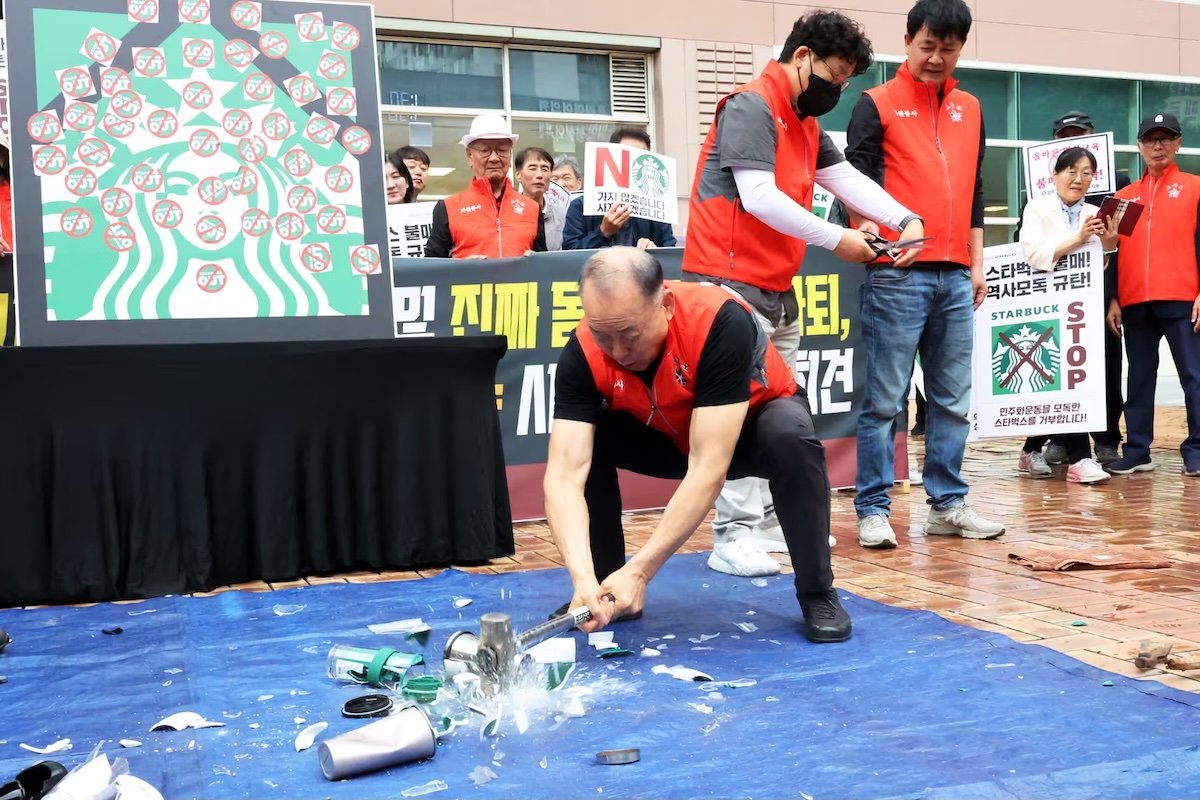
The movement's ties to corporate power became glaringly apparent in May 2025, when Starbucks Korea launched a reusable cup named “Tank” and promoted “Tank Day” on May 18—the anniversary of the 1980 Gwangju Uprising, when military tanks crushed civilian protests. The promotion sparked widespread outrage, leading to consumer boycotts. Starbucks Korea later closed over 2,000 stores early for historical awareness training, incurring losses of 2.1 billion won ($1.4 million). The incident highlighted how a marketing gimmick could be tailored to the chairman's political leanings, despite public sentiment.
Chung's influence extends beyond symbolism. He has effectively funded Build Up Korea, a far-right youth group founded by Mina Kim in 2023, modeled after Charlie Kirk's Turning Point USA. Kirk, a prominent US far-right influencer, was the keynote speaker at Build Up Korea's 2025 rally before his assassination in September that year. The event was fueled by free coffee from Starbucks Korea, donated by Chung's conglomerate. In a September 2025 interview, Kim jokingly asked Kirk if he would sue her for copying his tactics.
The far right has also adopted MAGA-style strategies, including meme warfare and social media campaigns. In June 2025, during a livestreamed baseball match in Seoul, players mocked opponents from Gwangju by chanting “Let's go to Starbucks” and “Tank Day.” Groups like Build Up Korea flood platforms with short videos and catchy songs to attract teenagers. In early June, hundreds of young protesters occupied Olympics Park in Seoul, claiming election fraud after ballots ran out at a polling station during a local election. They remain encamped, displaying banners with slogans like “Stop the Steal” and “CCP Out,” often in English.
The movement's ties to US conservatives are deepening. At the 2025 Conservative Political Action Conference (CPAC), commentator Gordon Chang, a China hawk, defended Yoon's coup attempt, framing South Korean liberalism as pro-China and pro-North Korea. At the 2026 CPAC, former South Korean Prime Minister Hwang Kyo-ahn, a conservative Christian, also spoke. These connections underscore a broader effort to align South Korea's far right with the global MAGA network.
This rise comes amid broader regional dynamics. South Korea's defense buildup and its alliance with the United States remain critical, as discussed in South Korea's Defense Buildup: Alliance Partner or Autonomous Power?. Meanwhile, the Bank of Korea's recent rate hike challenges global inflation narratives, as explored in Bank of Korea Rate Hike Challenges Fed's AI Inflation View. The far right's growth also raises questions about democratic resilience in a region where autocratic tendencies persist, as noted in Why Economic Openings Often Deepen Repression in Autocracies.
The movement's reliance on corporate patronage and US ideological imports poses a test for South Korea's institutions. While the government bears some responsibility for the election fraud claims—ballots ran out at a polling station—the broader trend reflects a deliberate effort to erode democratic norms. As the far right continues to gain traction, its impact on South Korea's political landscape and its relations with neighbors like Japan and China will be closely watched.