When American and South Korean officials describe the Republic of Korea's accelerating defense buildup, they often use the same enthusiastic language—but mean different things. For Washington, it is "alliance modernization": a redistribution of roles within the US-led security framework. For Seoul, increasingly, it is "autonomous defense": a long-term strategy to reduce dependence on American forces and technology.
Neither side has much incentive to dwell on the divergence, but the gap is becoming harder to ignore as President Lee Jae Myung's administration pursues a more independent military posture while the Trump administration demands allies shoulder more of the burden—without building alternatives.
Two Frameworks, One Buildup
Andrew Yeo of the Brookings Institution has described modernization as the Trump administration's shorthand for pushing allies to adapt to a changing regional security environment and take on a greater share of defense costs. In Hyo Seol of the Korea National Defense University, writing for the Korea Economic Institute, frames it as "a redistribution of roles on a foundation of converging military interests."
That framework helps manage friction over specific issues, such as the timeline for returning wartime operational control (OPCON) of South Korean forces. If both sides agree on the goal of alliance modernization, disagreements become technical rather than strategic. But the reality is more complicated.
Autonomous defense traces its roots to the 1970s, when President Richard Nixon withdrew 20,000 troops from the peninsula during the Vietnam War, stoking fears of abandonment in Seoul. Today, it means greater self-reliance, indigenous weapons procurement sustained by arms exports, and ultimately limiting reliance on US forces as a deterrent to North Korea.
"The goal of autonomy policy is to hold our own while being alliance compatible," a senior South Korean official told this writer during a recent visit to Seoul. In other words, Seoul hopes to shift the alliance's internal balance of power, reduce technological dependency on US defense systems, and build sufficient indigenous capability to become a more equal partner.
OPCON Transfer: A Moving Target
The OPCON transfer initiative, initially targeted for 2012, has been replaced by a conditions-based threshold with no fixed timeline. Conditions range from South Korea's own capability to lead combined forces to its strike and air defense capabilities—and, most nebulously, to a regional security environment compatible with the transfer.
In 2019, the allies determined that Seoul met a minimum baseline capability and interoperability with US Forces Korea (USFK). Progress stalled until recently, when the Trump and Lee administrations agreed that a second stage—full operational capability—would be verified this year. Seoul appears likely to set 2028 as a new target year for OPCON transfer.
But USFK Commander Xavier Brunson suggested earlier this year that this timeline was too optimistic. The US Senate has backed that skepticism by proposing tighter conditions for the transfer. The push and pull reflects a deeper tension: Washington wants Seoul to spend more, not to build independent command structures.
Arms Production and Exports: A Success Story with Limits
South Korea's indigenous arms industry has transformed the country into a global leader in weapons sales, exporting armored vehicles, artillery, jet aircraft, and missile defense systems across Europe and Asia. Earlier this month, President Lee attended a NATO forum and suggested such sales could underpin an evolution of South Korea-NATO ties.
But senior Trump administration officials have pushed back on the notion that allies could or should replace reliance on American weapons. "The simple fact of the matter is that no alternative country or countries can compete with the US defense industrial base, either in quantity or quality," Pentagon policy chief Elbridge Colby asserted on social media last week. Access to the US defense industrial base, he added, "is a privilege, not a right."
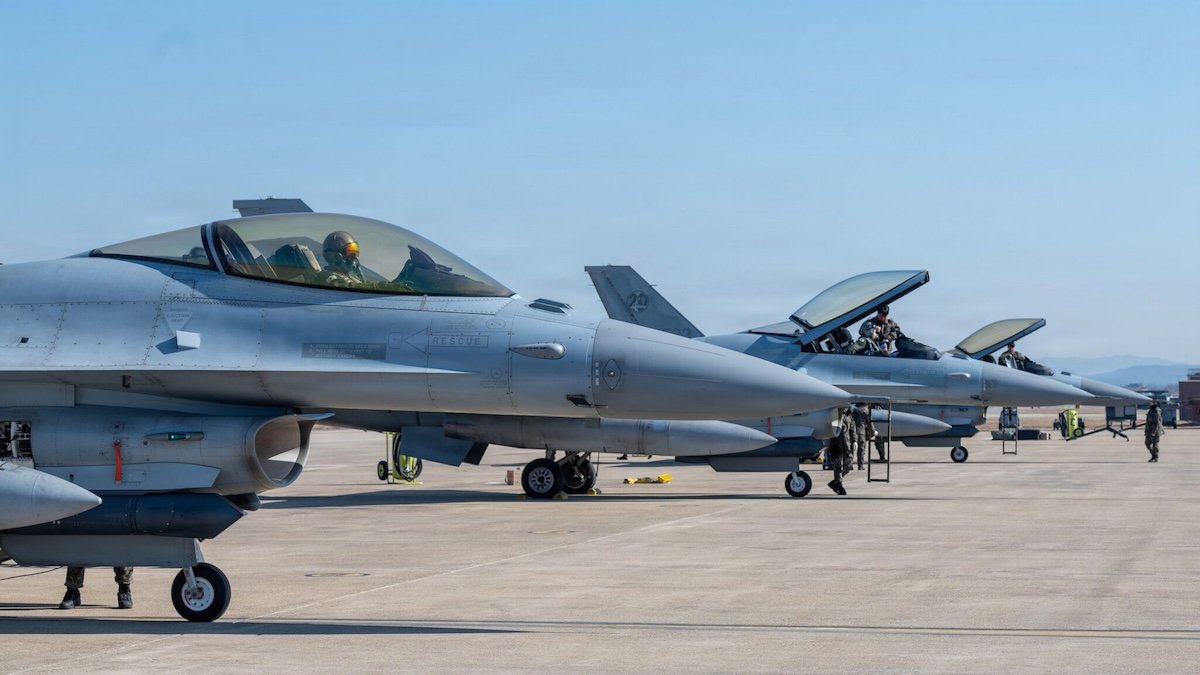
That message clashes with Seoul's ambitions. South Korea's defense exports have grown rapidly, but the US remains the dominant supplier of advanced systems like the F-35 fighter jet and missile defense interceptors. The tension is not just about money—it is about strategic autonomy.
Even in its most ambitious formulation, South Korea's autonomous defense still involves maintaining the US extended deterrence commitment against North Korea. "The withdrawal of USFK is not something we want to see," a senior Lee administration official told this writer. "But if it becomes a reality for us, and we have to fend for ourselves, we need to block the threat of nuclear weapons."
The most obvious way to do so—and the one that has attracted the most attention in American policy circles—is a South Korean nuclear weapons program. Alternatively, policymakers in Seoul are interrogating whether rapid changes in defense technology might create a path to deterrence without nuclear weapons. For now, the alliance remains the bedrock of South Korea's security, but the foundation is shifting.
As Seoul and Washington navigate these tensions, the broader regional context matters. Why Seoul and Washington Must Prepare for North Korea's Reckless Calculus underscores the urgency of maintaining a credible deterrent. Meanwhile, South Korea's AI-Driven Market Turmoil Sends Shockwaves Across Asia shows how economic and technological shifts are reshaping the peninsula's strategic landscape. And Inside North Korea: Running an NGO Amid Suspicion and Need offers a rare glimpse into the human dimension of the security challenge.