When United Nations Secretary-General António Guterres repeats that the two-state solution is the only way out of the Israeli-Palestinian impasse, the words sound less like a policy proposal and more like a Latin Mass: sacred, scheduled, and recited by the faithful. Whether anyone believes they describe the world as it is—or as it will be—has become irrelevant.
That is the condition of the two-state solution in 2026: an article of diplomatic faith floating above a reality that has been moving in the opposite direction for three decades. The ceasefire in Gaza last October, the recognition of Palestine by Britain, France, Canada, Australia, and others the month before, the shuttering of the PLO mission in Washington, and the approval of the E1 settlement that bisects the West Bank—none of these events points toward partition. Several quietly close the door on it.
Yet the Quartet, the General Assembly, editorial pages, and much of the American foreign policy establishment continue reciting the formula, as though incantation could substitute for cartography.
Origins and Erosion
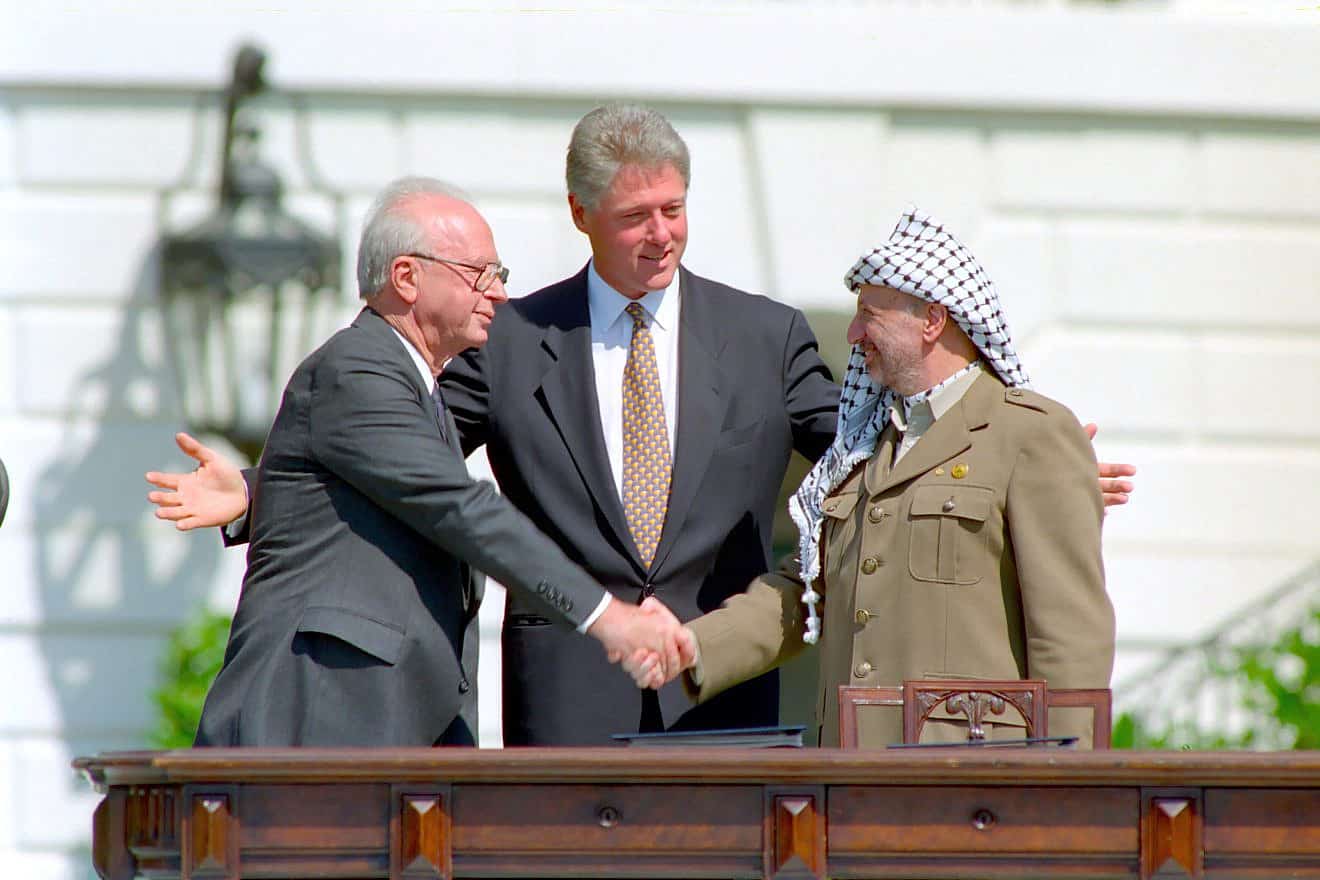
The two-state idea, in the form Washington now defends, is not ancient. It dates practically to the Oslo Accords of 1993—a framework whose architects, the late Yitzhak Rabin and Yasser Arafat, are both more than a quarter-century gone, along with the political coalitions that produced them. The Israeli Labor party that signed Oslo has been marginal for two decades. The Palestinian Authority that emerged from it is propped up by donor money and survives at the sufferance of an Israeli security apparatus that no longer pretends to regard it as a partner. Mahmoud Abbas, now in the twenty-first year of a four-year term, governs a fragment of the West Bank while Hamas—battered, decapitated, and still standing—retains de facto authority over what remains of Gaza. To call this a peace process requires the kind of imagination once associated with Soviet five-year plans.
The conventional response is that alternatives are worse. A one-state outcome, the liberal-Zionist argument runs, would either extinguish Israel's Jewish character or render it formally what its critics already call it. A continued status quo—military occupation indefinitely extended—corrodes Israeli democracy and condemns Palestinians to permanent statelessness. Therefore: two states. The logic is impeccable, in the manner of syllogisms. It is also unmoored from facts on the ground.
Demographics and Settlements
Some seven hundred thousand Israelis now live east of the Green Line, in settlements whose growth has accelerated since October 7. The ultra-Orthodox population that supplies a disproportionate share of new settlers has a fertility rate roughly twice that of West Bank Palestinians. Infrastructure—roads, utilities, a security architecture treating the West Bank as a single operational theater—has been integrated for years. The question is not whether dismantling all this is politically difficult; it is whether anyone in Israeli politics, including the dwindling peace camp, believes it is operationally conceivable. Ehud Olmert, who offered something close to the maximum a sitting Israeli prime minister has ever offered, did so in 2008. The country has moved decisively to his right since.
The Palestinian side presents its own arithmetic. Hamas, which won the last election in 2006, rejects the two-state framework as a matter of theology. Fatah accepts it but has spent two decades demonstrating it cannot deliver on any plausible bargain. The younger generation in Ramallah and Nablus, polled repeatedly, does not believe in the project either; it believes in resistance, or emigration, or both. A negotiated settlement requires negotiating partners, and the supply of plausible ones on either side has been contracting for a generation.
Why the Ritual Persists
What accounts for the persistence of the formula? Inertia, partly. The diplomatic establishment, like any guild, defends the framework that justifies its existence. American Jewish organizations that once treated two-state advocacy as moderate centrism are reluctant to admit the center has dissolved beneath them. European foreign ministries discover that recognizing a Palestinian state costs nothing and signals everything. None of this advances actual statehood by an inch, but all of it relieves the various parties of the burden of confronting what would.
The harder question—the one nobody in an official capacity wants to ask—is whether the conflict has any negotiated solution at all in this generation, or whether what lies ahead is something closer to the long Cypriot or Kashmiri equilibrium: an unresolved partition, managed rather than settled, with the international community's role reduced to humanitarian palliation and rhetorical maintenance. That latter outcome is grim. It is also, on present trends, what is actually happening. Pretending otherwise is not optimism; it is the displacement activity of an establishment that prefers its rituals to its problems.
A serious American policy would begin by acknowledging what every honest observer already knows: that the two-state solution, as a near-term political project, is dead, and that calling for its resurrection without proposing the wrenching steps that might revive it is theater. Whether the United States should expend further political capital trying to revive it—given the meager record of the past thirty years and more pressing claims on American attention from East Asia to its own southern border—is a separate question. For now, the liturgy continues.