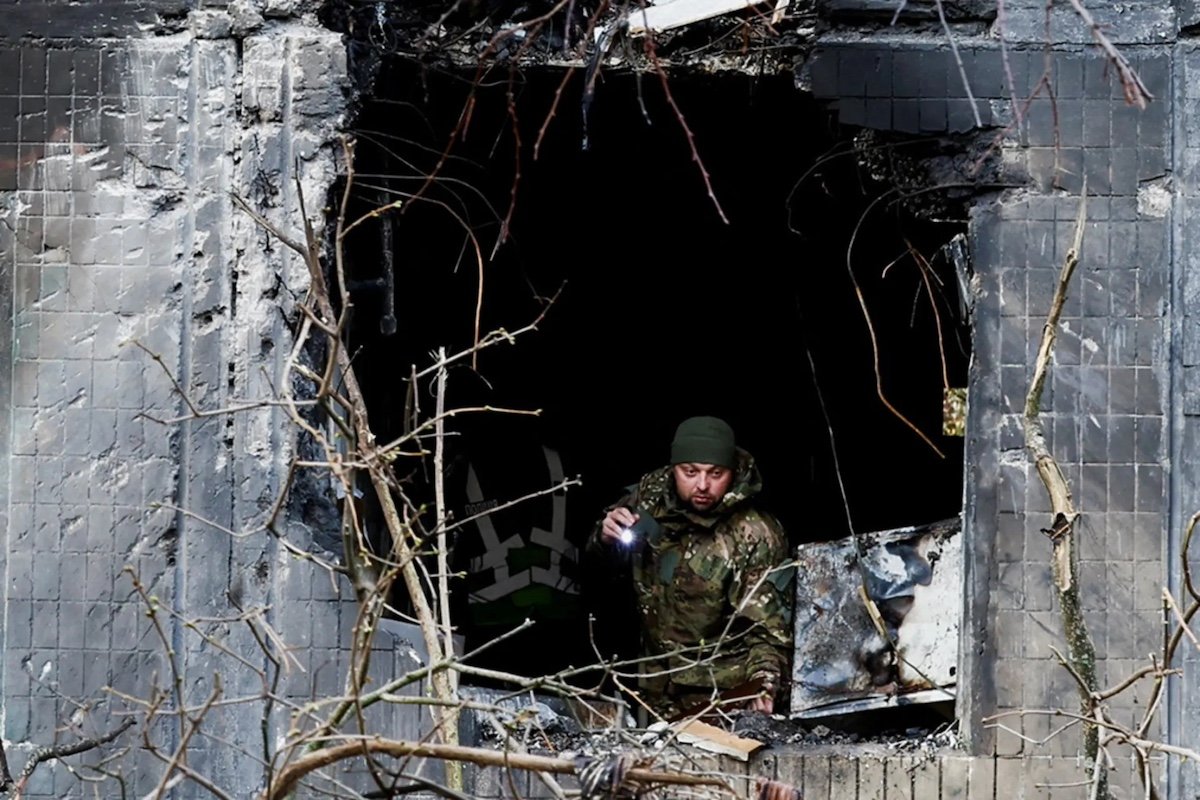
As the war in Ukraine grinds into its fifth winter, the collapse of recent diplomatic initiatives and Washington's explicit pivot from arming Kyiv to brokering a territorial freeze have laid bare a stark new reality. In February 2022, Western leaders predicted that sanctions would cripple Russia within months and that a united West would see Ukraine through to victory. More than four years later, Russia's economy has bent but not broken. The United States has turned from Ukraine's chief backer into a reluctant broker. Europe is paying for a war it cannot win.
Ukraine's fierce resistance has been central to this story. The country fought a brutal war of survival precisely because the liberal order failed to integrate it securely. Through its ongoing resistance and rejection of imposed territorial surrender, Ukraine has forced the West to confront the limits of its own assumptions. It has shaped the contours of the emerging order even as it pays the highest price.
But Ukraine is also the place where a larger project came to grief. For three decades after the Cold War, the West assumed that free markets, democracy and Western-led alliances would advance together, each reinforcing the others. Ukraine is where all three assumptions failed at once.
The liberal moment
The project began as an economic doctrine. Ronald Reagan and Margaret Thatcher championed it in the 1980s: cut taxes, deregulate, privatize, open borders to trade and capital. After the Soviet Union collapsed in 1991, open markets and liberal democracy came to be seen as two sides of the same coin, guarded by Western-led institutions such as NATO, the IMF, and the World Trade Organization.
Every American president from George H.W. Bush to Barack Obama pursued some version of it. Bill Clinton was its most effective champion. He signed NAFTA, helped launch the WTO and backed NATO's first eastward expansion. In Europe, Thatcher's legacy and a generation of Atlanticist leaders carried the agenda into the single market and the EU's own enlargement to the east.
Francis Fukuyama gave the era its intellectual frame. His 1989 essay, expanded into the 1992 book The End of History and the Last Man, argued that liberal democracy had won the contest of ideas. The rest of the world, the reasoning went, would follow sooner or later.
The assumption was not merely that markets and democracy were desirable. It was that they were convergent: economic integration would produce political moderation, and Western-led institutions would manage the transition. This was the convergence thesis. Ukraine is where it died.
NATO moves east
Victory bred confidence, and confidence bred expansion. A weakened Russia under Boris Yeltsin objected but could do little. NATO took in Poland, Hungary and the Czech Republic in 1999. The three Baltic states, Slovakia, Slovenia, Romania and Bulgaria followed in 2004, then Albania, Croatia, Montenegro and North Macedonia.
Warnings came from inside the Western establishment. In 1997, George Kennan, the architect of America's Cold War containment policy, called expansion "the most fateful error of American policy in the entire post-Cold War era." In 2007, Vladimir Putin used the Munich Security Conference to denounce it. In early 2008, William Burns, then US ambassador in Moscow, cabled Washington that Ukrainian membership was the brightest of all red lines for Russia's elite. Weeks later, NATO's Bucharest summit declared that Ukraine and Georgia "will become members."
Geography explains the alarm. Ukraine's eastern tip lies east of Moscow, and its border is roughly 450 kilometers from the Russian capital. Napoleon in 1812 and Hitler in 1941 both came across the same open plains. The West treated Russian objections as noise rather than as the predictable reaction of a great power with both a long memory — and an estimated 6,000 nuclear warheads. Yet NATO expansion, however provocative, did not dictate Moscow's response. The West's fatal error was assuming that economic integration would moderate Russian behavior.
Two miscalculations: Russia and China
The convergence thesis assumed that economic pressure would bring Russia to heel. It did not. Cut off from European markets, Moscow redirected its oil east. India, which bought little Russian crude before 2022, became one of its biggest customers, and trade between Russia and China reached record levels. Russia's economy suffered inflation and labor shortages, but it adapted and marshaled its considerable resources.
China was the second blind spot. Beijing has its own stake in Russia's survival. A Russia broken into weaker states would, in Chinese eyes, open the way to a Western presence along China's long northern border. Backing Moscow, short of open military aid, became a matter of strategic self-interest.
Behind both errors lay a deeper assumption: that the West would stay preeminent because of its economic weight and its political system. China's rapid rise in manufacturing and technology undermined that belief. The EU now runs a goods trade deficit with China approaching 1 billion euros a day, according to Eurostat trade data. Europe imports Chinese electric cars, solar panels and batteries while its own industries struggle to compete. The global market that was supposed to spread Western values has instead strengthened a rival.
It is tempting to treat these developments as a list of separate failures. They are better understood as a sequence in which each reinforced the next. NATO expansion created the security crisis. China's rise created the economic challenge. The war in Ukraine has exposed the fragility of the entire edifice. As the conflict grinds on, the Trump administration's embrace of Putin has ended any pretense of a unified Western front, while deals on diesel and other energy flows undercut Ukraine and Europe. The post-Cold War era is over, and the new order is being written in the trenches of eastern Ukraine.