Pakistan's government has moved to crush the last elected stronghold of the opposition party led by jailed former Prime Minister Imran Khan, imposing emergency rule in the northwestern province of Khyber Pakhtunkhwa. President Asif Ali Zardari signed the order on Sunday, suspending the provincial assembly and transferring authority to a federally appointed governor. Hundreds of activists from Khan's Pakistan Tehreek-e-Insaf (PTI) party, including provincial Chief Minister Sohail Afridi, have been arrested, along with three of Khan's sisters, according to The Guardian.
The emergency measures come after days of protests demanding Khan's release. Khan was removed from office in 2022 through a parliamentary no-confidence vote that he and his supporters say was orchestrated by the military under pressure from the administration of then-US President Joe Biden. He has been imprisoned since, facing a series of legal cases that Amnesty International and other rights groups say are politically motivated.
Pakistan's federal government said the emergency was necessary because local authorities failed to stop escalating attacks by Islamist militant groups. But PTI leaders and civil society groups describe it as a pretext to suppress dissent, including a planned march on Islamabad to demand Khan's release.
Mehlaqa Samdani, director of the Community Alliance for Peace and Justice, a group that opposes US support for political repression in Pakistan, called Khyber Pakhtunkhwa "the last remaining province where the military regime had been unable to take control." In a video statement, she said: "The government has now declared a state of emergency and imposed governor's rule in the province, effectively removing its elected government from power. Just think about what that means: Millions of people voted for their representatives, only to see their elected government stripped of its authority."
Samdani added: "Everyone saw these pro-democracy protests. This is a very transparent attempt to crush them by a military regime that is terrified of its own people."
Internet blackouts and mass arrests
Following the emergency declaration, internet monitoring group NetBlocks reported major disruptions to internet service across Khyber Pakhtunkhwa. Mobile networks have been disrupted, public transport halted, and roads closed in several districts. The scale of the crackdown has drawn international concern.
Babu Ram Pant, Amnesty International's deputy director for South Asia, said on Sunday: "Reports of arbitrary detentions of key leaders – including the provincial chief minister – and internet disruptions across the province raise concerns about the proportionality of these emergency measures." He added: "While states may, in strictly limited circumstances, derogate from their human rights obligations to respond to a public emergency that threatens the existence of the nation, emergency measures are not a blank cheque to crack down on human rights, silence dissent, or concentrate power."
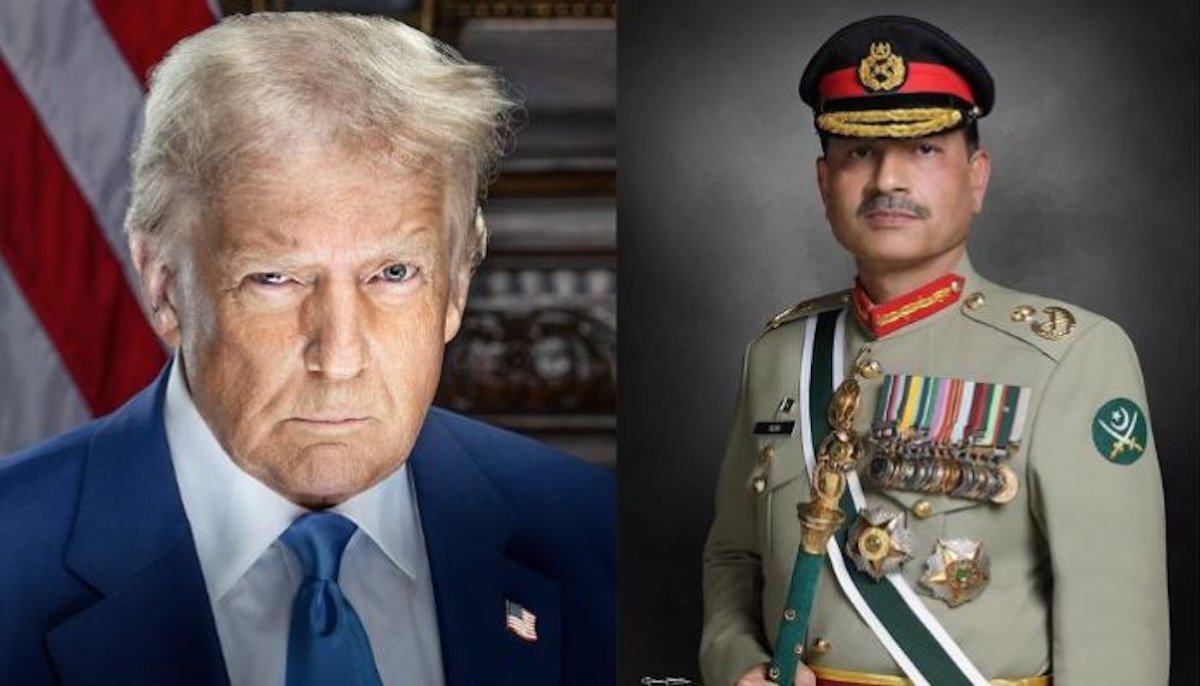
The crackdown has been overseen by General Asim Munir, the army chief who has consolidated control over Pakistan's armed forces and secured immunity from prosecution. Munir has become a key ally of US President Donald Trump, who hosted him for an unprecedented two-hour Oval Office meeting last year without any other Pakistani officials present. Trump has called Munir "my favorite field marshal," "a very important guy," and "an exceptional human being."
In December, the Trump administration approved a $686 million sale to upgrade Pakistan's F-16 fighter jets. Trump has also used Munir as a go-between with Tehran amid the US war with Iran. This deepening relationship has raised eyebrows among democracy advocates, who note that Munir's military has been the driving force behind Khan's ouster and imprisonment.
Hussain Nadim, a Pakistani political analyst at George Washington University, argues that Munir has made himself useful to Trump because it "confers international legitimacy as his military rule faces deep questions at home." Writing in August, Nadim observed: "Pakistani generals have long understood how to capitalize on American fears, anxieties, and domestic political needs of a wide range of American presidents. Military rulers position themselves around political changes in Washington, knowing urgent American political and security needs can override concerns about democracy and governance in countries like Pakistan."
The situation in Pakistan also has regional implications. The instability in Khyber Pakhtunkhwa, which borders Afghanistan, comes as Afghanistan's Wakhan road opens a new route to China, potentially reducing Pakistan's leverage in the region. Meanwhile, Russia's courtship of the Taliban adds another layer of complexity to Pakistan's security calculus.
Opponents of US intervention, including Samdani, have renewed calls for Washington to cut off support for Pakistan's military. "The US continues to train and work closely with the very military regime that is crushing democracy," she said. "Every dollar of American aid is complicity in this crackdown."
As the emergency rule takes hold, PTI supporters have vowed to continue protests. The party's leadership, now largely in detention, has called for a nationwide civil disobedience campaign. The coming weeks will test whether Pakistan's military can maintain its grip without triggering a broader crisis.