The United States government is doubling down on its bet that advanced nuclear technology can help meet rising electricity demand without adding carbon emissions. Last month, the Department of Energy (DOE) announced it would award $1 billion to X-energy, a Maryland-based startup backed by Amazon, to help build four small modular reactors at a Dow Chemical facility in Seadrift, Texas. The new award brings total federal support for the project to $2.1 billion, following an initial $1.2 billion commitment in 2021.
Both tranches are structured as 50-50 cost-sharing agreements under the DOE's Advanced Reactor Demonstration Program (ARDP), launched in 2020 to accelerate the commercialization of next-generation nuclear designs. X-energy's Seadrift project now rivals the Bill Gates-backed TerraPower's Wyoming demonstration plant, which has received up to $2 billion in similar funding. TerraPower broke ground on its project earlier this year.
A crowded field, but few licenses
X-energy has not yet secured a construction license from the Nuclear Regulatory Commission (NRC), though it received a key environmental approval in May and expects the regulator to green-light construction in early 2027. So far, only TerraPower and Kairos Power, a startup backed by Google, hold NRC construction permits. The X-energy project is one of several advanced reactor initiatives vying to become the first to deliver power to the grid.
Nuclear energy has struggled in the United States for decades, but a combination of soaring electricity demand from data centers and manufacturing, plus a desire for carbon-free power, has revived interest. Tens of billions of dollars in public and private funding are now flowing into startups and efforts to restart or build large-scale reactors. The country currently operates 96 commercial reactors.
However, the industry's history of blown deadlines and budgets remains a cautionary tale. In 2023, the first small modular reactor project with an NRC-approved design was dissolved after cost overruns. X-energy itself estimated in early 2023 that completing its ARDP scope would cost between $4.75 billion and $5.75 billion. The company has not updated that estimate publicly, but the federal funding implies at least $4.2 billion in total spending. In securities filings this year, X-energy acknowledged facing the same inflationary and trade-related pressures that have raised costs across energy infrastructure.
CEO J. Clay Sell told investors on an August 13 earnings call that he expects the government to contribute more if needed. “I'm confident to the extent more dollars will be required, they will be provided by our partners at the Department of Energy and Commerce,” he said. “We'll see where the number ends up.” Andrew Kleiman, an energy transition analyst at Wood Mackenzie, said there's no indication yet that final costs will substantially exceed the 2023 estimate.
As of June 30, the DOE had reimbursed X-energy about $546 million under the ARDP agreement. The agreement covers design and licensing of the Xe-100 reactor, construction of a fuel fabrication facility near Oak Ridge National Laboratory in Tennessee, and the Seadrift plant. The company says the fuel facility, TX-1, remains on track to open in the first half of 2028.
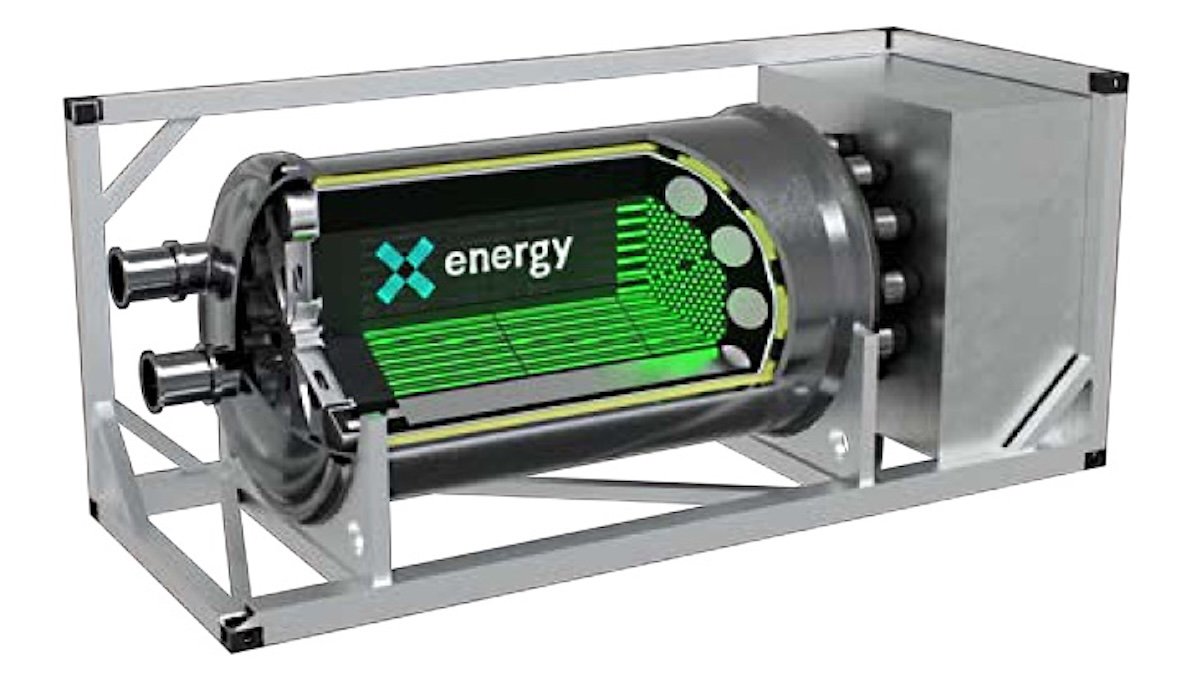
The Xe-100 is a high-temperature gas reactor that uses graphite to control the reaction and helium to transfer heat, unlike conventional water-cooled reactors. It uses TRISO fuel, a specialized uranium-based pellet designed to withstand extreme heat. The reactor's high operating temperatures make it suitable for providing both heat and power to industrial sites like Dow's petrochemical plant, which currently relies on aging steam and power assets. If built, the Seadrift reactors would cut the facility's annual greenhouse gas emissions by about 440,000 metric tons.
Dow is expected to make a final investment decision on the project in 2028 at the earliest. Kleiman noted that Dow's partnership with X-energy is not purely financial; the company aims to reduce its annual emissions by 5 million metric tons from 2020 levels by 2030. Backing out would force Dow to rely on fossil fuels, a step backward in its sustainability goals.
X-energy's original ARDP partner, Energy Northwest, a Washington state utility, withdrew in 2023, citing a lack of development capital without a committed buyer. Amazon later stepped in to back up to 12 Xe-100 reactors at a site in central Washington, though that project is at an earlier stage. In total, X-energy has commitments with Dow, Amazon, and UK-based Centrica for as many as 144 reactors worldwide, according to a securities filing last month.
The revival of nuclear power in the US has implications beyond its borders. As Asia's energy demand grows, countries like Japan and South Korea are watching closely. Japan, in particular, has been reconsidering its nuclear stance amid energy security concerns, as highlighted in debates over submarine propulsion. The success or failure of projects like X-energy's will shape whether advanced reactors become a viable option for the region.
For now, the industry's momentum is real, but the proof will be in execution. As decentralized energy gains ground in Asia, the ability to deliver small reactors on time and on budget will determine whether nuclear can compete with renewables and natural gas in the coming decades.