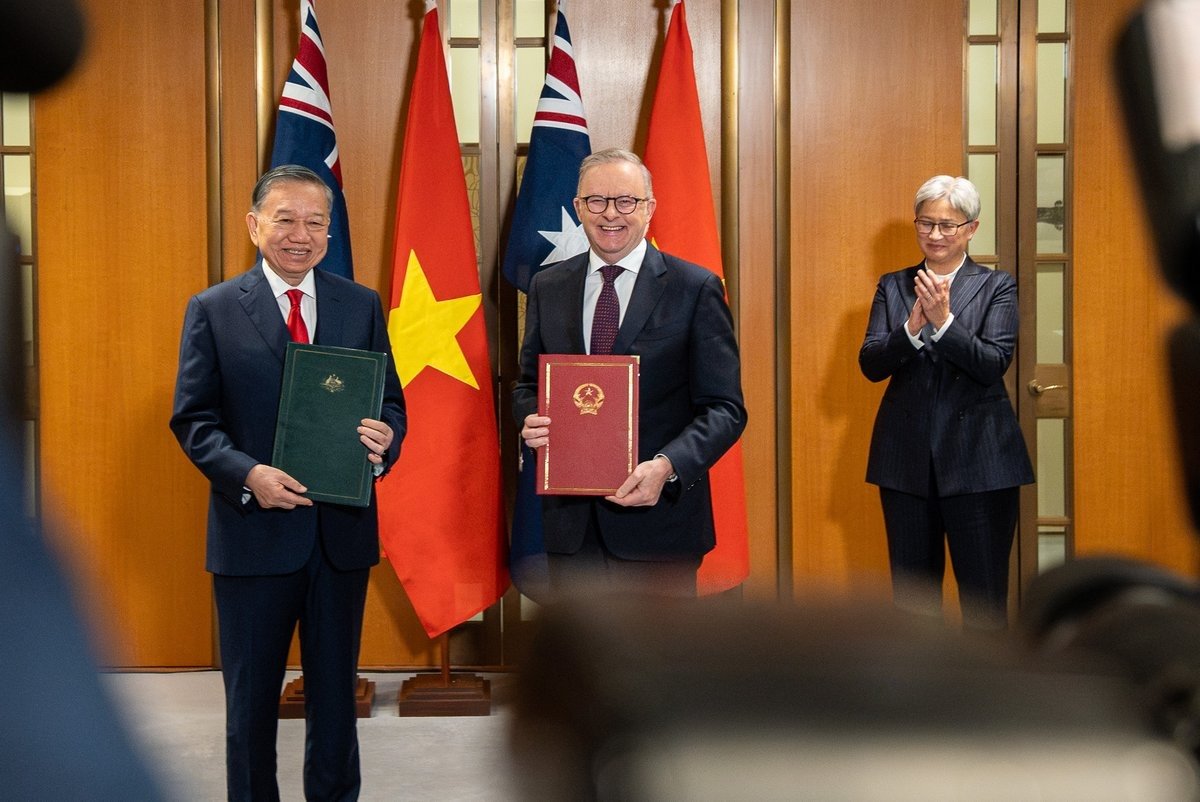
When To Lam, Vietnam's president and general secretary of the Communist Party, landed in Canberra on August 11, he became the first Vietnamese head of state to make a state visit to Australia since the country's reunification in 1975. The trip capped a busy diplomatic year for Lam, who has already visited China, India, Sri Lanka, Thailand, Singapore, and the Philippines, and it preceded a stop in New Zealand to meet Prime Minister Christopher Luxon.
The visit was the first face-to-face meeting between Lam and Australian Prime Minister Anthony Albanese, and it came just over a year after the two nations upgraded their relationship to a Comprehensive Strategic Partnership (CSP) in March 2024—Hanoi's highest tier of diplomatic engagement. That designation, once reserved for a handful of major powers, has been handed out more liberally in recent years, but Canberra and Hanoi have worked to give it substance.
Delivering on the 2024 commitments
Since the elevation, both governments have built institutional scaffolding around the framework. The inaugural ministerial security dialogue was held in 2024, a peacekeeping partnership agreement was signed in July 2025, and a defense cooperation plan for 2025–2027 is now in place. The ministerial energy and minerals dialogue, which was committed to in 2024 but had not yet convened, finally took place alongside the August 2025 visit. These are concrete follow-throughs, not just communiqué promises.
Defense ties have also deepened incrementally. Vietnam participated in Exercise Kakadu for a second consecutive cycle in 2024 and is slated to do so again in 2026, and it observed Exercise Talisman Sabre in 2025. Negotiations are underway for a maritime law enforcement agreement and a cooperation and mutual assistance agreement—significant steps for a country whose defense policy explicitly rules out military alliances.
Economics: public finance leads, private capital lags
On the economic front, the joint statement issued on August 11 was notably light on new numbers. The only figure cited was Export Finance Australia's cumulative A$1.3 billion in financing for infrastructure and exports to Vietnam since 2017—a reporting figure, not new money. Vietnam remains a key focus of Australia's blended finance portfolio, receiving A$83 million, over a third of Australia's total financing.
Other announcements included a nine-year extension of the Aus4Skills program to 2035 and an amended investment registration certificate for RMIT University's Hanoi campus. But all of these are publicly financed or government-facilitated. No private sector investment target was set, and no bilateral trade target was agreed.
The new Joint Statement on Economic Resilience Cooperation frames supply chain resilience across critical minerals, semiconductors, clean energy, grid infrastructure, and agricultural essentials. Whether this becomes operational or remains a framing document will depend on whether specific projects follow. Current Australian figures put two-way trade in goods and services at A$30.0 billion in 2025, while the total stock of two-way investment sits at just A$2.0 billion.
Structural factors constrain private investment. Vietnam caps aggregate foreign ownership in commercial banks at 30 per cent of charter capital, and foreign individuals and organizations cannot hold land use rights under Vietnamese law, limited instead to leases capped at 50 years under the 2024 Land Law. On the Australian side, institutional investors have limited exposure to frontier markets like Vietnam. These are not problems a joint statement can solve, but they explain why the economic section of the CSP remains dominated by public finance rather than private capital.
Technology and people-to-people ties
On technology, the TechConnect forum launched in Sydney on August 10, and a Joint Statement on Science, Technology and Innovation Connectivity was signed, alongside a health cooperation MOU. Vietnam has pursued parallel technology cooperation with Japan, South Korea, and Singapore in recent months, including joint semiconductor research with Japan and semiconductor and data center agreements with South Korea. What Australia can offer centers on research training, critical minerals supply chains, and governance frameworks rather than commercial technology.
The relationship carries significant people-to-people depth. Australia is home to around 350,000 people of Vietnamese heritage, and Vietnam is Australia's fourth-largest international student market, with approximately 35,000 students currently enrolled and over 160,000 alumni. Vietnam's Deputy Minister of Foreign Affairs Nguyen Manh Cuong described this people-to-people dimension as social capital that cannot be created overnight by any agreement.
Yet the diaspora is not monolithic. A substantial portion descends from refugees who arrived after 1975, and organized Vietnamese-Australian groups have routinely protested visits by Vietnamese leaders to Canberra. Annual Black April commemorations and the continued use of the heritage flag keep historical distrust of the Communist Party leadership visible. While older generations are aging and newer ones are less engaged with the political legacy, the absence of a substantive gesture from the party-state toward the community's historical grievances has made reconciliation and efforts to tap into the diaspora's full potential considerably more difficult. As our analysis of Vietnam's diaspora potential notes, this is a resource that remains only partially mobilized.
The overall trajectory of bilateral relations is consistent. The CSP's 2024 commitments have been delivered, and the institutional machinery is humming. But the familiar limits—on private investment, on technology transfer, and on diaspora reconciliation—remain. For all the steady progress, the partnership's full potential will require addressing these structural and historical constraints.