The effort to modernize Da Nang's maritime infrastructure may appear at first glance to be just another Asian port development project. But the transformation underway along Vietnam's central coast carries considerably more weight, bringing together three priorities that increasingly define Hanoi's foreign policy: economic modernization, technological self-reliance, and stronger maritime awareness in the South China Sea.
This convergence will be on display when the USS George Washington (CVN-73), a Nimitz-class nuclear-powered aircraft carrier and the US Navy's premier forward-deployed carrier in the Indo-Pacific, visits Da Nang from July 30 to August 3. The port call follows previous high-profile visits, including the USS Ronald Reagan in June 2023 and an amphibious group visit by the USS Tripoli and USS Robert Smalls in December 2025. These naval visits serve as reminders that Da Nang has become an important point of contact between the two former battlefield foes, now strategic comprehensive partners.
Smart port infrastructure takes shape
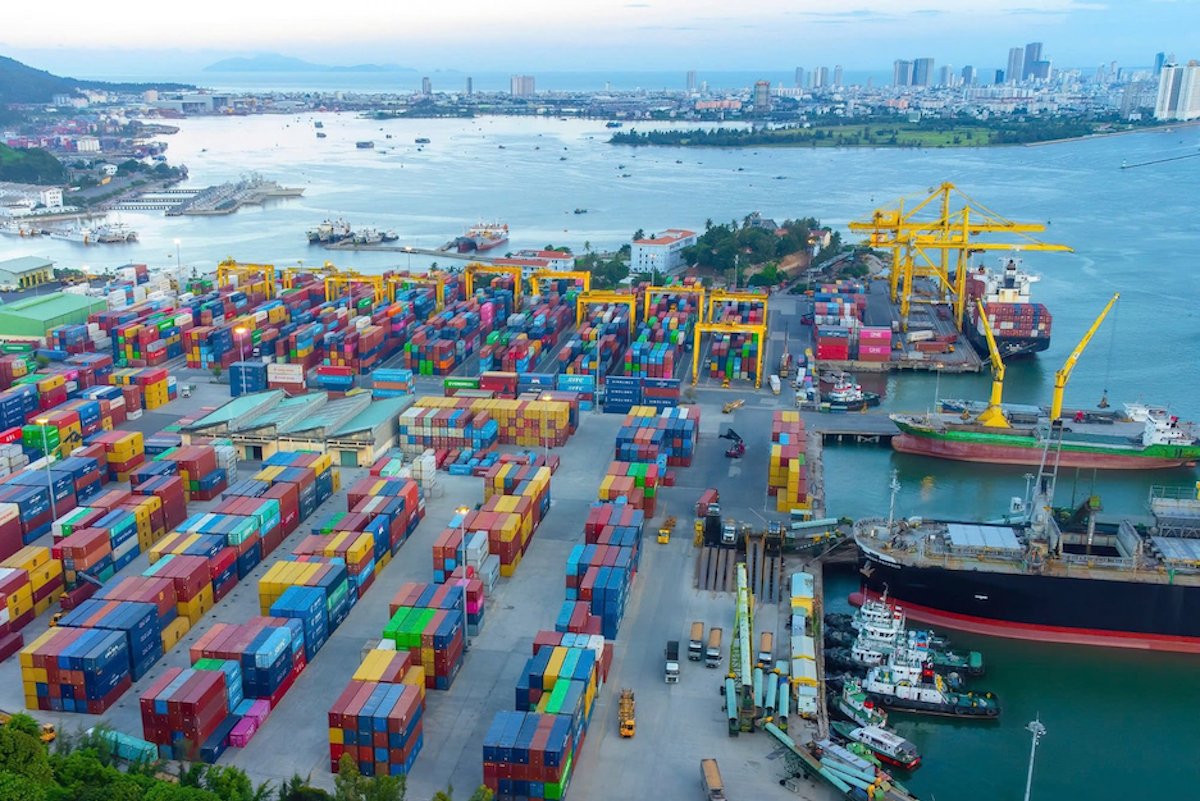
The more consequential story, however, is taking place ashore. Vietnam is expanding the Lien Chieu port complex as part of its plan to turn Da Nang into a major logistics gateway linking central Vietnam with regional and international markets. The city envisions a modern container port with highly automated cargo-handling technology and eventual capacity measured in millions of containers annually. Da Nang also wants stronger road and rail links connecting the port with industrial centers and the East-West Economic Corridor stretching toward Laos and Thailand.
Da Nang Port is already experimenting with digital tools. In April, it introduced an electronic mapping system that combines real-time container-yard information with GPS navigation, allowing truck drivers to locate containers and navigate the terminal more efficiently. It is a modest example of a larger transformation toward data-driven port management.
Satellites are part of that transformation. Vietnamese researchers are increasingly using remote sensing to monitor coastal waters, shoreline changes, and port development. A recent study using European Sentinel-2 satellite imagery examined changes at Lien Chieu between 2022 and 2025, demonstrating how satellite data can track shoreline movement, land reclamation, and environmental impacts associated with major port construction. Vietnam has also started combining satellite observations with artificial intelligence to monitor seawater quality, using Sentinel-2 data, machine-learning algorithms, and cloud computing to assess coastal conditions.
For port managers, these technologies have obvious commercial value. Satellite imagery can reveal sedimentation near navigation channels, monitor coastal erosion, and help planners understand how construction is changing shorelines. Automatic Identification System data can track vessel movements. Digital port platforms can reduce congestion, improve cargo flows, and lower logistics costs. But information gathered for commercial purposes does not stop being useful at the harbor entrance.
Geopolitical significance beneath the surface
The same combination of satellites, vessel tracking, geospatial analysis, and environmental sensors can improve maritime domain awareness — essentially giving authorities a clearer picture of what is happening at sea. That is where the Da Nang story has geopolitical significance. Vietnam faces the South China Sea while managing a difficult relationship with China, its largest neighbor and an important trading partner but also rival claimant to contested maritime territories.
Hanoi has no interest in turning Da Nang into an anti-China outpost, nor is Vietnam likely to abandon its longstanding reluctance to enter formal military alliances. Instead, Vietnam is building resilience. Better ports strengthen supply chains. Better satellite information improves environmental management. Better vessel tracking improves navigation and maritime safety. Collectively, however, those same capabilities make it easier for Vietnam to understand activity along its coastline and in nearby waters. Civilian technology and national security are increasingly difficult to separate at sea.
Washington has good reason to pay attention. Since elevating relations to a Comprehensive Strategic Partnership in 2023, the US and Vietnam have broadened cooperation in science and technology, the digital economy, semiconductors, defense, and maritime security. Washington has also provided equipment and programs aimed at improving Vietnam's maritime domain awareness, port security, and ability to combat illegal fishing. Da Nang therefore offers a logical laboratory for the next stage of the relationship. American universities, technology companies, and government agencies possess considerable expertise in satellite analysis, geospatial information systems, environmental monitoring, artificial intelligence, and smart-port management.
Cooperation in these fields would be less politically sensitive than a dramatic expansion of military access while still strengthening Vietnam's capacity to manage its maritime space. It would also meet Hanoi on its own terms. Vietnam's strategic approach is not built around choosing Washington over Beijing. It is about acquiring enough diplomatic, economic, and technological options to avoid excessive dependence on either. Smart maritime infrastructure fits that strategy particularly well because it delivers immediate economic benefits while quietly strengthening national capacity.
Da Nang's geography only magnifies its importance. The city sits on Vietnam's central coast facing the South China Sea and has long served as a maritime gateway. Today, planners see Lien Chieu as a key link between the country's industrial heartland and global markets. The port's expansion also dovetails with Vietnam's broader push to upgrade its logistics sector, which has struggled to keep pace with the country's rapid export growth. For Washington, supporting this transformation offers a practical way to deepen ties without triggering the kind of backlash that a formal military basing arrangement would provoke. It is a quiet opening, but one that both sides appear eager to explore.
Meanwhile, the broader context of US-Vietnam relations includes other developments, such as the controversial Trump golf resort built on a former graveyard in Vietnam, which has drawn attention as ties deepen. Additionally, Vietnam faces internal challenges like the graft case exposing To Lam's security-state economy, which could affect the political landscape for such cooperation.