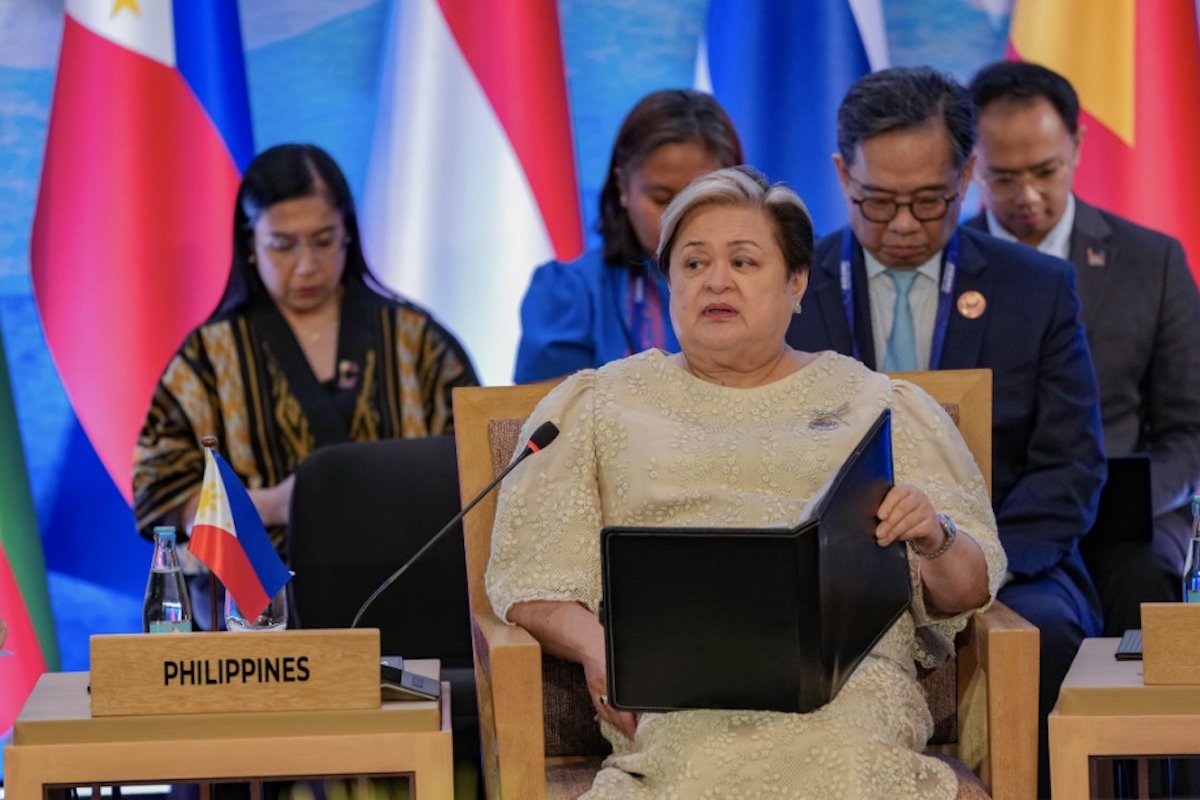
Manila entered the 2026 ASEAN chairmanship with what looked like a strong hand on the South China Sea. It controlled the drafting of the communiqué. It had built domestic legal infrastructure and secured bilateral commitments from partners. The foreign ministers' meeting fell in the week of the tenth anniversary of the 2016 arbitral ruling.
Yet the final text on the South China Sea is functionally identical to the one Malaysia produced the year before. The arbitral ruling is not mentioned. That outcome reveals less about Philippine diplomacy than about a structural constraint built into ASEAN's consensus mechanism.
Institutional moves, but no language shift
The Philippines has been active institutionally. In May, the 48th ASEAN Summit in Cebu endorsed the ASEAN Maritime Centre, to be hosted by Manila, with an operational framework due by November. In June, the ASEAN Coast Guard Forum's institutional framework was finalized in the capital, with the communiqué looking forward to embedding it in the ASEAN Charter. In mid-July, the Department of Justice established a dedicated maritime law unit to consolidate legal expertise and sustain gains from the 2016 ruling.
At the AMM itself, foreign ministers adopted new cooperation arrangements under the Treaty of Amity and Cooperation, opening a channel for signatory states that are not formal ASEAN partners to work together on maritime security. The Philippines also secured bilateral deliverables: Australia announced roughly $18 million in drone support and civil maritime assistance at Philippine Coast Guard headquarters on the meeting's opening day. Four European countries — Lithuania, Poland, Romania and Sweden — acceded to the TAC at the 50th anniversary ceremony. Turkey was admitted as ASEAN's 12th dialogue partner, with Denmark, Germany and Qatar granted sectoral dialogue partner status.
The external architecture has expanded. But the core text on the South China Sea remains frozen.
The external coalition goes further
The arbitral ruling's tenth anniversary on July 12 produced the strongest external coalition statement to date. Fourteen countries reaffirmed the ruling as final, legally binding and definitive. The EU issued a separate endorsement. The coalition included claimant-state partners such as Japan, Australia and the United States, along with European states with no direct territorial stake. No ASEAN member signed either statement except the Philippines.
That gap is telling. When a clash between Philippine and Chinese sailors at Second Thomas Shoal on July 20 drew condemnation from several external partners, no ASEAN member stood with Manila. The external coalition is willing to go further than the organization the Philippines chairs. This dynamic echoes broader trends in the region, as ASEAN reclaims a central role even as its internal consensus on sensitive issues remains constrained.
The communiqué's South China Sea paragraphs confirm the pattern. Comparing the 59th AMM text with the 58th from the year before, the language is near-identical. The “concerns expressed by some Ministers” formulation is carried over. The self-restraint, non-militarization and confidence-building passages are unchanged. The arbitral ruling is not mentioned.
One shift is worth noting, though it cuts against Manila's stated ambitions: The 2025 communiqué called for “the early conclusion” of the Code of Conduct and cited the “Guidelines for Accelerating” its completion. The 2026 text drops the acceleration reference entirely and instead looks forward to “continued efforts in endeavoring to conclude” the COC “within this year.” The aspiration has softened even as a deadline has been attached. Malaysia's foreign minister told reporters on the AMM sidelines that the COC is now expected to be finalized at the 49th ASEAN Summit in November.
The fundamental obstacles remain unresolved after more than a decade of negotiation, including whether the code will be legally binding and how it relates to the 2002 Declaration on the Conduct of Parties.
The Middle East overtakes the agenda
The communiqué's most distinctive language had little to do with the South China Sea. It affirmed “the right of transit passage in straits used for international navigation,” a formulation that had not appeared in previous communiqués, and called specifically for the “restoration of the safe, unimpeded and continuous transit passage of vessels and aircraft in the Strait of Hormuz.” The Middle East section expanded from four paragraphs in 2025 to seven in 2026, tracking the escalation from US-Israeli strikes on Iran in February through retaliatory attacks and a June memorandum of understanding.
The South China Sea held at two paragraphs. The AMM that the Philippines built around maritime legal order in the western Pacific was substantially overtaken by an energy and security crisis in the Persian Gulf.
No chair can break the pattern
The point is not that the Philippines failed to move the consensus. It is that no chair has managed to do so. In 2016, when the arbitral ruling was issued during Laos' chairmanship, every proposed reference to it in the Vientiane communiqué was blocked. A decade later, with the claimant state holding the pen, the result was the same.
ASEAN's consensus norm and non-interference principle are what hold the bloc together. They are why 11 states with vastly different political systems and strategic alignments can sustain a common institutional framework, and why ASEAN can issue collective positions on issues from the Middle East to Myanmar. However, on high-stakes sovereignty disputes like the South China Sea, those same principles become a constraint. Moving the communiqué language would require members to collectively accept that the institution can take sides in a territorial dispute. That redefinition is beyond what any single chairmanship can deliver.