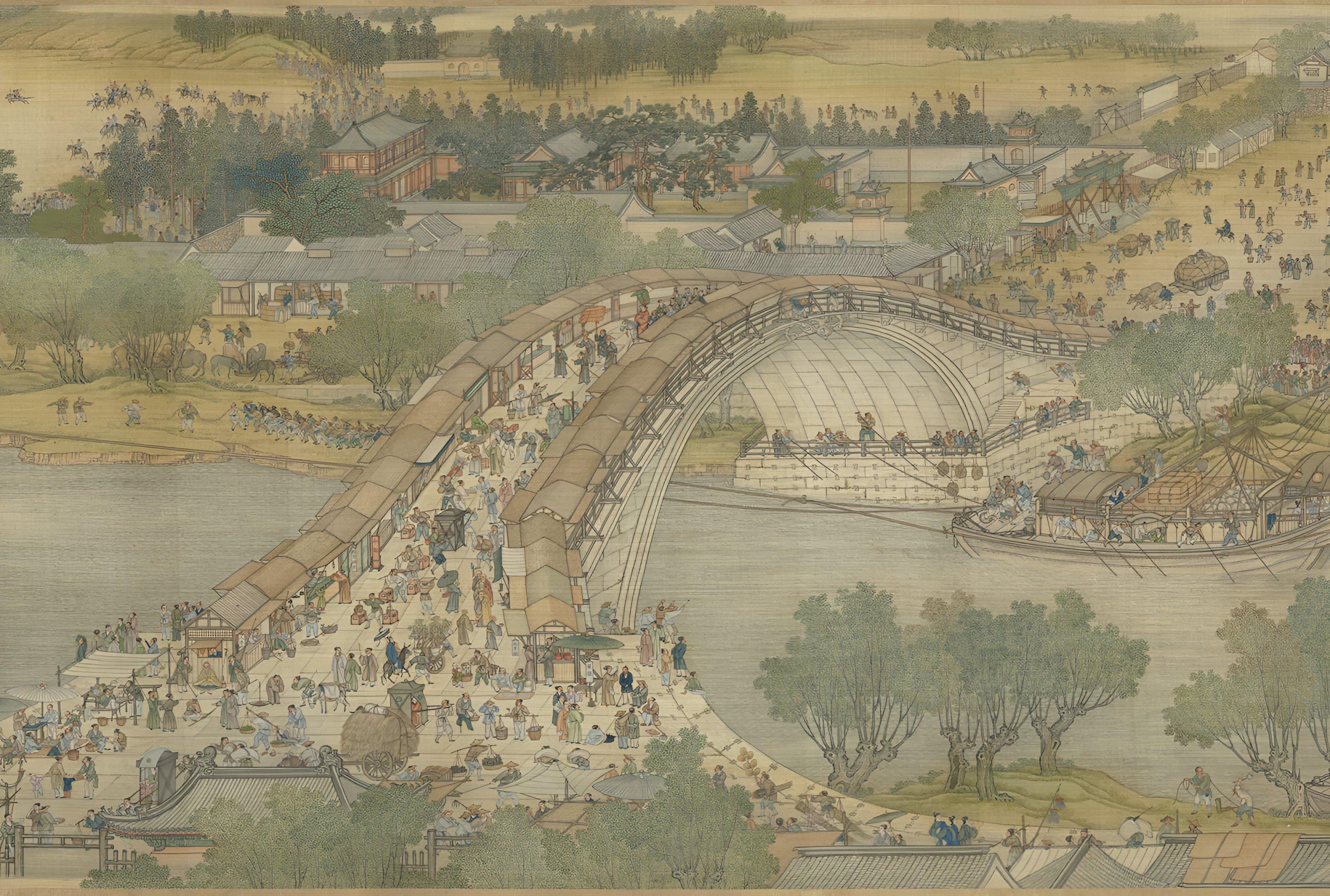
In Zhang Zeduan's Along the River During the Qingming Festival, a boat is about to hit a bridge. This moment, captured in the early 12th century, reveals the painting's deeper secret: beneath the surface of prosperity lies a portrait of a city so interconnected that its survival depends on constant, precarious movement.
The scroll, housed in Beijing's Palace Museum, is widely considered the earliest surviving version of Qingming shanghe tu. It depicts the Bian River in Kaifeng, then the capital of the Northern Song dynasty. At first glance, it appears to celebrate wealth and order. But a closer look shows a system under strain: boatmen shout, ropes tighten, a mast is lowered, and a heavy vessel struggles through a crowded waterway. Above, people lean over railings; on the banks, shopkeepers, porters, travelers, monks, doctors, fortune-tellers, laborers, and children press into the scene.
A City, Not a Portrait
Western audiences often call this work "China's Mona Lisa," but the comparison is misleading. The Mona Lisa is a face; the Qingming scroll is a system. It is not built around a single human mystery but around the movement of an entire urban organism. When much of Western high art still placed salvation at its center, Zhang Zeduan placed a city there.
In Europe, the early 12th century was the age of Romanesque churches and biblical manuscripts. Durham Cathedral was built between 1093 and 1133; the Cross of Cong, an Irish church treasure, was made in 1123; the chevet of Saint-Denis, linked to Gothic art's birth, was consecrated in 1144. The comparison is not meant to diminish Europe but to clarify the historical shock of the Chinese scroll: it depicts a secular, logistical metropolis centuries before the Renaissance.
The painting's central section is organized around the great bridge, where a large boat tries to pass beneath as its mast is lowered and the crowd gathers in alarm. This is not ornamental animation; it is a near accident. Palace Museum researcher Yu Hui has interpreted this scene as part of a larger pattern of urban anxiety in the Song original. He notes signs of disorder: a fire-watch tower with no proper guard, slow and negligent officials, the dangerous bridge incident, weak city defense, and commercial encroachment into public space. Whether one accepts every part of this reading, it is difficult to see the painting as innocent once these details are noticed.
The Bian River is not a decorative river; it is an artery. Boats enter the city because the capital must be fed, supplied, taxed, and sustained. Goods move by water, then by cart, then by shoulder, then by stall and shop. The city exists because movement continues. The scroll's brilliance lies in showing that prosperity is not a static condition but a rhythm: loading, unloading, pulling, steering, selling, buying, waiting, crossing, turning, shouting.
One detail, almost invisible to casual viewers, changes the painting from a masterpiece of urban observation into a document of technical history: the yaolu, or yuloh. This large stern oar, worked by a lateral, rhythmic motion, gives continuous thrust and control. The China Exploration and Research Society explains that a yuloh boat has a single sculling oar pivoting at the rear, propelled by a left-and-right or push-and-pull rhythm. The scroll shows several men maneuvering such an oar. By contrast, the English lexical record for a scull dates to around 1345–1346, while the Chinese yaolu is already documented in Chinese visual sources from the 12th century.
The scroll does not denounce the empire. It observes it too carefully to be merely flattering. For an informed audience, this painting remains a powerful lens on the complexities of urban life—then and now. As Asia's cities continue to grow, the Qingming scroll offers a timeless reminder that prosperity is fragile, and that the rhythm of a city is both its strength and its vulnerability.