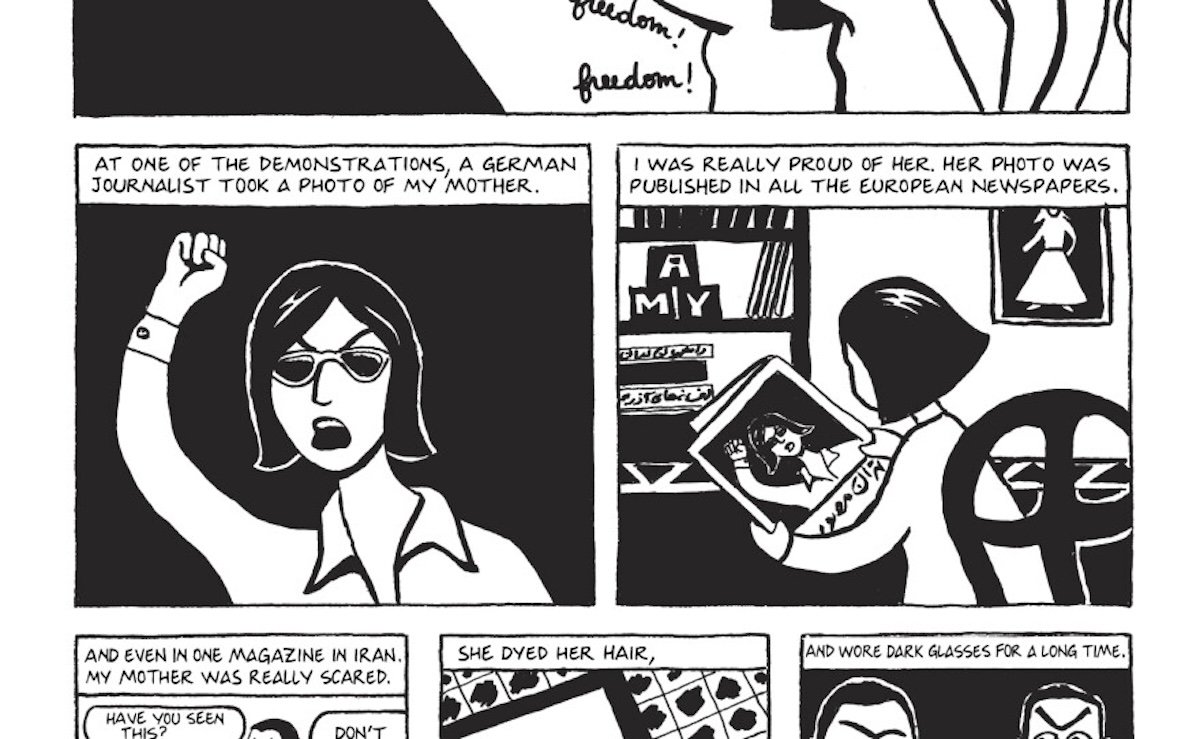
Marjane Satrapi, the Iranian-born graphic novelist and filmmaker, died last week in Paris at age 56, just as renewed hostilities between Israel and her native Iran brought her work back into sharp focus. Her memoir Persepolis, first published in 2000, has long been celebrated for blending personal narrative with the political upheavals that shaped modern Iran. But the book has also stirred controversy, particularly among those who see it as a polemic against the Islamic Republic.
Satrapi’s genius lay in her ability to embed her own coming-of-age story within the larger arc of Iran’s 20th-century history. In Persepolis, she recounts how Reza Khan, an Iranian officer, overthrew the Qajar dynasty after World War I and sought to establish a secular republic. The British, who had already installed monarchies in Iraq and Jordan, persuaded him instead to crown himself shah in 1925, founding the Pahlavi dynasty. That dynasty would be toppled in the 1979 Islamic Revolution, a pivot point that Satrapi explores through the eyes of her younger self.
The book does not pretend to be a neutral history. Critics have accused it of historical inaccuracies, but that misses the point. Satrapi was not a historian; she was an artist drawing on her own experiences of life both inside and outside Iran. Her bold, monochrome panels convey the emotional truth of living through revolution and war, not a dry recitation of facts.
A Teacher’s Controversial Assignment
The polarizing nature of Persepolis was brought home to me in 2007, when I assigned it in a history of Iran class at Bogazici University in Istanbul. Students affiliated with the campus Communist party objected, arguing that the book’s focus on religious oppression under the Islamic Republic was a covert argument for regime change. Protests outside my classroom grew so intense that I was forced to resign and leave Turkey.
I had assigned the book for the same reasons any teacher assigns a text: it was relevant to the subject, artistically worthwhile, and I knew it intimately. The controversy underscored how Satrapi’s work can provoke strong reactions, precisely because it refuses to simplify Iran’s complex history.
The book opens with the revolution, as Marjane’s father, Ebi, explains to his daughter why they took to the streets: “2,500 years of tyranny and submission. First our own emperors. Then the Arab invasion from the west. Followed by the Mongolian invasion from the East. And finally modern imperialism.” By “modern imperialism,” he means the British support for Reza Shah’s ascension in 1925, the British and Soviet invasion during World War II, and the 1953 coup that toppled Prime Minister Mohammad Mossadegh—a joint operation by MI6 and the CIA that reinstalled Mohammad Reza Pahlavi.
From then on, the United States supplied the shah with advanced weaponry, including F-14 fighter jets, to counter the Soviet Union during the Cold War. American military advisors on Iranian soil fueled nationalist resentment, which culminated in the 1979 revolution. Persepolis captures the chaos of that period, when Ayatollah Khomeini’s faction consolidated power amid the Iraqi invasion of Iran in September 1980. The resulting war revived Iranian nationalism and pro-republic sentiment.
One of the most poignant passages in the book involves the song “Ey Iran.” During the Iran-Iraq War, Marjane hears it on state radio to accompany news that Iran’s F-14 fleet had raided Iraq in retaliation for bombing Tehran. The song, however, predates both the monarchy and the Islamic Republic. It was written by poet Hossein Gol-e-Golab during World War II, after he witnessed an American soldier beating an Iranian greengrocer. The lyrics begin: “Oh Iran, oh bejewelled land / Oh, your soil is the wellspring of the arts / Far from you may the thoughts of evil be / May you remain lasting and eternal.”
Satrapi does not shy away from the contradictions of her characters. Her father, a leftist who initially opposed the shah, ended up resenting the Islamic Republic. He would weep upon hearing “Ey Iran.” To this day, any Iranian student of mine who hears the song becomes tearful. The song’s enduring power—born from a single encounter with an American soldier—raises a sobering question: what artistic legacy will emerge from the latest American war in the Middle East?
Satrapi’s work remains essential reading for anyone trying to understand Iran’s deep-seated resentment of foreign interference. As tensions between Iran and Israel escalate, her stories remind us that the region’s conflicts are not just geopolitical chess games but lived realities for millions. For more on the broader regional dynamics, see our analysis of why Trump pulled back from renewed war with Iran and the enduring crisis in the Middle East that has no military solution.