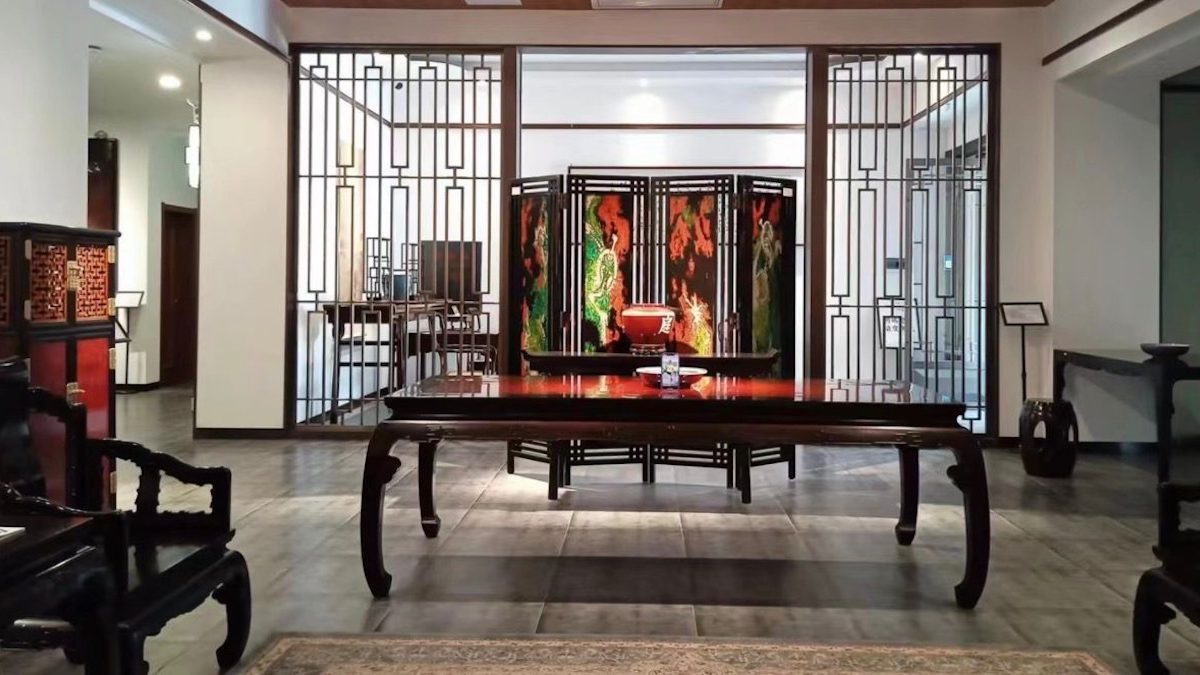
Stand before a Ming-style horseshoe-back armchair, and a quiet surprise sets in. It does not read as an antique. It reads as a piece of modern design completed centuries too early. There is no imperial pomp, no crowded carving, no mother-of-pearl inlay. Four legs touch the ground. The arms open outward. The back curves with restraint. Under the light, the wood grain moves. The object is silent, yet its structure, proportion, and hierarchy are unmistakable.
The value of Chinese classical furniture lies not in a vague label of “Eastern style.” It lies in how timber, craftsmanship, bodily scale, spatial etiquette, and collecting history converge into a daily object that becomes a form of civilization.
The Hierarchy of Wood
According to Shi Hao, founder and director of the Donghu Rosewood Museum in Wuhan, the three great tribute woods of antiquity—huanghuali, zitan, and dahong suanzhi—were selected for imperial use during the Ming and Qing periods. Known as “first yellow, second purple, third red,” they define a material hierarchy. Huanghuali is prized for warmth and grain; zitan for density and gravity; dahong suanzhi for deep red tone and stability.
Among Ming-style furniture, huanghuali holds a special place. The finest Hainan huanghuali glows in tones of amber, honey, and reddish brown. Its grain may resemble mountains, running water, or drifting clouds. Most distinctive are the guilian or limian patterns—ghost faces or lynx faces—dark brown clusters that look like theatrical masks or ancient coins. These images are not carved; they grow from within the wood. This is why Ming furniture often prefers plain surfaces: it respects the material. Excessive carving would interrupt the wood’s own painting.
From the middle and late Ming period onward, fine hardwoods entered elite furniture through southern trade, maritime commerce, and the consumer culture of Jiangnan. As large pieces became scarce, huanghuali came to be regarded as “gold among woods.” The literati liked it unadorned because the grain itself was the event.
Today, the Donghu Rosewood Museum occupies about 2,000 square meters and houses more than 400 pieces of precious classical rosewood furniture. Through research and development with expert teams from the Palace Museum and the Shanghai Museum, it uses Suzhou-style craftsmanship to revive the elegance of Ming furniture. This signals that Ming-style furniture is no longer only an antique category in the collecting market; it has returned to material study, craft history, museum research, and contemporary aesthetic education.
The Grammar of Structure
After material comes structure. The most refined part of Chinese classical furniture is often hidden at the joints. Mortise-and-tenon construction is not merely the romantic idea of “using no nails.” It is a structural system for dealing with force, expansion, contraction, weight, and stability. Wood moves with humidity; metal nails can injure its nature. Mortise and tenon allow furniture to breathe within limits, which is why so many pieces have survived for centuries.
To understand a horseshoe-back armchair, one must see how the arms extend from the back, how the back splat receives the human body, whether the legs splay just enough, how the stretchers distribute force, and how aprons and openings balance support with visual rhythm. Luoguo stretchers, ba wang stretchers, mitered frames with floating panels, waisted construction, foot supports, and soft seats are not antique terms; they are the grammar of structure.
If the proportion is wrong, the spirit of the object collapses. If the arm is too high, the body resists. If the back is too straight, one does not wish to remain seated. If the legs are too thick, lightness disappears. Fine Ming furniture is not simply “simple.” It is accuracy after compression. Minimal appearance is only the surface; precision is the essence.
In the traditional craft system, measurement was never casual. Ming carpenters, especially in Jiangnan, often used the Luban ruler—also called the menguang ruler or bazi ruler—to determine dimensions. Luban, whose personal name was Gongshu Ban, was a celebrated craftsman of the state of Lu during China’s Spring and Autumn period (roughly 770 to 476 BCE). This period overlaps broadly with archaic Greece and the Roman kingdom. At a time when the foundations of Eastern and Western civilizations were both being laid, Chinese craft culture was already linking technique, measurement, and symbolic order. The Luban ruler divided measurement into auspicious and inauspicious positions, with favorable characters including wealth, righteousness, office, and good fortune.
This revival of material knowledge and structural precision is not confined to one institution. It reflects a broader cultural reengagement with China’s classical heritage—one that values order, character, and time preserved in wood. For those interested in how narrative tools shape China's strategy, or how economic indicators reveal deeper truths, the story of Ming furniture offers a tangible parallel: beneath the surface lies a system of precision and meaning.