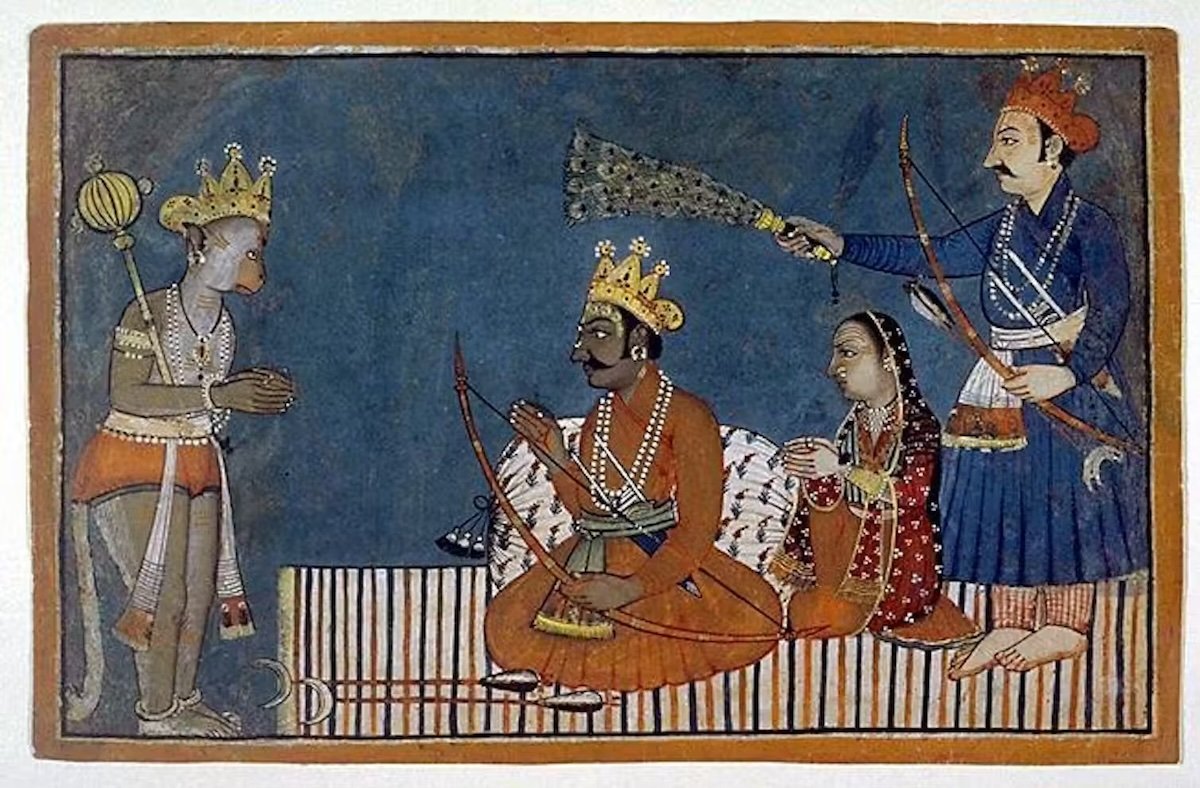
American audiences will soon see a new Hindi-language adaptation of the Ramayana, dubbed into English and released in theaters in November 2026. Directed by Nitesh Tiwari, the film is the latest in a long line of retellings of the ancient Sanskrit epic, which has been reimagined across South Asia for centuries in dramas, puppet shows, folk songs, and television series.
The Ramayana, composed between 400 BCE and 400 CE, follows Prince Rama, an incarnation of the god Vishnu, as he rescues his wife Sita from the demon king Ravana. Its themes of exile, loyalty, and moral duty have resonated far beyond the subcontinent, and Hollywood has repeatedly turned to the epic for inspiration.
From colonial India to New York boarding schools
One striking example is Alfonso Cuarón's 1995 film A Little Princess, an adaptation of Frances Hodgson Burnett's 1905 novel. The film opens with Sara Crewe, the daughter of a British Army captain stationed in colonial India, narrating the Ramayana to her classmates. Cuarón visualizes the epic with scenes of Rama and Sita in a lush forest, and when Sita is abducted by Ravana after stepping outside a protective circle, the story mirrors Sara's own life.
After her father is presumed dead in World War I, Sara is reduced to servitude in a New York boarding school. She draws a chalk circle on the attic floor, echoing Rama's protective circle, and is eventually rescued by her father, who returns to take her back to India. Cinema scholar Jyotsna Kapur notes that the Ramayana serves as an imaginative thread binding father and daughter through their separation.
Hanuman on screen
The divine monkey Hanuman, a beloved figure in the epic, has appeared in multiple films. In Pixar's 2015 short Sanjay's Super Team, director Sanjay Patel reimagines Hanuman, Vishnu, and Durga as superheroes, helping a young Indian American boy appreciate his family's traditions. The film was nominated for an Academy Award.
In Marvel's Black Panther films, the Jabari tribe worships a gorilla deity referred to as Hanuman, a nod to the epic's influence. The character M'Baku proclaims "Glory to Hanuman!" in both movies, blending African and South Asian mythological elements.
Dev Patel's 2024 action-thriller Monkey Man places Hanuman at the center of a revenge story. The unnamed hero, an Adivasi from an Indigenous Indian community, is inspired by Hanuman to avenge his mother's rape by a corrupt policeman working for a Hindu nationalist leader. The film draws on the Ramayana and American revenge thrillers like John Wick to address sexual violence and religious extremism in contemporary India.
Ramayana and Hindu nationalism
The 2008 Oscar-winning Slumdog Millionaire also engages with the epic's political dimensions. The film's protagonist, Jamal Malik, a Muslim contestant on the Indian version of Who Wants to Be a Millionaire?, is asked a question about the Ramayana. The reference evokes the 1992 demolition of the Babri Masjid in Ayodhya, which Hindu nationalists claimed was built on Rama's birthplace. The riots that followed killed over 2,000 people across South Asia.
These films show how the Ramayana remains a living tradition, adaptable to new contexts and concerns. As my research on cinematic adaptations of the epic shows, Hollywood's engagement with the Ramayana is not merely exoticism but a way to explore universal themes of exile, identity, and justice. The upcoming 2026 film is likely to continue this trend, bringing the epic to a new generation of viewers.