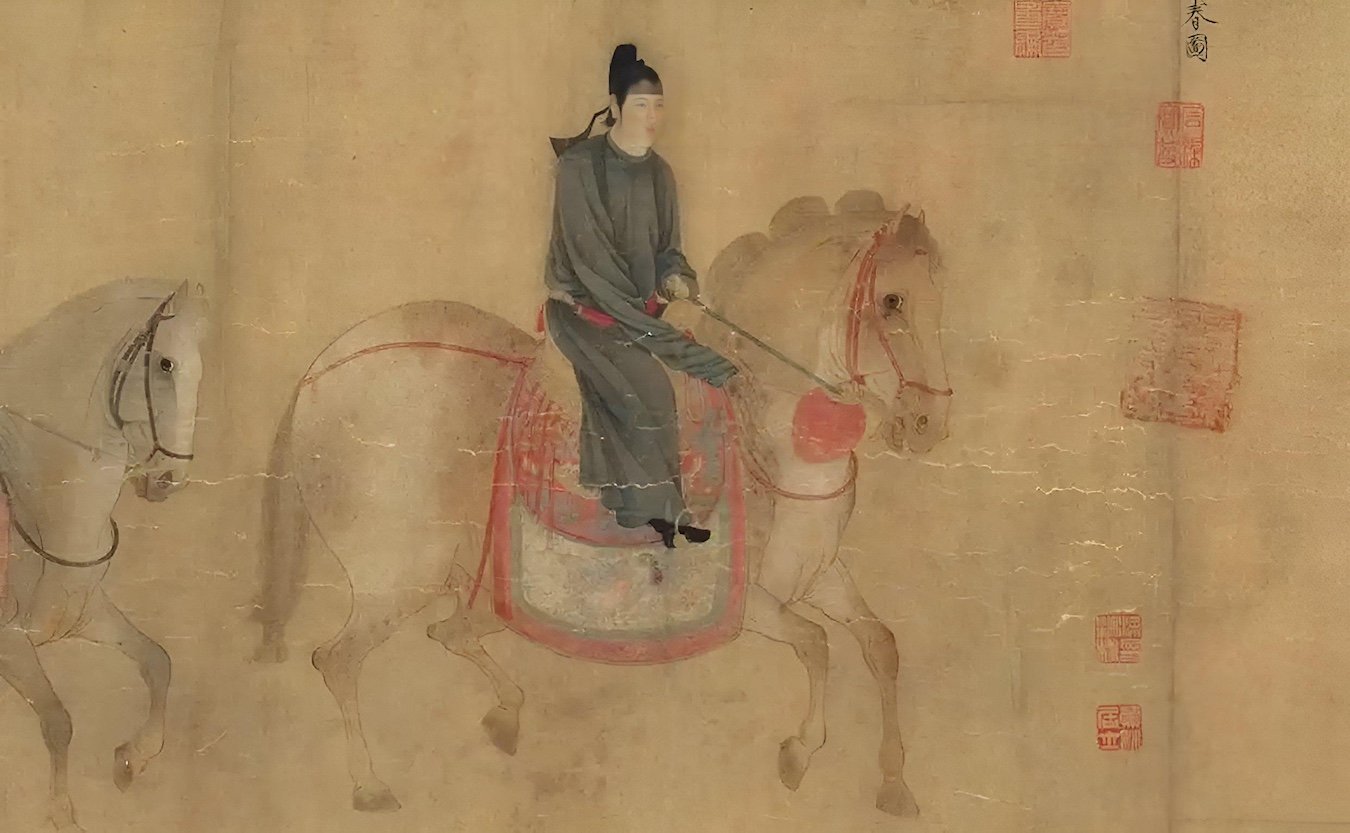
Standing before The Court Lady Guoguo's Spring Outing, a visitor does not first encounter history. They encounter movement. There is no palace, no riverbank, no flowering tree. Across the silk handscroll, only a small procession moves through an empty field: nine figures, eight horses, robes of pale red, green, and white. The painter does not describe spring; he allows it to pass through the riders.
The work, known in Chinese as Guoguo Furen Youchun Tu, is traditionally attributed to the Tang dynasty master Zhang Xuan. What survives today, however, is not the Tang original but a Song dynasty copy. It now resides in the Liaoning Provincial Museum as a national-level relic, a rare visual witness to the elegance, power, and fragility of the High Tang.
A Cosmopolitan Capital
The Tang dynasty, especially under Emperor Xuanzong in the early eighth century, represented one of the most cosmopolitan moments in Chinese history. Chang'an, the imperial capital, was a metropolis comparable to Constantinople, Abbasid Baghdad, or Renaissance Florence. Merchants, monks, musicians, and envoys moved through its streets. Its court absorbed Central Asian music, foreign textiles, Buddhist imagery, and equestrian culture. Women of the aristocracy rode horses, appeared in public, and sometimes dressed in garments associated with men. The world of this painting could only have emerged from such confidence.
At the center of this historical atmosphere stood Yang Guifei, the beloved consort of Emperor Xuanzong. Often compared to Helen of Troy or Marie Antoinette, she was a Tang woman whose beauty, family, and fate became inseparable from the memory of an empire at its most radiant and vulnerable. Her family rose with her. Her sisters were granted noble titles: the Ladies of Han, Guo, and Qin. Among them, Lady Guoguo became one of the most visible women of the imperial circle, not merely a court beauty but a figure whose dress, movement, and presence became part of political theatre.
The handscroll shows such theatre without drama. The procession is arranged in groups. The horses move at different tempos; some advance, some turn, some pause within the rhythm of the journey. The riders' robes fall in controlled lines. Their faces are calm, almost unreadable. Nothing is hurried. Nothing is accidental.
The Front Rider: A Radical Interpretation
One of the most fascinating interpretations concerns the rider at the very front. Some Chinese art historians argue that the figure dressed in male attire and leading the procession may be Lady Guoguo herself. This is not universally accepted; the painting bears no label identifying each figure. Other scholars place her among the central female riders. Yet this essay follows the first reading, not because it is the most dramatic, but because it is the most revealing.
Lady Guoguo, as remembered by history, was not a woman easily imagined in retreat. She belonged to the Yang family at the summit of imperial favor, a family whose women did not merely inhabit privilege but made it visible. The horse strengthens this reading. Its three-flower mane, shaped into raised tufts along the neck, and the round red tassel ornament on its chest are marks of rank, ceremony, and aristocratic display. If this rider is placed first, dressed like a young nobleman, and mounted on so distinguished an animal, she is not merely joining the procession. She is announcing it. She becomes the first figure seen because she is the figure meant to be seen.
If Lady Guoguo is indeed the figure at the head of the procession, the image becomes quietly radical. A woman of high rank would normally be expected to remain protected within the middle of a retinue, surrounded by attendants, shielded by order and distance. Rank in courtly society was expressed not only through luxury but through placement. To be placed in the center was to be protected. To ride in front was to be seen first.
The front rider's dress, posture, and mount therefore matter. Male attire on elite women was not unknown in Tang China, but on such a figure it becomes more than fashion. It becomes declaration. The horse, too, is not a decorative animal. In Tang court culture, the mount, its trappings, and its position in the procession all carried signals of status. A noble woman on horseback was not the same as a woman hidden in a carriage. She occupied space. She entered the world.
This painting survives as a testament to a moment when an emperor's flight—Xuanzong's retreat from Chang'an during the An Lushan Rebellion—shattered the world it depicts. The spring outing, frozen in silk, outlasted the dynasty. For an informed audience, it offers a window into the complexities of Tang society, where gender, power, and visibility intersected in ways that still resonate. As Asian economies assess fallout from global shifts, such cultural artifacts remind us of the region's deep historical layers.