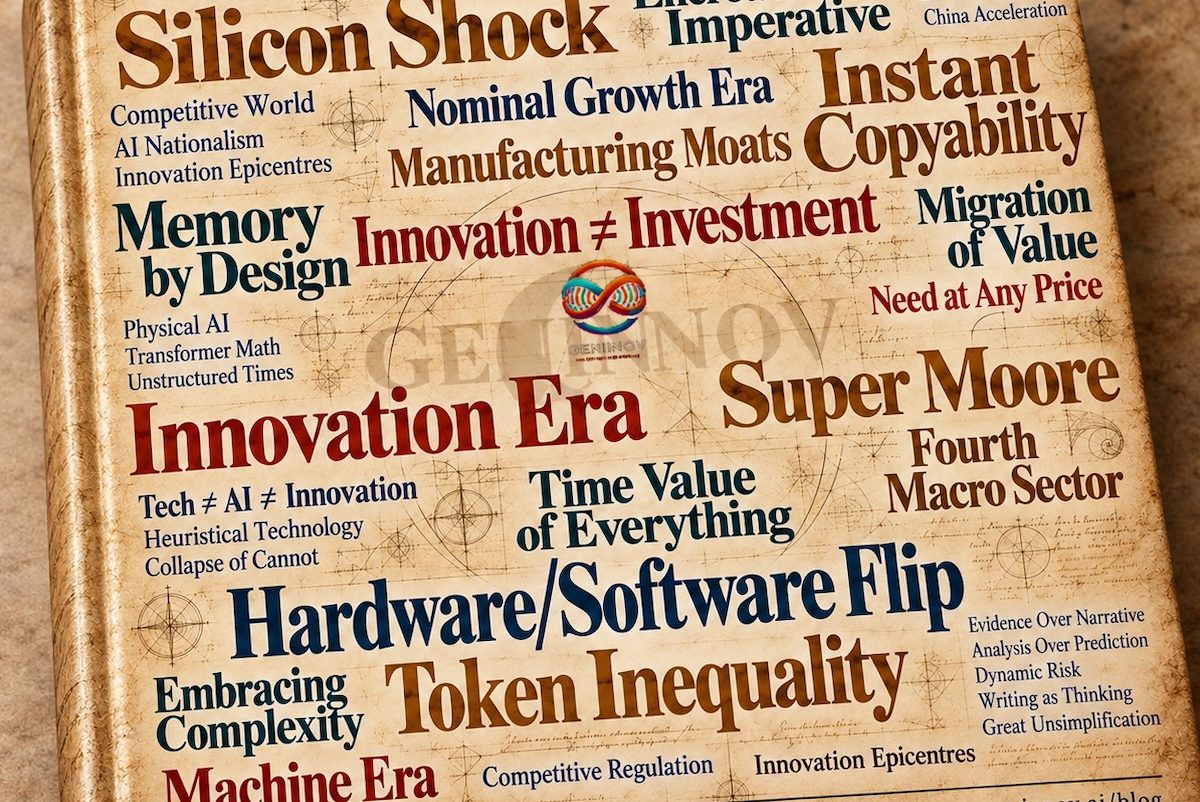
Since 2023, our essays have built a worldview piece by piece. Readers who joined mid-conversation often stumble over terms like the hardware/software flip, super Moore, or token inequality. This glossary is our attempt to lay out the ideas that define our thinking—no alphabet, no predictions, just the order in which we reason.
We start with the changing nature of innovation and machine intelligence, move through competition and the unraveling of the old software order, then turn to the return of the physical stack and the redrawing of geography and power. We end with the questions we keep brooding over and how we try to invest in all of it. Each idea stands alone, but together they form a coherent lens on the AI era.
The innovation era: a billion Einsteins
We have entered what we call the innovation era. General-purpose models now hold dozens of fields at once, working alongside scientists in biology, chemistry, mathematics, materials, and chip design. In recent months, they have designed proteins that bind in the lab, overturned an 80-year-old Erdős conjecture, and lifted a long-standing bound on the Riemann hypothesis. Machines are only half the story. Capital, talent, and corporate and government attention are turning toward invention with an intensity unseen in decades.
Much of the gain comes from crossing boundaries. We divided knowledge into fields because one skull could hold only so much, and every handover between specialists loses time and part of the question. Models carry no such limit, and nature never agreed to our departmental charts. Some of the biggest discoveries may sit in the gaps between disciplines whose experts rarely talk. The loop is also closing: models now help design the algorithms, data, and chips that train their successors.
AI is the engine; innovation is the theme. Chatbots, humanoids, agents, and any given chip architecture are passing manifestations. Many will fail. That is why we run an innovation fund, with themes we expect to keep changing.
Fourth macro sector and the GenAI rupture
Agriculture, industry, services—and now a fourth macro sector: machines that produce cognition. In this Machine Era, machines analyze, design, code, diagnose, and discover. They are starting to act in the physical world. When output no longer needs matching human thought, the lines between capital, labor, and services blur. Investors should spot the sector before statisticians name it. Like its predecessors, it needs its own factories, materials, and energy.
Transformer-led GenAI is a break from the AI that came before. The internet connected people to existing information. Generative systems create, infer, and recombine it. Calling rules engines, narrow prediction models, and today’s systems all “AI” hides the gap. Expertise built on the old architectures buys little on the new one. Incumbency can even hurt when existing products and economics limit how far a company will rebuild. Nor is the new architecture settled. Transformers and their successors will keep evolving fast, often in directions nobody planned.
Super Moore and the hardware/software flip
Moore’s Law described one exponential. Today dozens run at once: transistor density, parallelism, memory bandwidth, networking, model scale, algorithms, quantization, synthetic data, software optimization, and increasingly machines doing research themselves. Their interaction is the Super Moore Era. When one layer stalls, another carries the load. When several advance together, gains compound. Progress arrives from many directions at once. Few people see the next turn coming, including those building it. Ideas now spread as fast as they improve—the same acceleration seen from the competitor’s side.
Cheaper intelligence also means more of it. When cost falls and usefulness rises, consumption explodes. The largest effect is often demand that did not exist before. An efficiency breakthrough rarely ends hardware demand. This is why the hardware buildout will last for years, as computing swings back from personal devices to collective machines. Profits are shifting from software to hardware, and capex is now the price of admission in technology. Companies that hoard cash lose out; those that invest in memory, packaging, optics, cooling, and power—not just processors—gain an edge.
This shift has profound implications for Asia. Japan’s semiconductor revival, South Korea’s memory dominance, and Taiwan’s foundry leadership are all central to the new hardware economy. Meanwhile, China’s push for self-sufficiency in chips and AI is reshaping global supply chains. The US-China AI race is no longer just about frontier models but about who can deploy them at scale.
Token inequality and the new geography of power
Access to tokens and compute is becoming the new inequality between companies and countries. Those with abundant compute and data will pull ahead; those without will fall behind. This is not just a corporate concern—it is a geopolitical one. Governments from New Delhi to Jakarta are waking up to the strategic importance of AI infrastructure. The pragmatic deals between Indonesia and Singapore on digital and data flows are a sign of the times.
AI will spill out of technology into economics, geopolitics, and domestic politics. Risk changes when technology turns capital-hungry, growth turns nominal, and shares become currency. An announcement, a roadmap, or even real technical progress must never be mistaken for an investment case. With the elevator pitch dead and visibility collapsing, we stay ambitious about technology while assuming most companies, architectures, and theses will fail.
This glossary is our current answer to those questions. It is not a prediction but a framework—one that we hope will help readers navigate the AI era with clarity and purpose.