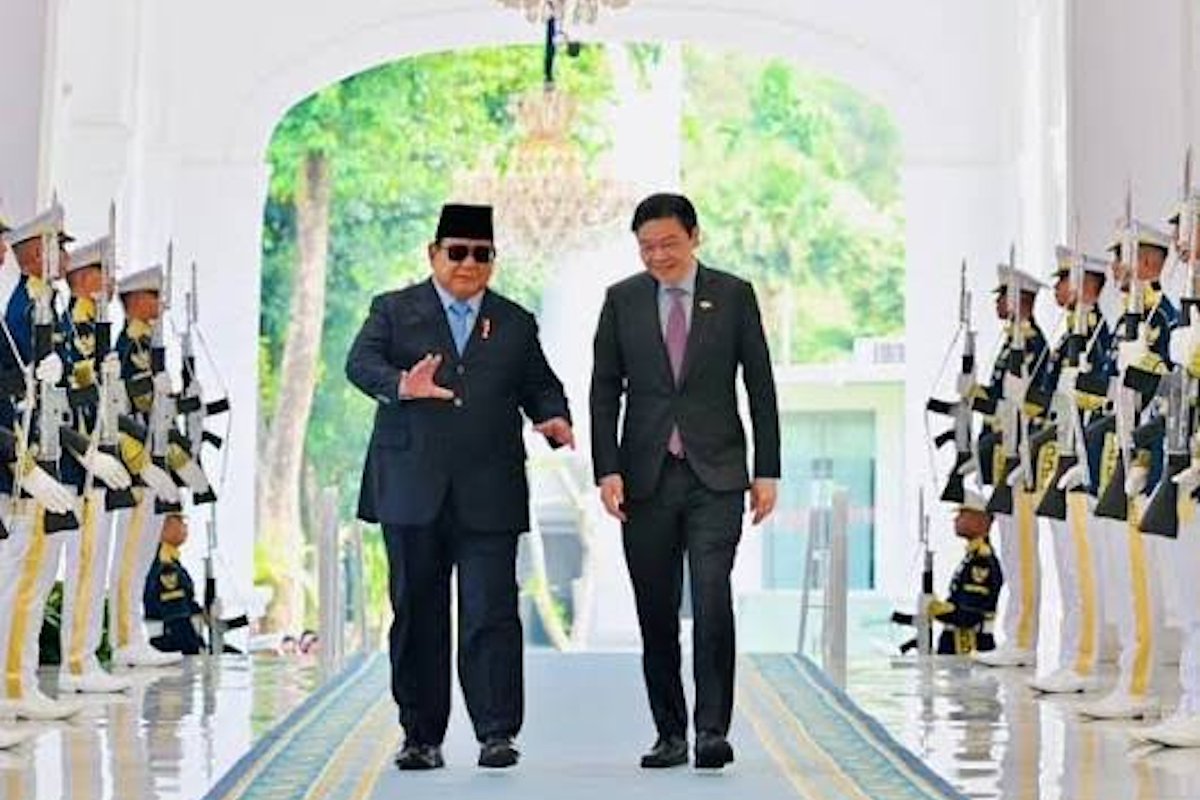
The annual Indonesia-Singapore Leaders' Retreat, held at Merdeka Palace in Jakarta on July 6, was more than a routine diplomatic exercise. With Indonesian President Prabowo Subianto and Singapore's Prime Minister Lawrence Wong presiding, the summit marked the full consolidation of a new generation of leadership in both nations.
Flanked by key Cabinet members, including Deputy Prime Minister and Minister for Trade Gan Kim Yong and Defense Minister Chan Chun Sing, Wong was received with formal military honors on the palace grounds before beginning intensive talks. The official schedule yielded 26 deliverables, comprising 18 government-to-government pacts and eight business-to-business agreements, spanning sectors including supply chain resilience, digital infrastructure and clean energy interconnection.
Strategic Calculus Shifts
From a regional standpoint, the retreat signaled a shift in strategic calculus. The headline agreements went well beyond routine diplomacy, laying out frameworks for cross-border electricity trading, multibillion-dollar solar projects in Morowali backed by the Indonesia Investment Authority and Sembcorp, and cross-border insolvency legal cooperation. Against a volatile global backdrop, the moves by both nations sent a strong signal to regional markets. Singapore needs physical space and supply chain certainty, while Indonesia under Prabowo is pressing for more equitable partnerships, domestic industrial downstreaming and recognition of its growing economic weight in Southeast Asia.
Yet behind the handshakes and photo opportunities was a more complicated picture. The retreat took place as escalating tensions in the Middle East repeatedly threatened the security of the Strait of Hormuz, pushing Singapore to look warily toward the nearby Strait of Malacca. The city-state's central concern is ensuring its immediate neighborhood remains insulated from Indonesia's increasingly assertive resource nationalism. Jakarta, meanwhile, used Wong's visit to showcase its new sovereign wealth fund, Daya Anagata Nusantara (Danantara), gently positioning it as a rival to Singapore's Temasek and GIC. Both leaders tested the limits of pragmatic compromise amid growing global turbulence.
Tensions Beneath the Surface
Assessing Indonesia-Singapore relations requires unvarnished realism, without the diplomatic platitudes that often characterize ASEAN's formal rhetoric. Analysts suggest Prabowo views Singapore with a mix of respect for its economic efficiency and a firm resolve that Indonesia will no longer be treated merely as a source of cheap raw materials. Prabowo has signaled he expects a more reciprocal relationship prioritizing balanced, mutual gains. Prime Minister Wong, by contrast, is seen as viewing Indonesia as an unavoidable giant, a nation whose market potential and geographic scale will shape Singapore's economic prospects for decades to come.
While the bilateral relationship is institutionally stable — cemented by full implementation of long-stalled agreements on flight information regions, extradition and defense cooperation — structural friction points mean tensions still simmer beneath the surface. The sharpest point of friction lies where regulatory shifts collide with economic nationalism. Jakarta's stop-and-start policies on exporting sea sand and sediment for Singapore's land reclamation projects remain a persistent sticking point. Singapore views the bans as arbitrary constraints on its need for physical expansion, while Jakarta frames them as matters of ecological sovereignty and maritime boundary enforcement.
Indonesia's mandates for local data center hosting and required technology transfers in green energy projects are also forcing Singapore's economic planners to recalculate profit margins. The current alignment between the two capitals is driven largely by pragmatism: both need high growth and regional stability.
Geopolitical Balancing Act
This bilateral dynamic is further shaped by the wider US-China rivalry. Singapore maintains a long-standing strategic and military alignment with Washington while serving as a major financial conduit for Chinese capital. Indonesia, meanwhile, under Prabowo's "free and active" foreign policy doctrine, is balancing Beijing's economic footprint in its nickel downstreaming and infrastructure sectors by upgrading defense ties with the United States and its Western allies. Some in Singapore fear Indonesia could swing too far into Beijing's economic orbit, a shift that could upend the security balance in the South China Sea and the Strait of Malacca. Jakarta, in turn, remains wary of Singapore's diplomacy, at times viewing it as overly accommodating to US security architecture in Southeast Asia — a posture that risks provoking Beijing and fracturing ASEAN unity.
These tensions echo broader regional concerns. As ASEAN's Decade of Silence on the South China Sea ruling shows, the bloc's consensus-based approach often masks deep divisions. Meanwhile, Indonesia's push for downstreaming, particularly in nickel, has created its own vulnerabilities, as China's role in Indonesia's nickel boom raises questions about long-term dependency.
Food Insecurity and Malacca Trepidation
The most urgent driver behind Wong's visit to Jakarta is Singapore's shortage of land to meet its energy needs and net-zero emissions targets. The island nation lacks the land mass required to deploy large-scale renewable energy infrastructure. The cross-border power trading framework and the Morowali solar project signed at the summit amount to an economic lifeline for Singapore. Without green electricity imports from Indonesia, Singapore's manufacturing hubs and data centers risk losing global competitiveness and failing to clear international carbon requirements. Wong sought long-term legal certainty to ensure billions in investments by Singaporean entities are not derailed by shifts in Indonesian domestic politics.
Beyond the power grid, Singapore's food security also looks fragile. Global supply chain disruptions have made food source diversification a priority, and Indonesia is the most logical option. However, Jakarta's economic trajectory under Prabowo — including the centralization of state control under Danantara's super-holding company and an emphasis on domestic food self-sufficiency — sits somewhat uneasily with Singapore's free-market business model. The retreat ultimately underscored a new era of ASEAN transactionalism, where bilateral ties are driven less by sentiment and more by hard-nosed calculations of mutual benefit and strategic necessity.