On June 21, in the hills of Hpapun Township, Karen State, Major Kyaw Min Thant, commander of the junta's Light Infantry Battalion 19, was shot dead by his own bodyguard—a forcibly conscripted civilian from Bago Region who had been abducted five months earlier. Within days, that conscript and 21 others, including recaptured deserters under death sentence, walked into Karen National Liberation Army lines and defected.
The incident is emblematic of a conscription policy that briefly gave Myanmar's junta a manpower boost—and is now, two and a half years in, unraveling from within. Western policymakers told the regime has “stabilized” should examine the battlefield closely before weighing engagement, sanctions relief, or post-election recognition.
The Bubble and Its Leaks
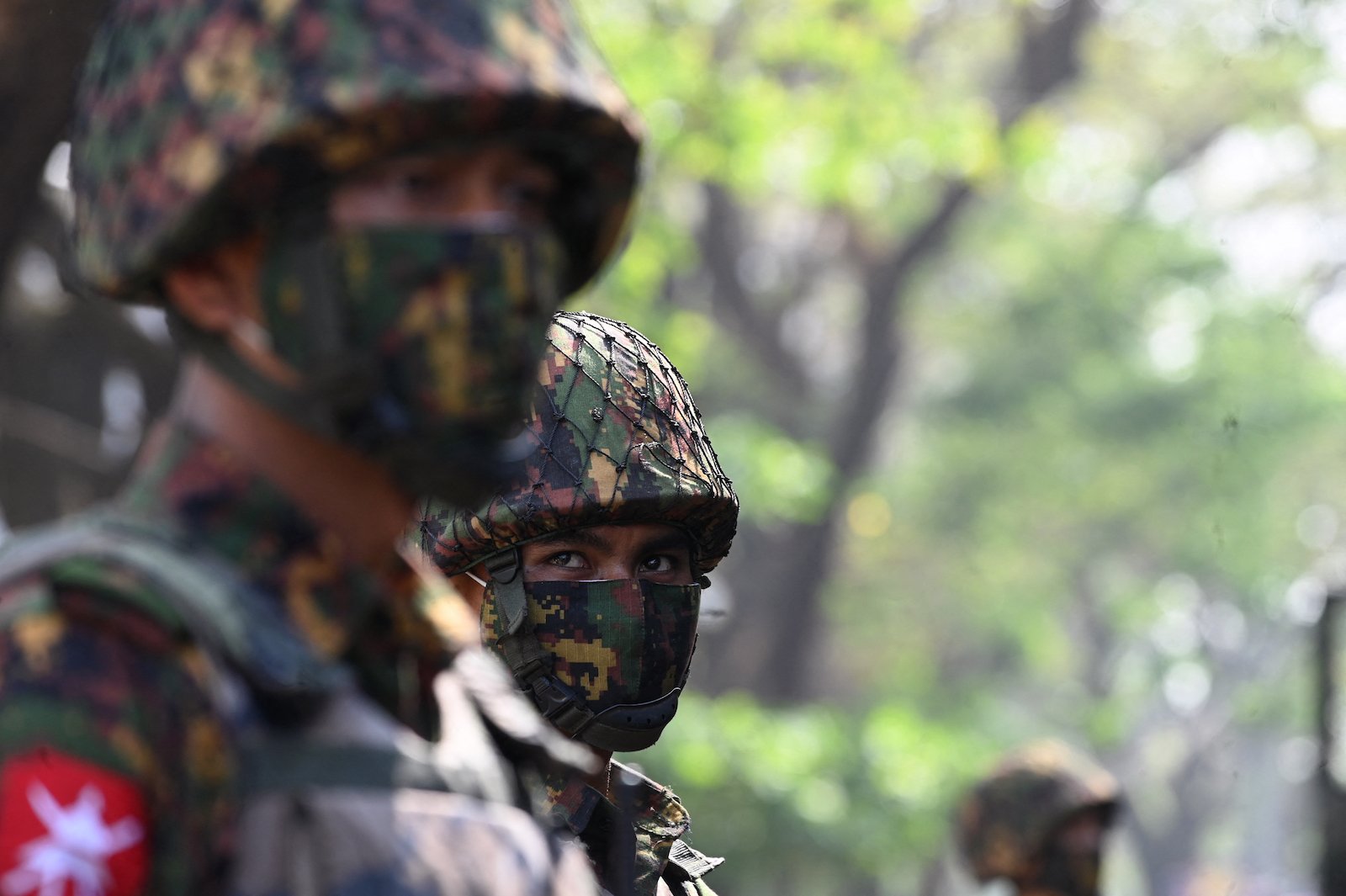
The Tatmadaw activated the dormant 2010 People's Military Service Law on February 10, 2024, after losing more than half the country's townships in a coordinated resistance offensive. It has since inducted roughly 120,000 men through 25 conscription cycles, with over 60,000 forcible recruitments in 2025 alone—six times the 2020 intake. Unlawful Conscription Watch has verified 32,974 individual cases between May 2025 and May 2026.
The conscripted manpower bought a window. Coup leader Senior General Min Aung Hlaing retook roughly 20 towns, including Falam, Lashio, and Myawaddy, and pushed columns into Hpapun and Kyaukphyu. Expanded drone units, mechanized paratroopers, and gyrocopters added tactical options. But resistance forces still control approximately 87 towns as of mid-May, and most “recaptures” are urban pinpoints—a battalion planted in a town center for a propaganda photograph while resistance forces reorganize in surrounding villages.
The 2024 law set a nominal two-year term for conscripts, and that clock has now expired for the first wave. Fearing the next intake will collapse if it doesn't release anyone, the regime has let a token cohort go home. But an “emergency” clause lets it retain conscripts for up to five years, and it is using that clause aggressively. Accounting for men killed, disappeared, or deserted, fewer than half of all conscripts have returned to civilian life; only about 12% have been formally released.
Conscripts are sent to the front straight from training, violating the junta's own February 2024 pledge. At Kyaukphyu's besieged Taung Maw Oo naval base in Rakhine State, hundreds of new recruits have not broken the Arakan Army's siege and are quickly becoming casualties or deserters. Resistance fighters on the Karen front describe having to pause fighting periodically to let junta units collect the bodies of freshly conscripted troops killed in wave after wave.
Desertion and defection are now structural. The Hpapun conscript who killed his commander planned it from the moment his column left base, gained the officer's trust to be assigned as bodyguard, and coordinated 22 personnel in a single defection cluster. Similar cases surface almost weekly. The resistance's task, increasingly, is not to defeat these conscripts on the battlefield but to receive them when they cross the line.
Pinned Down and Undermanned
The junta is fighting simultaneous campaigns in every state and region except Yangon, and every front is bleeding manpower. In Arakan, an 18-month offensive has produced almost nothing; the Arakan Army now threatens Sittwe and Kyaukphyu, and allied formations push into Ayeyarwady, Bago, and Magway. In Chin, the push from Hakha into Kanpetlet and Mindat has stalled. In Kachin, Regional Military Command 4's offensive toward Shwegu has been broken up by repeated ambushes—the RMC commander himself was evacuated after being wounded.
In Sagaing, guerrilla interdiction has cut the regime's main logistics corridors. In Karen, relief columns trying to reach the besieged Waw Lay Kone garrison have collided with intensified fighting around Minlatpan. In Karenni, the regime holds urban pinpoints and nothing more; in Tanintharyi, tempo is rising against a thin junta presence.
The unit picture is most telling. All ten of the Tatmadaw's Light Infantry Divisions—LIDs 11, 22, 33, 44, 55, 66, 77, 88, 99, and 101—are simultaneously pinned to active fronts, with no strategic reserve rotating out to rest and refit. Of the army's 20 Regional Military Commands, 15 are committed to forward combat operations. RMC 16 was overrun and is being rebuilt from scratch in Lashio; RMCs 5, 9, and 15 have collapsed and cannot be reconstituted at all. This is strategic exhaustion in an order of battle. The manpower pulled in during 2024 and 2025 has been largely spent. The resistance is now destroying not just outposts but entire regime columns.
Shredded Social Contract
The Tatmadaw's social contract with the Bamar majority is gone. Mandalay lawmakers have publicly likened the junta's recruitment teams to human traffickers. Yangon families stay indoors after 7 p.m. to avoid overnight inspections, and a parallel extortion economy in deferment bribes has emerged around the ward administration system.
Skilled labor is fleeing. The International Organization for Migration recorded 2.3 million registered Burmese migrant workers in Thailand alone, with undocumented numbers more than double that; three in four Myanmar youths are no longer in education or training. The World Bank warns of “long-lasting implications for productivity and household incomes.” The border crisis originates on ground the junta itself controls—the narcotics, scam compounds, and trafficking flows alarming Bangkok, New Delhi, Dhaka, and Beijing all come out of territory where the junta's writ barely extends.
For a deeper look at the resistance's evolving structure, see Myanmar's SCEF: A Resistance Body That Demands to Be Taken Seriously. On China's limited leverage, read China's Embrace of Myanmar's Junta Chief Exposes Limits of Influence.