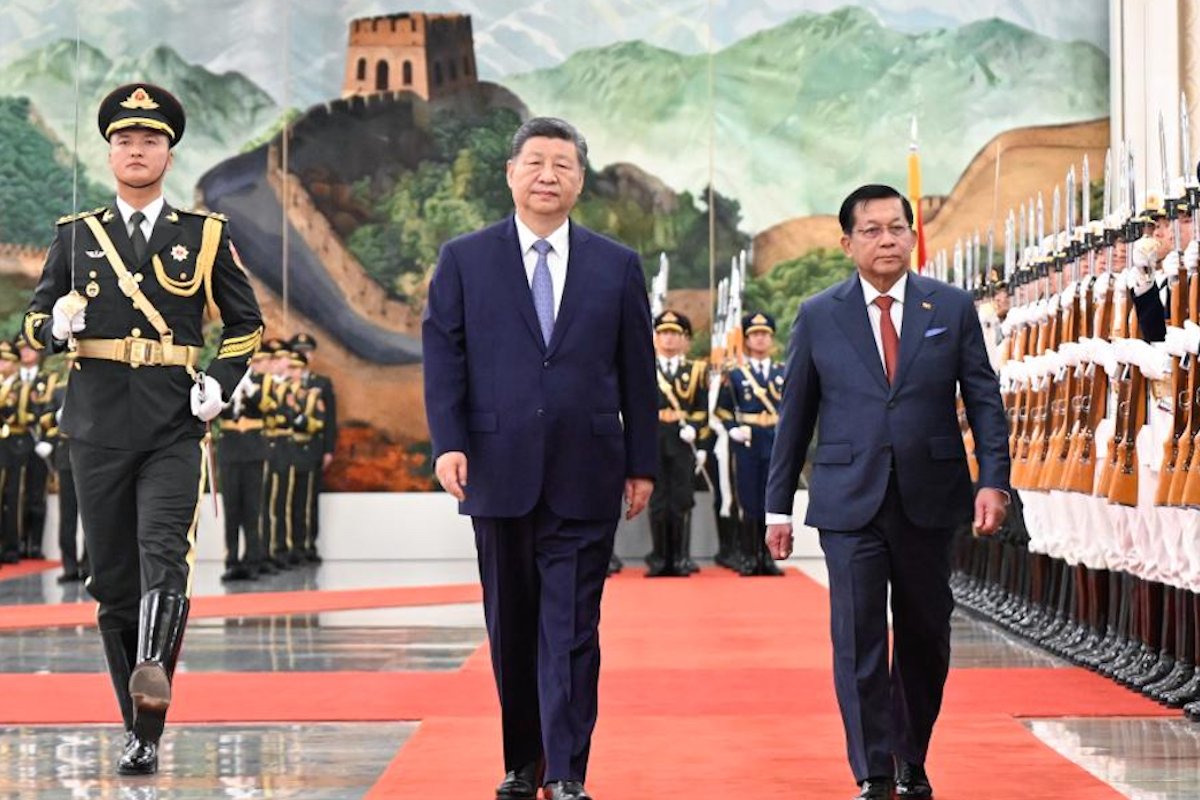
When Chinese President Xi Jinping hosted Myanmar's coup-installed leader, Senior General Min Aung Hlaing, in Beijing on June 15 with full state honors—including a Huawei phone as a gift—the optics were designed to project consolidation. But the reality on the ground tells a different story.
Five days later, at the United Nations General Assembly, Special Envoy Julie Bishop pointedly used the titles "President Win Myint" and "State Counsellor Aung San Suu Kyi"—the constitutionally legitimate officeholders deposed in the 2021 coup. The contrast between Beijing's ambitions and its actual reach has become the defining fact of Myanmar's civil war.
Signed Documents, Unsigned Projects
China's influence in Myanmar is real but increasingly exposed. The 18 cooperation documents signed during the visit covered transport, public health, and media. Yet the two unsigned agreements mattered far more: the Kyaukphyu deep-sea port, flagship of China's Indian Ocean access strategy, and the Muse–Mandalay railway, backbone of the China-Myanmar Economic Corridor (CMEC).
Three years after Beijing first framed the CMEC as the deliverable of its Myanmar bet, and two months after Min Aung Hlaing's staged December–January sham election produced his self-installed "civilian presidency," those anchor projects remain unsigned. The reason is simple: Min Aung Hlaing cannot deliver the territory through which China's hoped-for pipelines, rails, and roads must run.
Territory Held by Armed Resistance
In western Rakhine State, the Arakan Army now besieges the naval approaches to Kyaukphyu. Junta retaliation in Kyaukphyu Township has displaced more than 50,000 civilians. In northern Kachin State, the Kachin Independence Army controls the rare-earth belt that feeds China's heavy-metal separation industry—a sector already under scrutiny as Japan pushes G7 for rare earth price floors to counter China's dominance.
The Ta'ang National Liberation Army holds the rail corridor north of Mandalay. At talks brokered by Beijing in Kunming in May 2026, the TNLA refused junta demands to evacuate four further townships. China's mediation, far from a solution, has become a mirror of its own limitations.
Beijing's anxiety over its Myanmar pipeline is palpable. The arrest of a US scholar in Yunnan on espionage charges, linked to research on the pipeline's vulnerability, underscores a deeper strategic fear: that China's Malacca anxiety is now compounded by a Myanmar problem it cannot control.
The Bear Hug That Backfired
China's bear hug of Min Aung Hlaing was meant to signal that Beijing backs the junta as the only viable partner in Naypyidaw. Instead, it has exposed the junta's inability to secure the very infrastructure China needs. The CMEC, once touted as a win-win corridor linking China's Yunnan Province to the Indian Ocean, is now a dead letter in the territories that matter most.
For Beijing, the calculation is increasingly stark: continue backing a junta that cannot deliver, or pivot to engage the armed resistance groups that control the ground. Neither option is easy. The Arakan Army, the Kachin Independence Army, and the TNLA are not mere insurgents; they are de facto administrators of large swaths of Myanmar, with their own political demands and external backers.
China's diplomatic choreography in Beijing may have looked like a consolidation of power. But in the jungles of Rakhine and the hills of Kachin, the real power lies with those who hold the territory—and they are not signing any deals with Min Aung Hlaing.