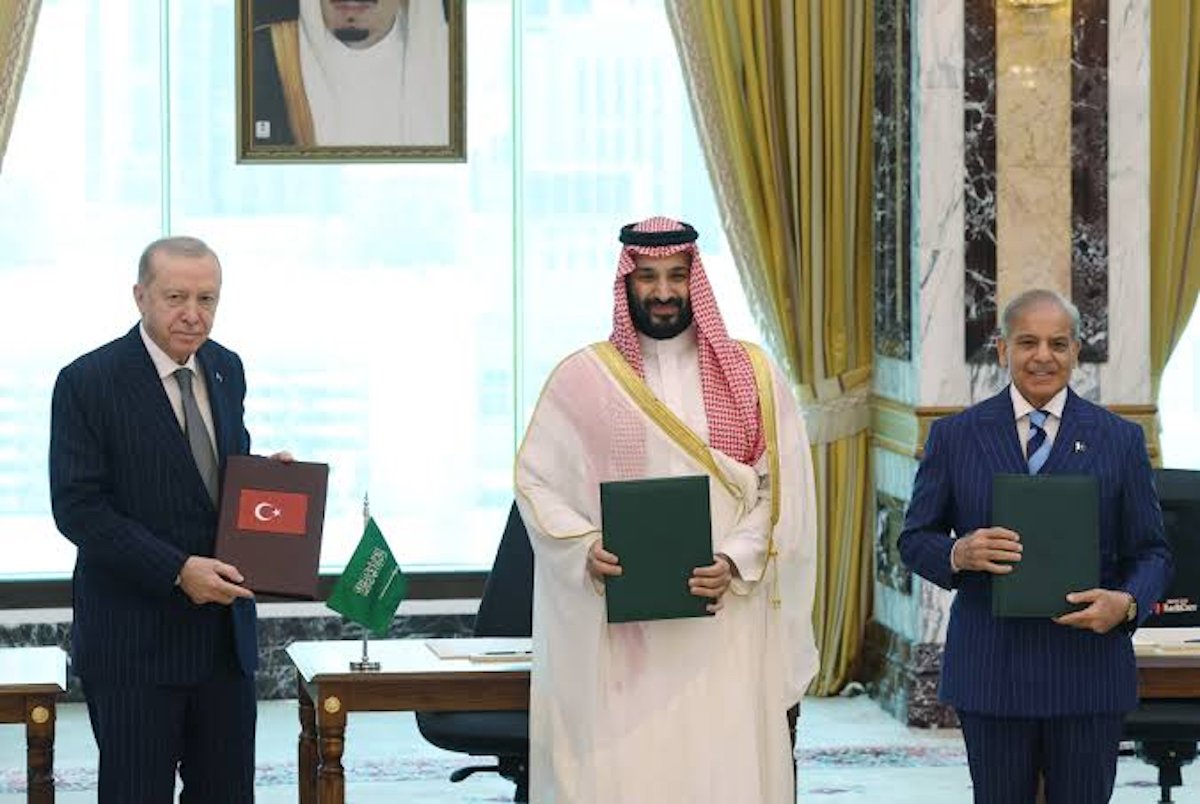
On August 7, 2026, at Al-Safa Palace in Makkah, Saudi Crown Prince Mohammed bin Salman, Turkish President Recep Tayyip Erdogan, and Pakistani Prime Minister Shehbaz Sharif signed the Makkah Joint Defense Agreement. The trilateral pact declares that an armed attack against any one of the three states will be treated as an attack against all.
The choice of venue and timing was deliberate: a Friday signing in Islam's holiest city, framed as an act of religious and civilizational solidarity. Yet beneath the symbolism lies a more sober strategic calculation, born of a region that has spent the better part of a year absorbing shocks it did not fully anticipate.
A region reshaped by war
The agreement cannot be read apart from the war that has convulsed the Gulf since February 28, 2026, when the United States and Israel launched strikes against Iran that killed Supreme Leader Ali Khamenei and triggered a prolonged regional conflict. Iran's retaliation extended well beyond Israel, reaching Saudi Arabia, Kuwait, Bahrain, Qatar, the UAE, Oman, and Jordan.
Tehran's effective closure of the Strait of Hormuz cut crude and LNG shipments through the waterway by roughly nine-tenths, a disruption serious enough that Gulf officials do not expect full flows to resume before 2027. Riyadh, in particular, absorbed direct fire while watching its economic diversification plans fall into jeopardy.
This sustained exposure, arriving despite decades of American security guarantees and billions of dollars in American arms purchases, appears to have done more to catalyze the Makkah pact than any single event. It followed and built upon a bilateral Pakistan-Saudi defense understanding signed in Riyadh in September 2025, itself a response to earlier shocks, including an Israeli strike on Doha that alarmed Gulf capitals.
The trilateral agreement can therefore be understood less as a sudden rupture than as the latest and most formal step in a gradual process of Gulf states hedging against the possibility that Washington's protection may prove selective, slow, or simply nonexistent. This dynamic is part of a broader trend of US defense decentralization leaving Asian allies exposed.
Complementary strengths, but not an integrated command
The logic of the pact rests on genuine complementarity. Turkey brings NATO's second-largest standing army and a defense-industrial base that has made it a significant drone and missile producer. Saudi Arabia brings financial depth, custodianship of Mecca and Medina, and one of the best-equipped air forces in the region. Pakistan brings the only nuclear arsenal in the Muslim world, along with a large army long involved in training and advising Gulf militaries.
Analysts have described the pact's purpose as building deterrence and balancing Iranian and Israeli influence, rather than seeking direct confrontation with either. Yet complementary assets are not the same as an integrated command. As several defense analysts have noted, the three militaries operate largely incompatible equipment: American systems predominate in Saudi service, a mix of Chinese and domestic platforms in Pakistan's, and NATO-standard as well as indigenous systems in Turkey's.
There are, as yet, no shared data links, no status-of-forces arrangements, no pre-positioned stocks, and no joint headquarters. NATO took roughly a decade, and a far more existential threat, to build that infrastructure among states that at least shared contiguous territory. The Makkah Agreement's signatories are starting, for now, from a communiqué rather than a command structure.
Watchful reactions
Reactions elsewhere have been watchful rather than hostile. Iran's initial public response emphasized Muslim unity rather than confrontation, consistent with Saudi officials' insistence that the pact is defensive and threatens no one. Israel has offered no formal comment, though some Israeli commentary has begun to describe Turkey's regional weight, alongside Iran's, as a factor to watch.
India has said it is studying the pact's implications, a natural response given its own defense ties with Israel and its long-standing, complex relationship with Pakistan. Washington, for its part, appears to view the pact as one more indicator that Gulf and South Asian partners are diversifying their security options rather than as a repudiation of the US relationship outright. The US and Gulf officials alike have described the agreement as an institutionalization of long-standing cooperation rather than a response to any single actor.
Open questions
Several questions remain genuinely open. The pact's text, so far as has been made public, leaves unspecified what obligations “collective defense” actually entails — whether troop commitments, basing rights, or purely diplomatic and economic solidarity. The three states also do not share identical threat perceptions: Pakistan's primary security preoccupation remains India, Saudi Arabia's is Iran and the Houthis, and Turkey's spans Syria, the Kurdish question, and its own complicated ties with Israel.
Whether the agreement can accommodate such divergent priorities without becoming diplomatically hollow, and whether it will eventually be opened to other Muslim-majority states such as Egypt or Qatar, are questions that will only be answered as the pact is tested. For now, the Makkah Joint Defense Agreement is thus best understood as a hedge rather than a revolution: a formal acknowledgment that three states with complementary strengths and a shared sense of vulnerability have decided that pooling their deterrence, however loosely defined, is safer than relying on any single external guarantor in a region that has recently proven capable of upending assumptions very quickly.