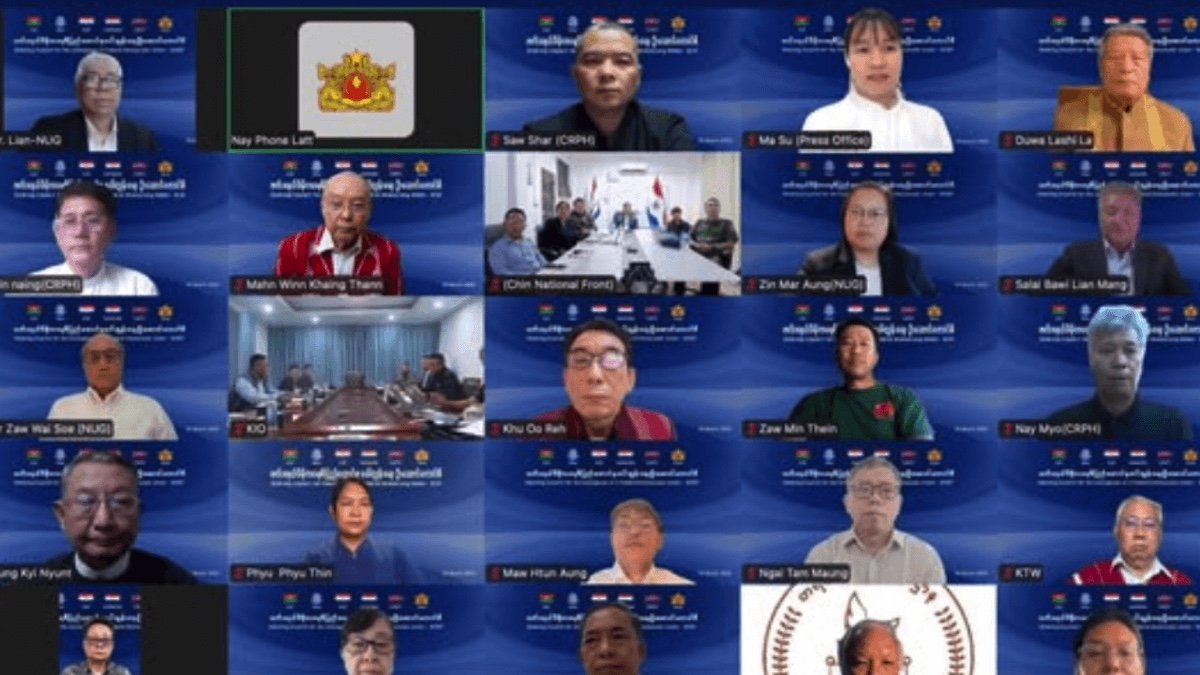
Three months after Myanmar's civilian opposition and ethnic revolutionary organizations unveiled the Steering Council for the Emergence of a Federal Democratic Union (SCEF), the body is being scrutinized by international analysts as the war for narrative legitimacy intensifies alongside the ground conflict. Senior General Min Aung Hlaing spent the second quarter of 2026 in New Delhi and Beijing, observing diplomatic protocol and, in China's case, signing 18 agreements. The junta's rehabilitation campaign—a staged election in December 2025 and January 2026, followed by Min Aung Hlaing's April 10 swearing-in as a so-called civilian president—has been calibrated for foreign ministries, which now question whether the resistance retains the coherence to be treated as a serious interlocutor.
SCEF was built to answer that question. How its first months are read by the analytical community will shape foreign-ministry judgments as much as what it delivers. A recent Frontier Myanmar assessment raised fair questions about whether SCEF can bring coherence to a fragmented resistance. Some context belongs alongside that assessment.
A Date That Carries Political Weight
SCEF was formally launched on March 30, 2026, with a founding press conference that evening and a statement issued by the National Unity Government (NUG) the same night—not in April, as sometimes described. The 11-day difference matters: a March 30 launch means SCEF stood up before Min Aung Hlaing's April 10 swearing-in, as a preemptive institutional response to the junta's staged civilian transition, not a delayed reaction to it. The political character of the body shifts with the date.
SCEF's founding statement sets out six political objectives: end the military's involvement in politics; place all armed forces under elected civilian command; abrogate the 2008 constitution; draft a new federal democratic constitution by consensus; establish a federal democratic union; and institute transitional justice. This is a constitutional program, not a negotiating ultimatum. Civilian control of the armed forces—the first objective—is the standard threshold of every democratic transition since the late 20th century, from South Korea to Indonesia to Chile. Presenting it in isolation as a precondition invites the conclusion that the resistance is uniquely inflexible when its floor is the ordinary floor of civil-military constitutionalism.
Structural Constraints, Not Strategic Neglect
The charge that the NUG has neglected its neighbors must be weighed against the environment. Thailand, by Foreign Minister Zin Mar Aung's own acknowledgment, has declined to receive NUG officials on Thai soil. India rolled out a state welcome for Min Aung Hlaing from May 30 to June 3, with Foreign Secretary Vikram Misri describing New Delhi's posture as not constituting a commentary on internal political arrangements. China followed two weeks later. The useful question is not whether the NUG has neglected the region—it is whether the region has given the NUG any usable diplomatic surface to work within. In mid-2026, the answer is largely no. As we noted in India Repeats China's Myanmar Mistake by Backing a General Who Cannot Deliver, backing the junta risks repeating strategic errors.
Economist Sean Turnell—Aung San Suu Kyi's former Australian adviser—called SCEF incredibly important and positive. The Special Advisory Council for Myanmar, a body of former UN experts, described it as the most significant formal alliance between legacy Ethnic Revolutionary Organizations and federal democratic and parliamentary entities since the February 2021 coup. The Foundation for Defense of Democracies' April assessment in Asia Times characterized SCEF as potentially transformative because it grants operational military authority to the ethnic armed groups. That is not the language analysts reach for when a new institution is essentially cosmetic.
What Has Actually Been Built
Three months in, SCEF's deliverables are more substantial than a casual reader would gather. The Council has established a Military Strategic Cooperation and Command Committee—ten military leaders operating under one command, one policy, one strategy, the first integrated command structure of the post-2021 resistance. It has produced a single coordinated set of inputs to ASEAN where, as SCEF spokesperson Dr. Zaw Wai Soe noted, two or three competing voices had previously undermined engagement. Delegations were dispatched to Washington, Tokyo, and Istanbul within three weeks. Eight regional and ethnic bodies have formally signaled support, including the Tanintharyi, Sagaing, and Magway federal unit governments, the Chin National Defense Force, and the Karenni State Interim Executive Council. SCEF has not yet drawn the Three Brotherhood Alliance inside its tent, and that remains the most consequential unfinished business. But the record of the first quarter is one of institutional construction, not stasis.
The clashes between NUG-aligned forces and other resistance groups in early 2026 are real and raise legitimate questions about cohesion. Two pieces of context are worth including. In the February Bo Nagar operation in Pale Township, the NUG stated publicly—through spokesperson Nay Phone Latt—that the action followed specific criminal allegations against Burma National Revolutionary Army members, including child rape. Whether the operation was proportionate is a fair debate, but a different one from that implied when the NUG is described simply as treating other groups like criminals. On Mogok, the Ta'ang National Liberation Army's withdrawal of support for the Mandalay People's Defense Force was a stipulated condition of the Chinese-brokered Kunming ceasefire of October 27–28, 2025. For more on Beijing's role, see China's Embrace of Myanmar's Junta Chief Exposes Limits of Influence.
SCEF is not just another empty acronym. It represents a serious attempt to unify a fragmented resistance under a constitutional framework, and its early achievements—a unified command, coordinated diplomacy, and regional support—suggest it may yet become the interlocutor that foreign ministries cannot ignore. The junta's narrative of legitimacy, as explored in Myanmar's Junta 'Comeback' Narrative Crumbles Under Scrutiny, faces a credible challenge.