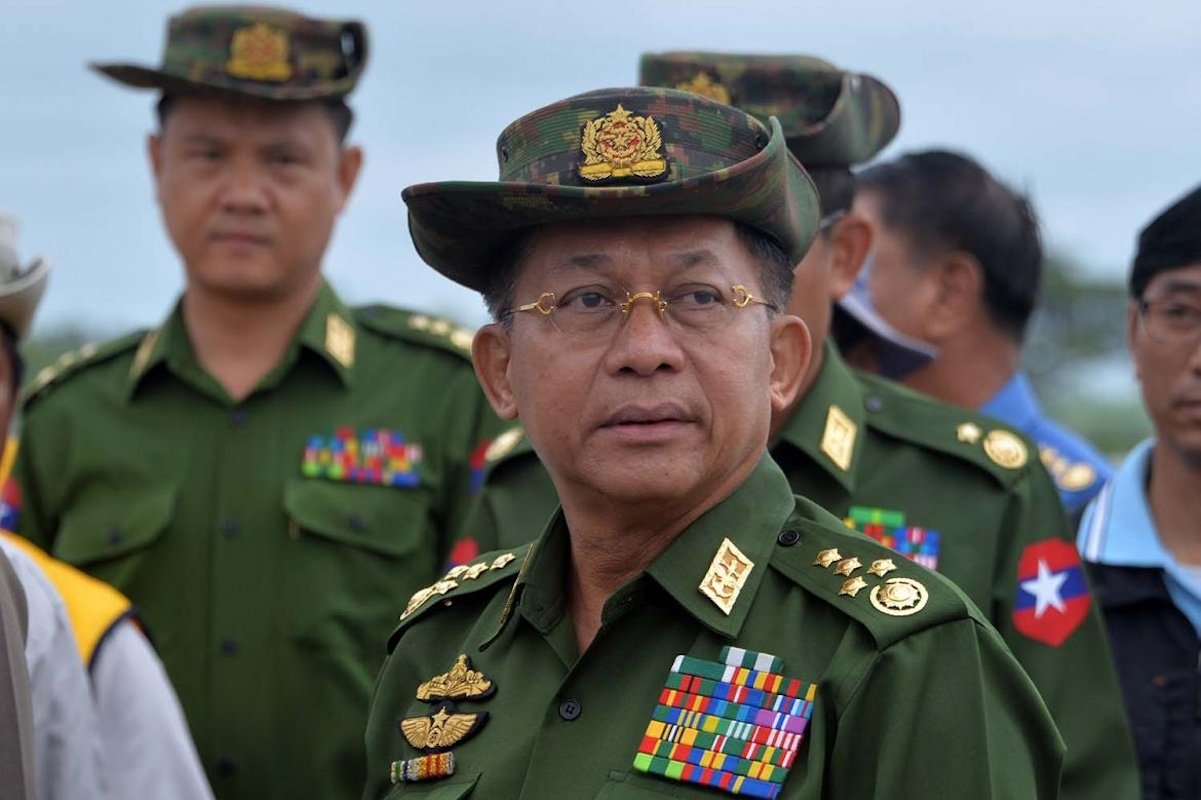
Senior General Min Aung Hlaing's allies have been pushing a narrative that Myanmar's military is on the upswing, mounting a comeback in a conflict often described as forgotten. Recent coverage in US media has amplified this storyline, pointing to tactical gains, diplomatic outreach, and a presidential façade following tightly controlled elections. But a closer look at the ground reality tells a different story.
The military indeed has superior firepower and has recaptured specific towns, notably Kyaukme and Hsipaw in northern Shan State in October 2025 with heavy Chinese support, and Lashio in April 2025 after the Myanmar National Democratic Alliance Army withdrew under Beijing's pressure. However, these gains do not translate into a strategic reversal. The Council on Foreign Relations' Global Conflict Tracker, drawing on a BBC World Service investigation, estimates the junta fully controls only about 21% of Myanmar's territory, while resistance forces and ethnic armed organizations hold roughly 42%, with the rest contested.
Territorial Control vs. Governance
Recovered territory has not restored governance. The Chinese-brokered Lashio handover left hundreds of surrounding villages outside junta authority and was accompanied by resentment over Beijing's coercion. Across much of the country, law and order remain fractured, public services degraded, and administrative reach thin. This is nominal control without durable state power.
In the west, the Arakan Army has taken most of Rakhine State and Paletwa Township in neighboring Chin State, controlling 13 of Rakhine's 17 townships by late 2024, including the entire Bangladesh border. ACLED reports the Arakan Army has since extended operations into Bago, Magway, and Ayeyarwady, functioning as the de facto government in western Myanmar.
Air Power as a Sign of Weakness
The military's growing dependence on air power underlines its weakness rather than masking it. Fortify Rights documented 304 paramotor and gyrocopter attacks on civilians across Sagaing, Magway, Mandalay, Ayeyarwady, and Bago between December 2024 and January 2026, with peaks coinciding with election rounds. Human Rights Watch documented escalating airstrikes, artillery, and drone attacks across all 14 states and regions in 2025. As the Mitchell Institute notes, more bombing does not prove more control, and firepower cannot by itself restore political legitimacy.
Economic and Geopolitical Realities
The economic and geopolitical dimension further undercuts the comeback thesis. India's outreach to Naypyidaw—including rupee-kyat trade settlement, the Kaladan Multi-Modal Transit Transport Project, and the India–Myanmar–Thailand Trilateral Highway—runs into the same obstacle: the formal counterpart in the capital often does not control the territory the projects must cross. The Kaladan route runs through townships now held by the Arakan Army, not the junta. As we've noted in India Repeats China's Myanmar Mistake by Backing a General Who Cannot Deliver, backing a general who cannot deliver is a strategic error.
Similarly, courting the junta for rare-earth access amounts to betting on the weaker side, as CSIS has warned. After the Kachin Independence Army seized Chipwi and Pangwa in late 2024, it became the de facto authority—and tax collector—over Myanmar's heavy rare-earth corridor along the China border. A June 2026 Foreign Policy report quoted former US Chargé d'Affaires in Myanmar, Susan Stevenson, describing Myanmar's rare-earth sourcing as more of a pipe dream than a realistic proposition because much of the resource base lies outside junta control.
Resistance Reconfigures, Not Collapses
The claim that ethnic armed organizations with Chinese ties have turned off the spigot of arms to People's Defense Forces and that some opposition forces are beginning to collapse deserves scrutiny. Some of that is real and serious—China has clearly pressured groups along its border. But the resistance architecture is not collapsing; it is reconfiguring. In March 2026, the National Unity Government, the Committee Representing Pyidaungsu Hluttaw, and major ethnic revolutionary organizations—the Karen National Union, Kachin Independence Organization, Karenni National Progressive Party, and Chin National Front—formed the Steering Council for the Emergence of a Federal Democratic Union to coordinate political and military strategy for a federal democratic order.
The Arakan Army has not publicly joined but cooperates militarily with the Chin Brotherhood and other resistance actors. Survey data cited by CFR indicate roughly 93 percent of respondents inside Myanmar view the NUG favorably. The pattern is uneven coordination among actors who still hold real ground, not resistance collapse.
If relevance is measured only by diplomatic protocol, Min Aung Hlaing's administration can appear to be regaining ground. But if relevance is measured by who can shape Myanmar's eventual political settlement, the junta's comeback narrative does not hold water. As Myanmar Bleeds While ASEAN Wavers on Junta Engagement highlights, the region's indecision only prolongs the crisis.