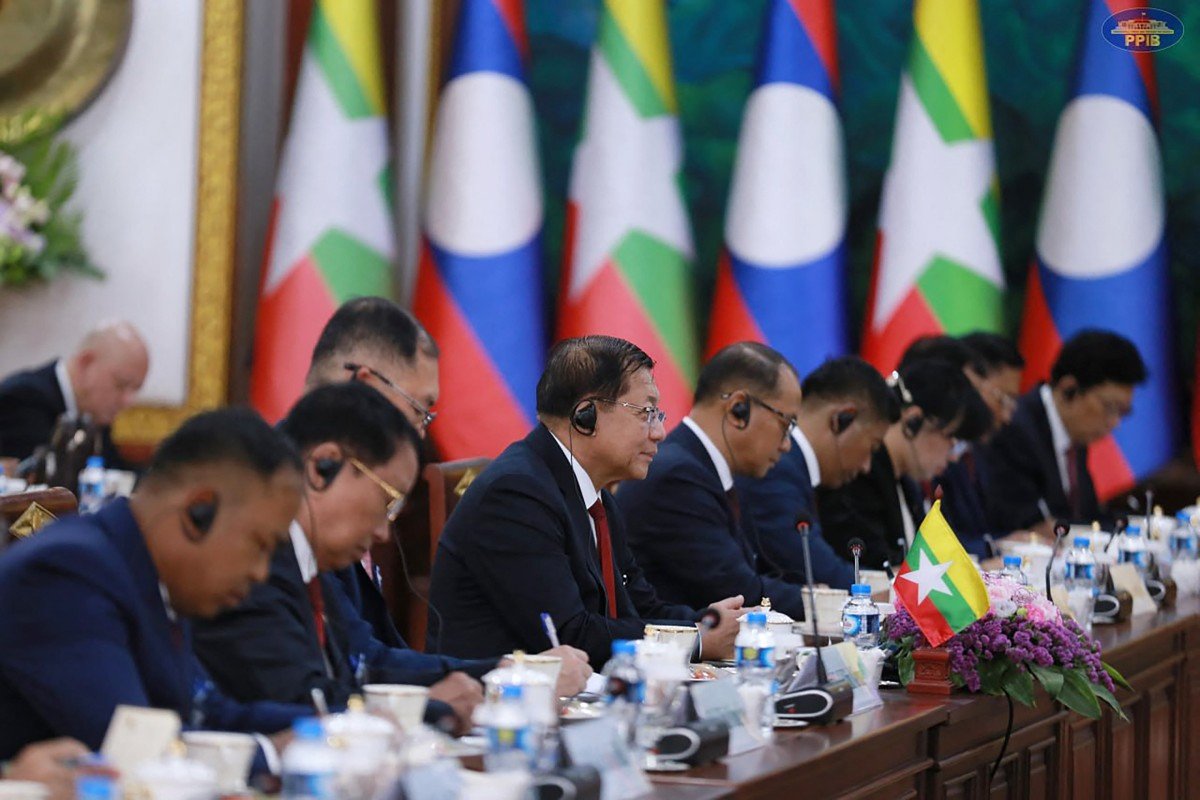
When Senior General Min Aung Hlaing, Myanmar's coup leader and self-appointed president, touched down in Vientiane, Laos, on July 3 for his first state visit to an ASEAN member since seizing power, a familiar refrain echoed through regional policy circles. The argument goes that Myanmar no longer has a single government worthy of recognition. Instead, observers point to a fractured landscape: a junta in Naypyidaw, a largely symbolic UN seat held by the resistance, a National Unity Government (NUG) operating in exile, and a periphery of ethnic armies and local militias where power fragments rather than consolidates.
The logical conclusion, proponents say, is for outside powers to engage whichever authority controls the function they need—border stability here, resource access there, cooperation on scam-fighting elsewhere. It is a tidy framework, but one that is deeply flawed in ways that quietly serve the party with the embassies and airport landing rights: the military junta. Three critical problems demand attention.
Territorial Reality vs. the Fragmentation Narrative
First, the numbers do not describe an ungoverned country. Independent trackers estimate stable junta control at roughly one-fifth of Myanmar. The BBC's mapping, cited by the Council on Foreign Relations, the Special Advisory Council for Myanmar, and Myanmar's own ISP-Myanmar, converges on the same range: the regime holds around 21% of territory with any confidence, contests some of the rest, and administers the balance only nominally. The remaining two-thirds is not empty. It is held by organizations with decades-old political wings, constitutions, judicial systems, and civilian administrations—the Kachin Independence Organization, the Karen National Union, the Karenni Interim Executive Council, the Chin National Front, the Arakan Army, and NUG-aligned People's Defense Force units operating under civilian township administrations. Labeling this landscape as mere "warlordism" writes federal politics out of Myanmar entirely.
Second, the fragmentation frame has missed the most important political development of 2026. On March 30, the NUG, the Committee Representing Pyidaungsu Hluttaw, and four major ethnic revolutionary organizations—the Kachin Independence Organization, Karen National Union, Karenni National Progressive Party, and Chin National Front—jointly established the Steering Council for the Emergence of a Federal Democratic Union. This is not a rebranded NUG or another exile committee. It is a coordination architecture built to align diplomacy, governance, and combat operations around a shared political program before, not after, the war ends. Its six founding objectives are public: end military political dominance; place all armed forces under civilian control; abrogate the 2008 military-drafted constitution; write and adopt a federal democratic constitution; establish a Federal Democratic Union; and deliver transitional justice for crimes committed since—and, in many communities, long before—the 2021 coup. A Military Strategic Cooperation and Command Committee coordinates fronts across theaters. Working streams handle constitutional drafting, transitional justice mapping, and diplomatic outreach from Bangkok to Tokyo to Ottawa, with rolling engagement of resistance groups outside the founding bloc. None of this looks like fragmentation. It looks like federal politics being built in the middle of a war—precisely the political architecture the region has said for years that Myanmar's resistance lacked. For more on this, see Myanmar's SCEF: A Resistance Body That Demands to Be Taken Seriously.
The Legal and Diplomatic Asymmetry
Third, the frame collapses a distinction that international law does not. Engaging multiple Myanmar authorities on functional issues is defensible, and, as China and India already show, unavoidable. Recognition is different. Recognition is what the UN seat, embassies, treaty signatures, and ASEAN summit credentials confer. Under any honest reading of the UN Charter, recognition tracks two things: constitutional legitimacy and a party's willingness to be bound by international law. On both counts, the Myanmar military fails a test its own conduct has set. Constitutional legitimacy in Myanmar runs from the November 2020 election, not from the 2025 exercise most of the opposition and much of the country could not participate in. Legal accountability runs through obligations the junta has discarded—the UN Charter, UN Security Council Resolution 2669 (2022), and the ASEAN Five-Point Consensus its own representatives signed.
Resolution 2669 is worth pausing on. It remains the only binding Security Council instrument on the Myanmar crisis, adopted 12-0 with China, Russia, and India abstaining rather than vetoing—a signal even the junta's closest partners were unwilling to defend its conduct. Four years on, none of its core demands have been met. The political prisoners it named remain in detention. The violence it demanded to end has intensified. The Five-Point Consensus it endorsed has become a diplomatic fiction. A government that treats a Security Council instrument as advisory is not a government the Council's other members can recognize without cost to the instrument itself.
This is where the real asymmetry lies. The Myanmar military will not, in any foreseeable arrangement, deliver justice, physical protection, or accountability to the people it rules. Airstrikes on schools and clinics, mass burnings of villages, forced conscription, and the continued detention of the country's elected leadership are not a policy the institution can be persuaded to reverse. They are its modus operandi. Justice, protection, and accountability are, in Myanmar today, functions only of the Steering Council, and its members—NUG, ethnic revolutionary organizations, and the federal actors coordinating with them—are structurally positioned to build. They will not build them alone or quickly. But an international posture that treats the two sides as functionally equivalent removes the one asymmetric pressure that has produced any behavioral change in Naypyidaw since 2021 and starves the actors with both the mandate and the incentive to deliver what Myanmar citizens actually need.
Timor-Leste, Singapore, and the Philippines have held this line. Meanwhile, the junta's consolidation of gains in some areas, as detailed in Myanmar's Civil War Nears Decisive Phase as Junta Consolidates Gains, underscores the stakes. The international community must recognize that the "no single government" narrative is not a neutral observation—it is a diplomatic convenience that undermines the very federal future Myanmar's resistance is fighting to build.