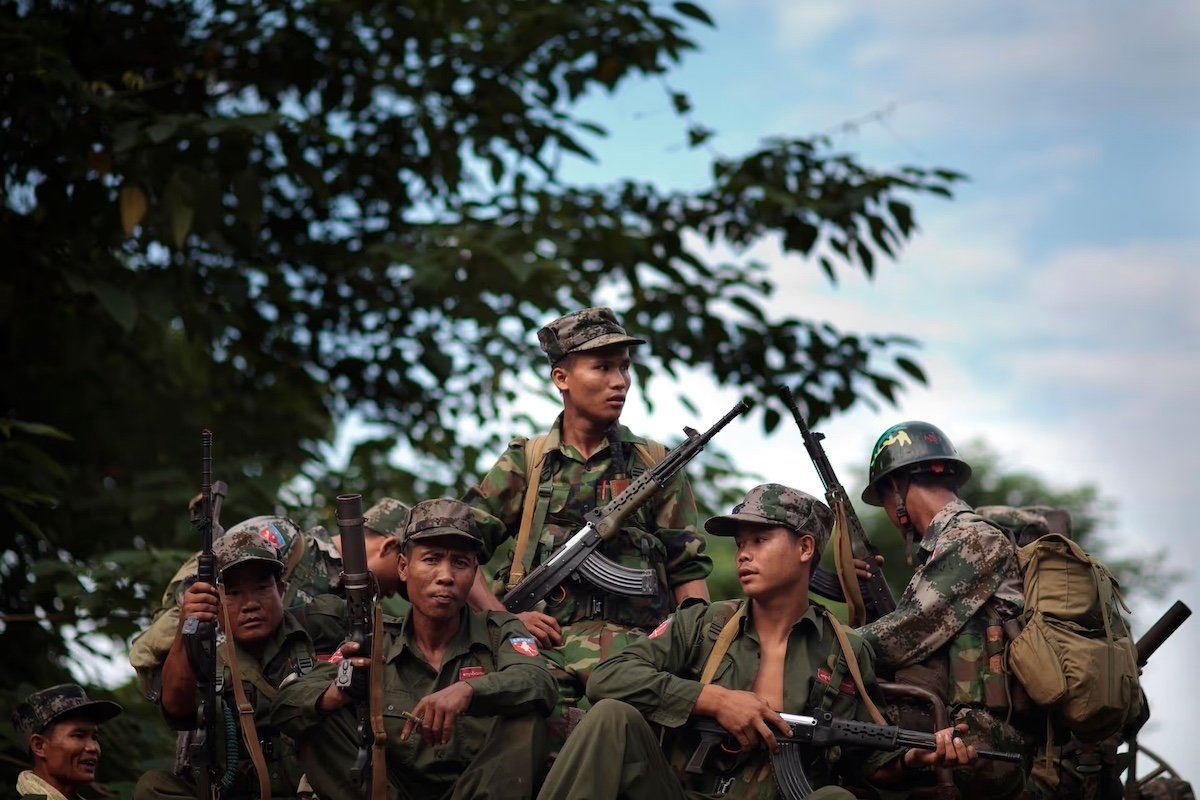
By mid-2026, the trajectory of Myanmar’s civil war has become starkly clear: the military junta, led by dictator-turned-president Min Aung Hlaing, is on a sustained offensive that has reversed many of the opposition’s gains from 2023 and 2024. Yet the conflict remains far from resolved, with the Tatmadaw’s own vulnerabilities threatening to prolong a grinding stalemate.
The junta’s battlefield successes are not the result of strategic brilliance from new Commander-in-Chief General Ye Win Oo, whose rise owes more to loyalty than tactical acumen. Instead, they stem from a methodical campaign launched in early 2025, sustained through the rainy season, and continuing today. This offensive aims to reassert control over economic hubs and border trade routes lost during the opposition’s Operation 10.27, which saw coordinated attacks by ethnic armed groups like the Myanmar National Democratic Alliance Army (MNDAA), the Ta’ang National Liberation Army (TNLA), and the Arakan Army (AA).
Four key factors underpin the junta’s recent advances: a massive conscription drive that has added over 100,000 new troops since early 2024; new drone technology and tactics; unchallenged airpower; and crucial support from China, which has effectively neutralized the MNDAA and TNLA along the Chinese border. As we have previously noted, China’s embrace of Myanmar’s junta chief exposes limits of influence, but Beijing’s backing has been decisive in tilting the balance in key theaters.
Territorial Gains and Stretched Resources
The military has recaptured most of the highway between Mandalay and the Chinese border, pushed north along the Ayeyarwady River into Kachin State, and reopened the road to Myitkyina. In northwestern Sagaing, efforts are underway to secure the border highway from Tamu to Kaletwa, while in eastern Chin State, the recapture of Falam, Tedim, and Tonzang has been followed by thrusts toward the Indian border. In eastern Karen State, clashes have spilled onto Thai territory as the junta targets border bases south of Myawaddy.
Attention is now turning to Myanmar’s southern panhandle, where army chief General Kyaw Swar Lin has promised major operations around Dawei. These are intended to reassure Russia, which has agreed to build a coal-fired power plant and oil refinery near a planned deep-sea port that has been threatened by opposition attacks.
Despite these gains, the Tatmadaw remains years away from achieving stability. The sheer size of Myanmar’s geography means that even with conscription-driven manpower boosts, the army is increasingly overstretched. Before the civil war, the military struggled to maintain garrison presence while conducting borderland operations. Now, it must also confront central regions that have risen in revolt, facing an opposition that is better organized and armed than ever before.
Morale is the junta’s second critical vulnerability. Conscription has been deeply unpopular, driving thousands abroad, into hiding, or into opposition ranks. Ward- and village-level recruiters face mounting pressure to deliver fresh troops, but many conscripts receive only basic training before being sent to front-line Light Infantry Divisions (LIDs), where heavy casualties have turned deployments into near-death sentences. As one retired army colonel noted, referring to LID battalions: “In the mess hall, you see the fear in their eyes. They know they are being sent to die.”
The opposition, meanwhile, has shown resilience. Groups like the Shadow Civilian Executive Force (SCEF) have emerged as credible actors, coordinating resistance across ethnic and political lines. While the junta’s narrative of a “comeback” has gained traction, scrutiny reveals deep cracks in its long-term viability.
As the dry season approaches, both sides are bracing for a decisive phase. The junta’s ability to hold its gains will depend on sustaining morale and managing overstretch, while the opposition must exploit these weaknesses to regain momentum. For now, Myanmar’s civil war remains a brutal contest of attrition, with no end in sight.