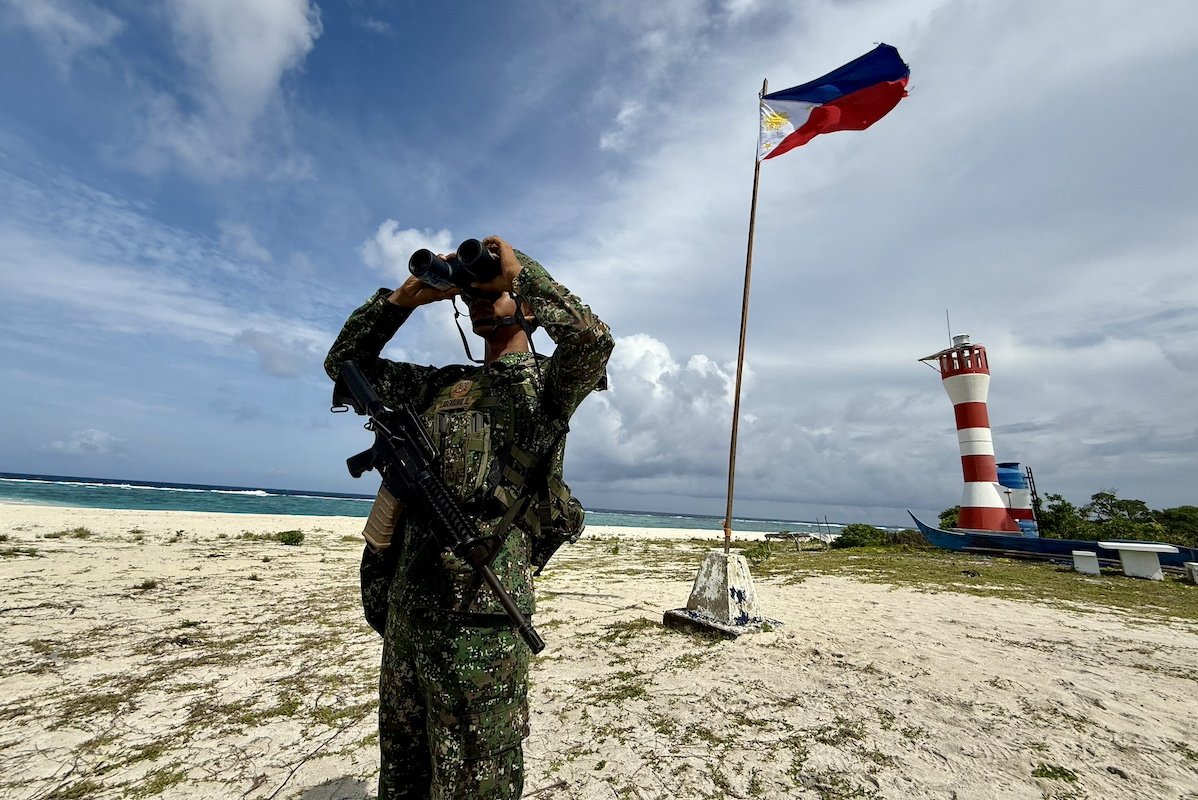
On July 12, 2016, the Permanent Court of Arbitration in The Hague delivered a landmark ruling in favor of the Philippines, declaring that China's expansive claims in the South China Sea had no legal basis under the United Nations Convention on the Law of the Sea. Ten years later, that ruling is a footnote—ignored by Beijing, unenforced by the international community, and barely acknowledged by the regional bloc that should have been its strongest advocate.
The arbitral tribunal's decision was unambiguous: China's so-called "historic rights" within the nine-dash line were "contrary to" UNCLOS and "without lawful effect." But Beijing refused to participate in the proceedings, dismissed the outcome, and accelerated its construction of militarized outposts across the Spratly and Paracel islands. Today, China operates at least four large artificial islands with runways, missile batteries, and electronic warfare facilities—including a new dredging project at Antelope Reef, roughly 216 nautical miles from Da Nang, Vietnam. According to the Center for Strategic and International Studies, that outpost is set to become China's largest in the South China Sea, spanning an estimated 1,490 acres.
A Coalition of the Willing, Not a Bloc
The anniversary was marked by a joint statement from 14 nations—but only one ASEAN member, the Philippines, signed it. Chinese state media and online commentators were quick to highlight the absence of Vietnam, Malaysia, Brunei, and Indonesia, all of which have overlapping claims with China in the sea. The pattern is deliberate: Beijing pressures each claimant state individually, exploiting ASEAN's consensus-based decision-making to prevent a unified response.
ASEAN operates by unanimity, and members like Cambodia and Laos—economically dependent on Chinese investment—have repeatedly blocked joint statements on the South China Sea. This paralysis has allowed China to consolidate its territorial gains one step at a time, while the bloc's much-touted "centrality" in regional security fades into irrelevance. As US deterrence plans face industrial and political gaps, the burden of upholding the rules-based order falls increasingly on ad hoc coalitions rather than established institutions.
The 2016 ruling was never about sovereignty over specific islands; it dismantled the legal fiction of the nine-dash line—a set of dashes on a map that China submitted to the UN in 2009 as the boundary of its "jurisdiction." Any competent maritime lawyer would have advised against such a submission: historic rights claims are notoriously weak in international law. But by committing those claims to writing, Beijing revealed two things that should have alarmed every ASEAN capital. First, it showed itself an expansionist power intent on controlling a sea lane that carries roughly one-third of global shipping. Second, it demonstrated a willingness to sign international treaties like UNCLOS and then break their terms at will.
The United States has never ratified UNCLOS, wary of the obligations it would impose. China signed readily, then reneged on the parts it disliked. For ASEAN, that second point is the more alarming: it means no code of conduct, no framework, no bilateral memorandum that Beijing eventually signs will bind it further than its preferences allow. Any agreement is, to Beijing, little more than a piece of waste paper.
The Age of Naked Power
This is less a sign that an alternative rules-based order is emerging than that the age of naked power is reasserting itself through the cracks of the old one. ASEAN, as a bloc built on consensus and non-interference, remains its softest target. The 2016 ruling was a legal victory for Manila, but it was also a case that the Philippines effectively took on board for all ASEAN claimant states. Ten years on, that collective interest has been fragmented by Chinese pressure, economic dependency, and the bloc's own institutional weaknesses.
Vietnam, the state with the most immediate stake in the Antelope Reef construction, was not among the 14 signatories. Neither was Malaysia, Brunei, or Indonesia. The silence from Hanoi, Kuala Lumpur, Bandar Seri Begawan, and Jakarta speaks volumes about the limits of ASEAN solidarity. As Australia and Fiji reshape Pacific security dynamics, the contrast with ASEAN's inaction in its own maritime backyard is stark.
The rules-based order is increasingly fractured, and its defense is piecemeal. The 2016 ruling was a moment of legal clarity; the decade since has been one of strategic retreat. For ASEAN, the question is not whether the ruling matters—it does, as a legal benchmark—but whether the bloc can find the political will to act on it before the nine-dash line becomes a de facto maritime border enforced by Chinese warships and airstrips.