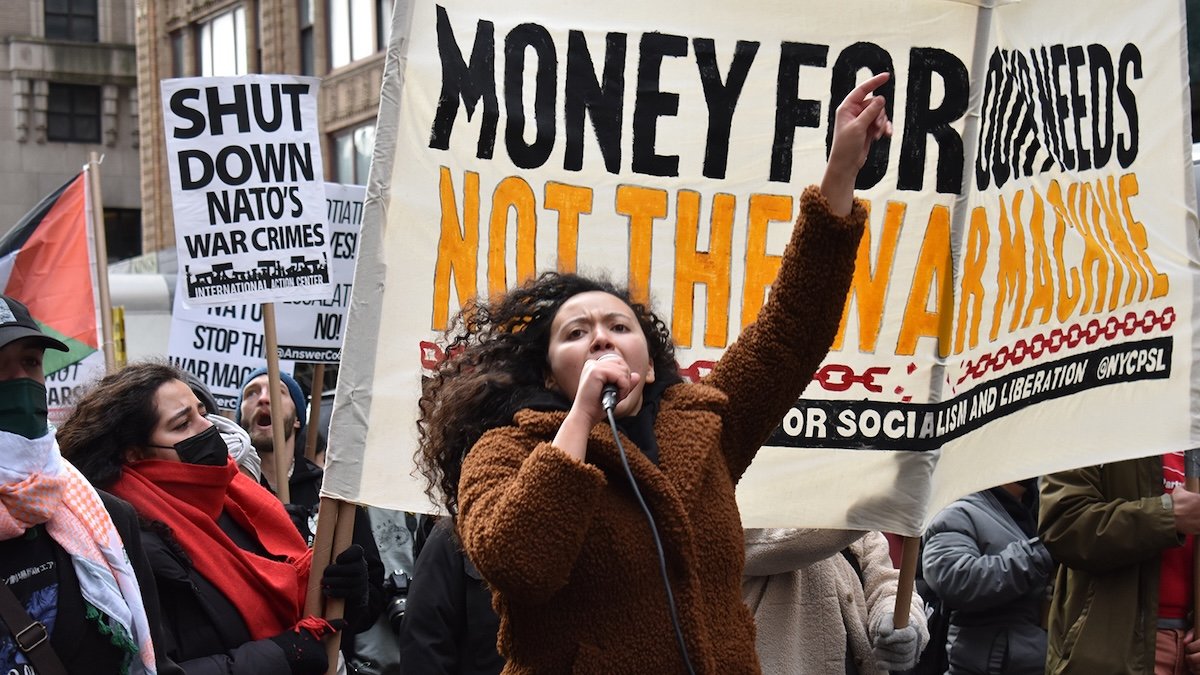
As US President Donald Trump met with Chinese President Xi Jinping in Beijing, a coalition of antiwar organizations launched a coordinated push for Congress to steer the administration away from confrontation. The groups, which include Just Foreign Policy, Win Without War, the Friends Committee on National Legislation, and Our Revolution, sent a letter to lawmakers on Thursday arguing that Americans increasingly favor cooperation with China and that heightened tensions serve no US interest.
“Americans are increasingly supportive of US-China cooperation, while tensions with China do not serve American interests,” the coalition wrote. They pointed to a January Pew Research poll showing that only 28% of Americans now view China as an “enemy,” down from 42% in 2024, as evidence of shifting public sentiment.
The letter warned that a confrontational posture toward Beijing is costing billions in military buildup, trade disruptions, and technology securitization—funds the groups argue should be redirected to domestic needs. This appeal comes amid Trump’s first visit to China in nearly a decade, a trip overshadowed by the ongoing US military campaign in Iran, a conflict where China has offered to mediate.
Taiwan Remains the Flashpoint
During the summit, Xi Jinping emphasized that Taiwan is the “most important issue in China-US relations,” cautioning that mishandling it could create a “very dangerous situation.” Secretary of State Marco Rubio reiterated the longstanding One China Policy, which does not explicitly address Taiwan’s sovereignty, but warned against any Chinese attempt to seize the island by force.
The antiwar coalition specifically urged Washington to “revitalize its One China Policy and press Beijing to reaffirm its focus on peaceful unification, with no timeline.” They argued that current military and political trends in the United States, China, and Taiwan are pushing the region closer to a serious crisis. “Diplomacy with Beijing, rather than military posturing or arms racing across the Taiwan Strait, is the only realistic path forward,” the groups stated, noting that only 35% of Americans support sending US troops to defend Taiwan if attacked, according to a November survey by the Institute for Global Affairs.
This diplomatic push contrasts sharply with pressure from Democratic leaders. On Wednesday, Representative Gregory Meeks (D-NY), ranking member of the House Foreign Affairs Committee, along with Representatives Ro Khanna, Jim Himes, and Adam Smith, urged Trump to approve a delayed $14 billion arms sale to Taiwan ahead of his visit. They argued that Trump must reaffirm the One China policy while standing firmly with Taiwan’s democracy and security. Just Foreign Policy dismissed the request as “deeply unserious” and “absurdly ill-timed,” warning it would sabotage diplomacy.
Jake Werner, director of the East Asia program at the Quincy Institute for Responsible Statecraft, another signatory to the antiwar letter, cautioned Democrats against goading Trump into a more hawkish stance. “If you want to attack Trump, that’s great, but you should attack Trump on the basis of prudent, conflict-avoiding principles,” Werner said. “They should be criticizing him not for engaging in diplomacy, but for engaging in the wrong kind of diplomacy.”
The coalition also called for a restrained US approach to the South China Sea, arguing that Washington should take no position on disputed territory sovereignty. They singled out a recent first-ever test launch of a US Tomahawk missile in the Philippines, which Chinese military observers described as the “worst provocation” in years, as a dangerous escalation. The groups urged Congress to avoid creating incentives for other nations to adopt confrontational stances toward China.
This antiwar effort underscores a growing divide in US politics over China policy, with some lawmakers pushing for arms sales and military posturing while others advocate for de-escalation and diplomacy. As the Trump-Xi summit unfolds, the outcome could reshape not only bilateral ties but also the broader security landscape in the Indo-Pacific. For more analysis on the summit’s implications, see Trump and Xi: Managing US-China Rivalry Without War and Trump's Taiwan Arms Sales Discussion With Xi Signals Policy Shift.