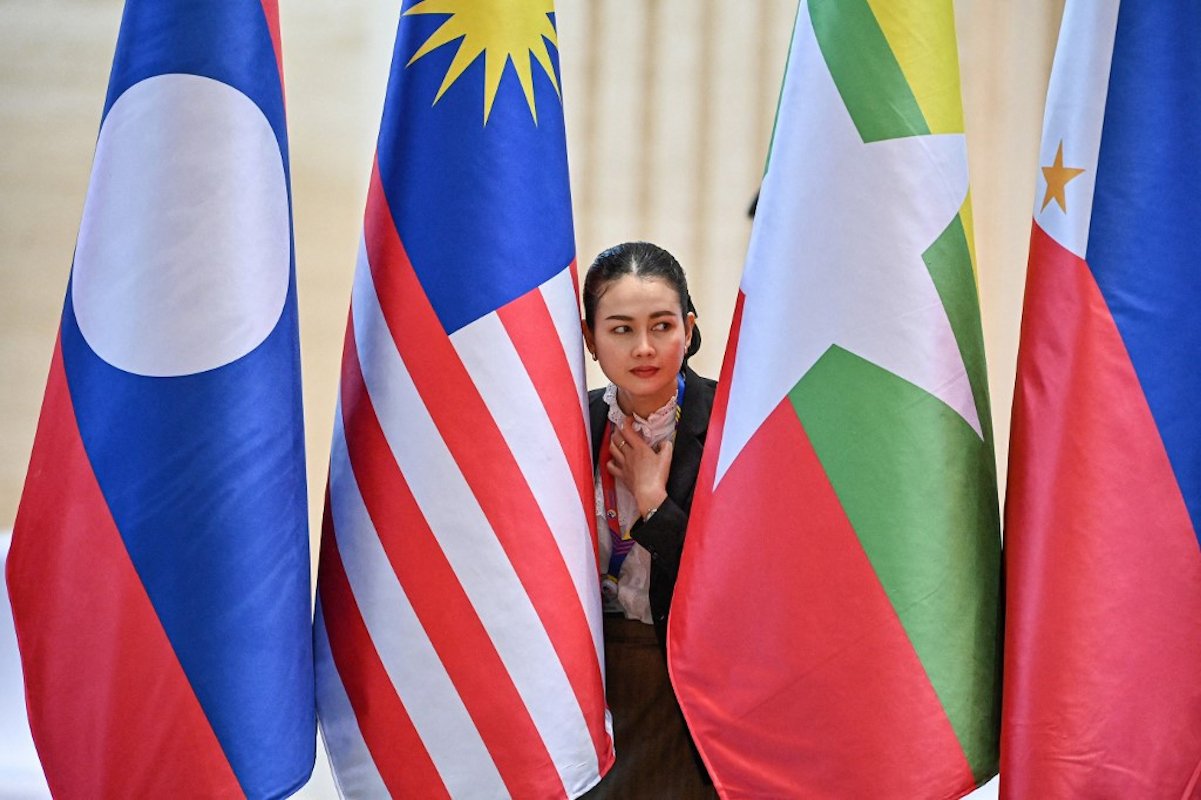
When ASEAN leaders gathered in Manila on November 15 to decide Myanmar's fate, the country's chair was occupied not by a minister but by a foreign ministry director-general. That modest seat—the last significant thing ASEAN still withholds from the generals in Naypyidaw—has become the bloc's final bargaining chip. The question now is whether ASEAN intends to use it or squander it.
The debate over isolating versus engaging the junta was settled long ago. ASEAN's special envoy, Philippine Foreign Secretary Theresa Lazaro, met Min Aung Hlaing in Naypyidaw on January 6 and returned on October 29, following in the footsteps of her Cambodian and Lao predecessors. ASEAN counts these high-level meetings as part of its peace plan, not as exceptions to its ban. On July 12 in Bangkok, ASEAN foreign ministers met the junta's foreign minister together and in person for the first time since 2021.
Five member states have hosted Min Aung Hlaing on official visits this year. The Manila decision even states that Myanmar's participation in sectoral ministerial bodies “should be unrestricted at all levels.” What remains is the ban on political representation at summits and foreign ministers' meetings—a restriction that critics say has changed nothing in five years. But the ban was never intended to topple the junta; it exists to give ASEAN something to trade.
The generals clearly want it lifted. In September, they formed an ASEAN Affairs Committee to “regain the country's original role and rights.” The Manila decision keeps the restriction “until there is meaningful progress,” but also endorses a “phased and progress-based approach” toward “the gradual restoration of Myanmar's full political representation.” Thailand already hopes for a decision by its 2028 rotational chairmanship. With nearly everything else on offer, surrendering the summit seat before results are verified would leave ASEAN with nothing to bargain with.
Normalization by installments
The danger is normalization by installments, as exceptional contact becomes routine. After the July meeting, the International Crisis Group's Richard Horsey warned: “It would be a mistake for ASEAN to accept Myanmar back into the fold without getting anything meaningful in return.”
The junta, meanwhile, collects engagement while rejecting any yardstick. Three days before the Bangkok meeting, its parliament passed a motion against the Five-Point Consensus. Just after Min Aung Hlaing's August visit to Bangkok, Naypyidaw declared the special ASEAN envoy's role “no longer necessary.” And on the eve of the Manila decision, its delegation rejected proposals on the envoy and on regular progress reports, arguing that elections had made an envoy unnecessary.
Optics are part of the transaction. As former Australian ambassador Nicholas Coppel observes, the regime's newspaper features meetings with foreign dignitaries almost daily as evidence of acceptance and “business as usual.” A disclaimer issued in a foreign capital cannot undo a photograph circulated in Naypyidaw. ASEAN should calibrate not only whom it meets but how: protocol, titles, and publicity should be earned by results.
ASEAN already has the means to resist this drift. Senior officials are discussing “elements for assessing progress in Myanmar.” They should become four published tests.
- Aid must reach “unserved communities in need,” including the AHA Centre's priority townships.
- All political prisoners, including Aung San Suu Kyi, must be released.
- Airstrikes on civilians must verifiably cease.
- The envoy must be able to convene the dialogue the Five-Point Consensus promised “among all parties concerned,” including the National Unity Government (NUG) and the opposition's Steering Council for the Emergence of a Federal Democratic Union (SCEF).
As Singaporean analyst Simon Tay put it, “Political acceptance should follow progress, not precede it.” Aid to civilians, however, must never become a bargaining chip.
Verification matters because the junta's declarations have proven worthless. After the March 2025 earthquake, the NUG paused offensive operations and the military announced its own ceasefire. Within days, UN Special Rapporteur Tom Andrews said the junta had “chosen to violate its own ceasefire.” The UN Human Rights Office later counted more than 550 military attacks by May 31. Because the Manila text names “the armed forces, security forces, and armed groups” in one clause, ASEAN must ensure that equal obligations do not become an assumption of equal culpability.
Nor should the junta decide who is seen. The Manila decision names neither the NUG nor SCEF, whose ethnic members were invited to Pattaya individually, not as a coalition, while the NUG spoke with the envoy only by video. Naming a coalition ASEAN already talks to costs it nothing. Keeping the opposition out of sight to preserve access to Naypyidaw lets the generals set the boundaries of ASEAN's diplomacy.
Benchmarks also mean little if the junta's supply lines stay open, so ASEAN should add a condition it must meet itself: no restoration while arms and jet fuel still reach the military through members' banks and ports. Andrews has identified what the junta needs to sustain its assaults as “money, weapons and legitimacy.” The United States, Britain, the EU, Canada, and Australia already sanction the junta's aviation fuel supply chain, though not all have followed Canada in banning jet fuel exports. Reuters found Iranian jet fuel disguised as South African diesel and paid for through a Thai bank account.
ASEAN members need not adopt Western sanctions; they need only enforce their own laws. Singapore prohibits arms transfers to Myanmar, and after a government review, it has tightened enforcement. The bloc's credibility—and its last shred of leverage—depends on whether it can hold the line until the junta delivers something real. As the Manila agenda unfolds, ASEAN's leaders must decide if they are negotiating from strength or simply surrendering in installments.