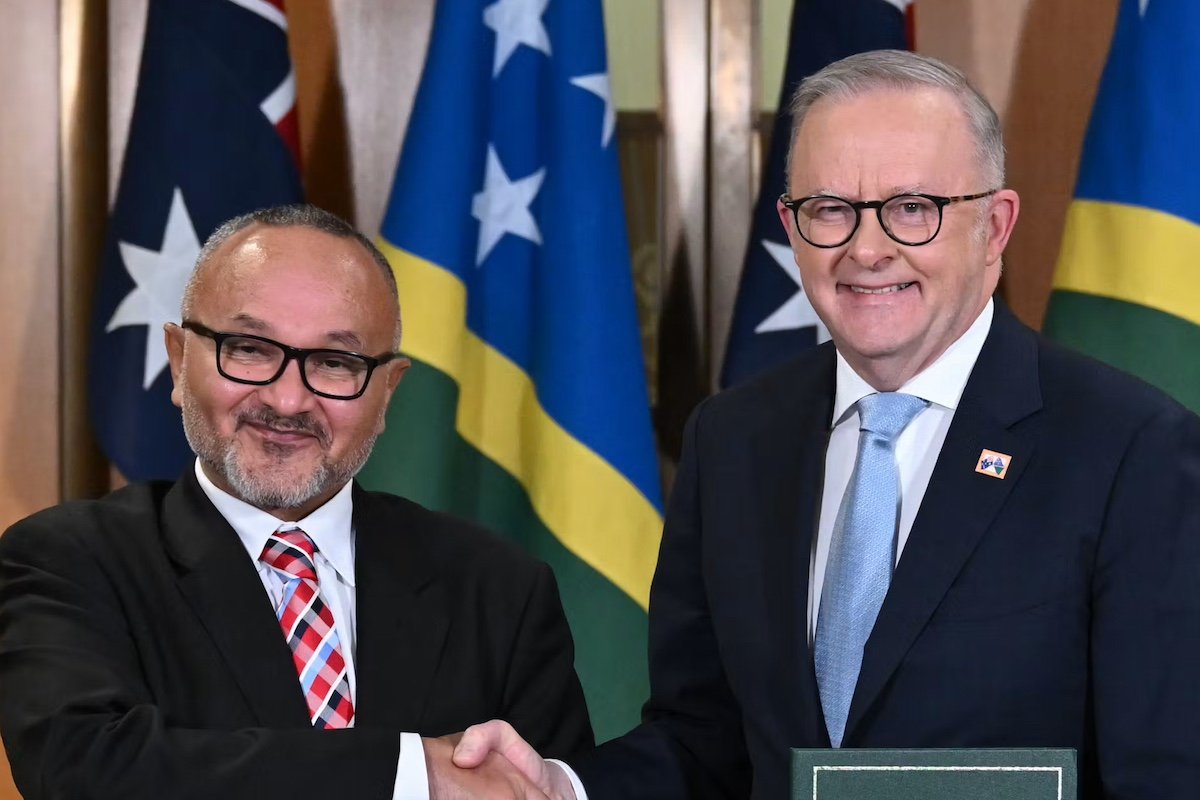
In a move that reshapes Pacific security dynamics, Australia and Solomon Islands have signed a comprehensive defense treaty, marking a significant setback for China's influence in the region. The agreement, finalized amid a large delegation from Honiara, was hailed by both sides as a milestone in bilateral relations.
The treaty, signed by Australian Prime Minister Anthony Albanese and Solomon Islands Prime Minister Matthew Wale, includes provisions for economic development, labor mobility, and security cooperation. It also formally ends the controversial security pact that Solomon Islands signed with China in 2022, a deal that had raised concerns among Pacific nations and Western allies about Beijing's growing military footprint.
Key provisions and economic benefits
The treaty recognizes the historical ties between Solomon Islands and Australia, including the legacy of the Regional Assistance Mission to Solomon Islands (RAMSI) and the painful period of blackbirding in the 19th century. It also acknowledges the contemporary connection with South Sea Islanders, a long-standing demand from community groups.
Australia has pledged support for Wale's signature fee-free education policy, which covers early childhood through university. This is a critical initiative in a country where secondary school enrollment is only 10-16%, and school fees are a major barrier to education. The treaty also expands the Pacific Australia Labour Mobility Scheme (PALM), which currently brings in SBD507 million (A$94 million) annually to Solomon Islands, into new sectors such as aged care.
Many Solomon Islanders will be watching closely to see if the treaty leads to enhanced visa arrangements for travel to Australia, a perennial issue in Pacific-Australia relations. The agreement also includes a nod to soccer, one of the most popular sports in Solomon Islands, but unlike other agreements, sport has not overshadowed other human security priorities.
Security and the China question
The treaty commits both nations to ensuring that Solomon Islands will not host any foreign military or security base, and that its sensitive infrastructure will remain free from militarization and foreign interference. This is a direct response to China's 2022 security pact with the Solomon Islands, which was signed by former Prime Minister Manasseh Sogavare and kept secret even from then-opposition leader Wale.
Wale, who became prime minister in 2024, had pledged to review the agreement. The decision to scrap it is a significant victory for Australia, which has been seeking to counter China's influence in the Pacific. However, the treaty does not necessarily mean a complete break with Beijing; it remains unclear whether the China pact has been fully terminated or will simply lapse when it concludes in April.
Sogavare, now the opposition leader, has warned Wale against terminating the agreement, but the new prime minister has assured China of his government's commitment to the One China policy. Analysts suggest that other Pacific nations are unlikely to follow Solomon Islands' lead, and that Honiara may negotiate a new agreement with China that better reflects its development priorities.
China retains significant public relations leverage in Solomon Islands, having invested billions of dollars in infrastructure projects. Recent upgrades to roads in Auki, the provincial capital of Malaita, are a sign of Beijing's strategic approach to winning hearts and minds. Malaita was initially opposed to the switch from Taiwan to China, so China's progress there is notable.
Wale now faces the challenge of explaining his decision to his constituents, many of whom may have benefited from Chinese investment. The news of the pact's termination only became public while his delegation was en route to Canberra, adding to the political sensitivity.
The treaty with Australia is a clear signal that Solomon Islands is recalibrating its security partnerships, but it also underscores the delicate balance between development needs and geopolitical pressures. As the Pacific becomes a focal point of great-power competition, the outcomes of this agreement will be closely watched across the region.