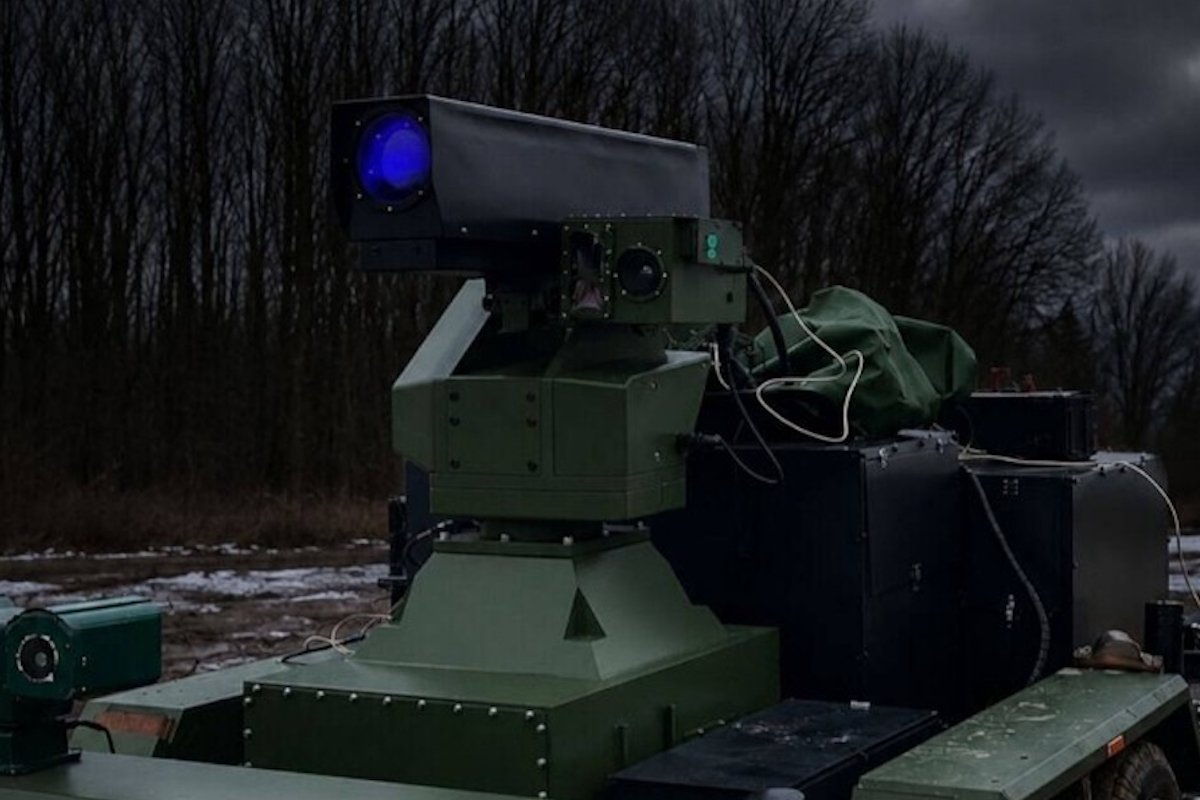
Ukraine has reportedly achieved a world-first combat intercept using a laser weapon, downing a Russian jet-powered Geran strike drone. The milestone, announced by Ukrainian Presidential Adviser Serhii “Flash” Beskrestnov, was carried out by the Blysk laser system developed by Ukrainian defense firm Carmine Sky under the state Private Air Defense program with support from Brave1. Deployed in early November to protect critical infrastructure, including around Kyiv, the 4-kilowatt system operates at ranges up to one kilometer.
The Blysk is designed to lock onto a fixed point and overheat internal components mid-flight. Its per-shot electricity cost is a fraction of the price of interceptor missiles or gun turrets, but burning through a strike drone fuselage takes several seconds, compared with a fraction of a second for smaller FPV drones. Beskrestnov cautioned that serial production remains premature as trials continue, citing high setup costs, precision-tracking challenges against agile targets, and weather limitations such as fog and cloud cover.
A cost-exchange crisis
The intercept comes as Russia expands its use of faster jet-powered Geran and Shahed-type drones, amid depleted air-defense missile stockpiles and winter strikes on energy infrastructure. Ukraine’s Private Air Defense effort, involving roughly 100 companies—about half operating active combat units—had reportedly downed over 60 Russian aerial targets by mid-October. That battlefield record gives directed-energy weapons a combat proof of concept while air-defense economics are under acute strain.
Ongoing hostilities in the Red Sea, Strait of Hormuz, and Ukraine have exposed a sharp cost-exchange problem. Defenders have repeatedly fired multi-million-dollar interceptors and vast quantities of ammunition to destroy drones built for a fraction of the munitions spent against them. Laser weapons promise to invert that equation through negligible cost per shot, instantaneous hits, and scalable power, yet moving from controlled test ranges to an active war zone introduces operational variables absent under test conditions.
Countermeasures and limits
Beyond high startup expenses, experimental hardware, and environmental constraints, adversary adaptation could erode the tactical impact of laser weapons. According to Bonnie Johnson and other authors in a 2023 Journal of Directed Energy article, engineers can use shielding—Bragg mirrors, reflective coatings, or ablative layers—or deploy laser-warning sensors and active defenses, including smokescreens, jammers, decoys, and counterfire. Operators can also use weather and atmospheric effects—such as fog, rain, turbulence, and thermal blooming—to scatter beams or increase dwell time, while evasive maneuvers and swarm tactics disrupt line of sight and targeting. Combining multiple engineered and operational defenses offers the strongest protection against laser threats.
Russia’s track record of rapidly evolving its strike arsenal underscores how quickly such countermeasures could emerge. Robert Tollast notes in a Royal United Services Institute (RUSI) article this month that Russia’s swift evolution of drones and mini cruise missiles reflects years-long military-industrial groundwork rather than purely ad hoc battlefield iteration. After fielding propeller-driven Geran 2 drones in late 2022, Russia upgraded them with electronic warfare resilience, mesh networks, rear-facing cameras, armor, new warheads, and decoys like Gerbera and Parodiya. It then scaled jet-powered mini cruise missiles—including Geran 3, 4, and 5, Banderol, Dan-T, and Filin—using commercial Chinese Telefly and Swiwin engines while advancing its domestic R500 turbine, first prototyped in 2018 and developed since 2020 with state institutes, enabling Russia to leap past Ukraine’s low-cost interceptor drones quickly.
Even if directed-energy systems keep pace with evolving drones, laser weapons face steep physical limits against the ballistic and hypersonic missiles Russia uses in Ukraine. As James Giordano noted in a February 2026 article for the Institute of National Strategic Studies (INSS), megawatt-class lasers can thermally compromise missile skins or fuel tanks before glide separation, and sustained heating can disrupt electronics or destabilize control surfaces; however, current laser weapons lack the power density or dwell time to defeat contemporary hypersonic or ballistic missiles at operational ranges.
Although Russia has fired hypersonic weapons such as the Kinzhal and Oreshnik at Ukraine, Vikram Mittal notes in a Forbes article this month that their use remains limited compared with conventional missiles. The high cost of hypersonic weapons relative to ballistic or cruise missiles limits their availability, forcing Russia to use them selectively. Yet even selective hypersonic strikes sit atop a surging conventional missile pipeline that low-power lasers cannot blunt. Business Insider reported this month, citing Ukrainian Defense Minister Yevhenii Khmara, that Russia may be capable of producing one ballistic missile every five hours. According to the report, Ukraine’s Main Directorate of Intelligence (GUR) said that Russia had 700 ballistic missiles and thousands of cruise missiles in October 2026, and could produce 110 ballistic missiles monthly—about one every six and a half hours.
The laser intercept is a genuine first, but it does not signal a revolution. The broader picture remains one of grinding attrition, where cost-exchange ratios and industrial capacity matter more than any single technology. For Asian militaries watching the war, the lesson is not that lasers will replace missiles, but that the race between offensive and defensive systems is accelerating. As China's laser arsenal grows, the region should pay close attention to how directed-energy weapons perform in real combat—and how quickly adversaries adapt.