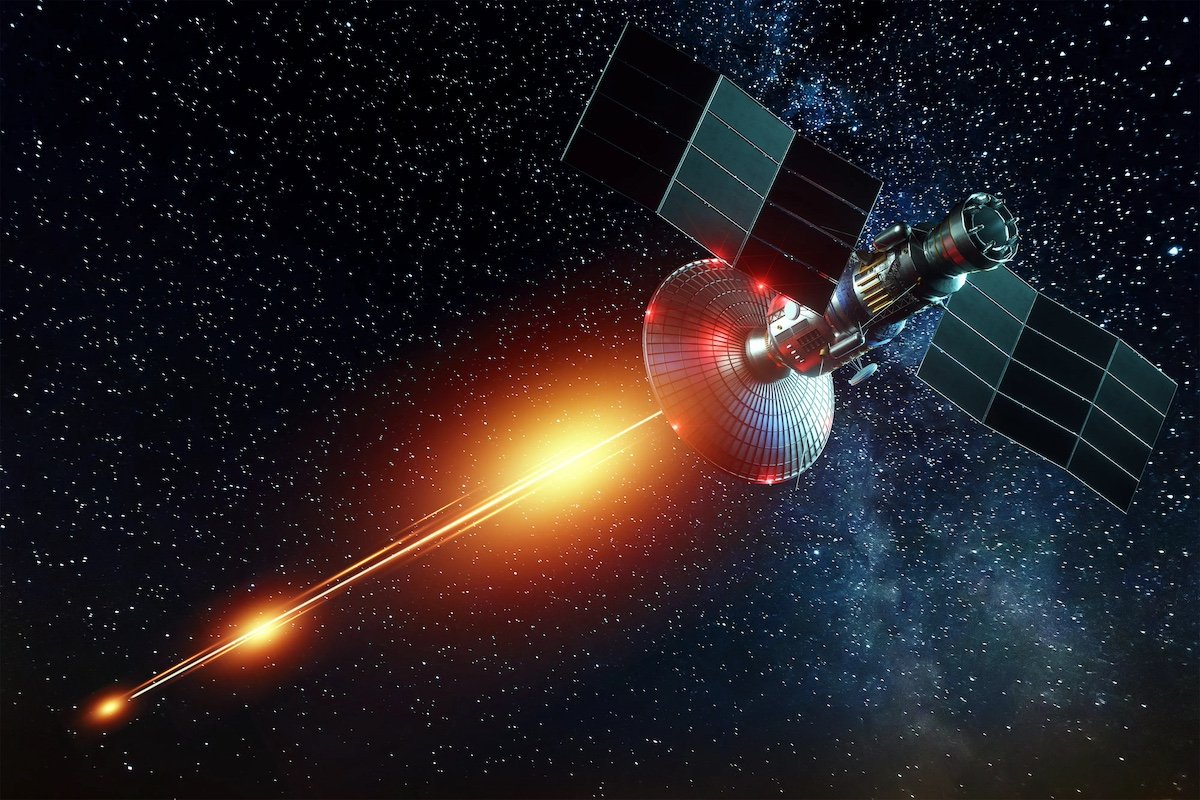
A newly declassified US intelligence assessment warns that China is significantly expanding its arsenal of directed-energy weapons, including ground- and space-based lasers, designed to blind, degrade, or permanently destroy satellites operated by the United States and its allies. The report, issued by the Defense Intelligence Agency (DIA), highlights Beijing's view of these systems as ideal counterspace tools because their effects can be calibrated along a spectrum—from temporary sensor dazzling to irreversible physical destruction.
The People's Liberation Army (PLA) already operates multiple ground-based laser systems with varying power levels capable of disrupting or damaging optical and imagery satellites in low Earth orbit. These weapons can blind sensors such as overhead persistent infrared and weather payloads that the US and allied militaries rely on for monitoring, tracking, and targeting. US intelligence projects that by the late 2020s, China could field space-based directed-energy platforms alongside higher-powered terrestrial systems, extending its reach to satellites in higher orbits.
Part of a broader counterspace strategy
China's directed-energy weapons are integrated with electronic jamming, cyberwarfare, and co-orbital systems, forming part of an active defense strategy aimed at degrading an adversary's space architecture and deterring intervention during a regional conflict. This approach reflects Beijing's broader military modernization, which treats outer space as a critical warfighting domain essential for winning informatized wars.
Brien Alkire, in an April 2025 testimony before the US-China Economic and Security Review Commission, noted that China sees vulnerabilities in the US network information system of systems. Striking key space-based dependencies, he argued, would severely hinder joint military operations. The PLA prioritizes holding these assets at risk through an expanding portfolio of counterspace capabilities designed to deny, degrade, or destroy critical infrastructure, thereby neutralizing US power projection and securing strategic advantage.
The disclosure comes shortly after US Air Force Secretary Troy Meink revealed that the US has deployed offensive and defensive weapons in orbit. While Meink withheld technical details, the unprecedented acknowledgment signals a profound acceleration in the militarization of outer space. Chris O’Meara, in an October 2026 Carnegie Endowment for International Peace report, suggested the announcement may have been intended to signal deterrence to rivals like China and Russia. He noted these assets could be electronic warfare or radio-jamming platforms rather than destructive kinetic weapons, though the disclosure has sparked intense debate and may provoke counter-deployments, accelerating a space arms race.
Deterrence challenges and escalatory thresholds
A May 2025 report from the China Aerospace Studies Institute (CASI) highlights that directed-energy weapons produce varying effects that complicate deterrence. Reversible actions—such as temporarily blinding optical sensors with a laser—are much harder to deter because of their minimal escalatory potential and low operating costs. Conversely, high-power microwave weapons can cause irreversible consequences, leading military planners to view them as carrying a much higher cost and escalation threshold.
This distinct operational nature shapes how adversaries evaluate the risks and benefits of counterspace operations. By tailoring these systems, military forces can calibrate operations to cause mission failure without crossing the line into kinetic destruction. This ambiguity, combined with the absence of clear operational thresholds in space warfare, fuels an orbital arms competition driven by mutual deterrence signaling and technical uncertainty.
Potential deployment scenarios and Starlink concerns
On how China might deploy counterspace directed-energy weapons in orbit, an April 2025 report by the Center for Strategic and International Studies (CSIS) notes that Chinese academic and defense-affiliated researchers have increasingly focused on the strategic implications of commercial mega-constellations like Starlink. The report cites simulations run by researchers at institutions such as Nanjing University of Aeronautics and Astronautics—designated as one of China's national defense “seven sons”—that explored coordinated, swarm-style attacks.
According to these Chinese simulations, groups of Chinese satellites, following biological hunting behaviors observed in marine predators like whales, could use directed-energy weapons, including lasers and high-powered microwaves, to target and disrupt massive sections of the Starlink constellation simultaneously, rather than going after individual spacecraft one by one. While there is no conclusive evidence that China has deployed space-based directed-energy weapons, it may be developing the capabilities to do so. The War Zone reported last month that China's secretive spaceplane could serve as a testbed for such technologies.
The expansion of China's counterspace arsenal is part of a broader, multidomain strategy to exploit perceived US vulnerabilities in orbit. As the US and its allies become more dependent on space-based systems, the stakes of this competition grow. The recent disclosures from both Washington and Beijing suggest that the militarization of space is accelerating, with no clear off-ramp in sight.